Korea's Ruling Party Is Rewriting Its Own Coup History
A ruling-party lawmaker's denial that Chun Doo-hwan staged a coup—and his refusal to call Yoon Suk-yeol's martial law declaration one either—lays bare a political movement actively undermining South Korea's judicial and historical foundations.
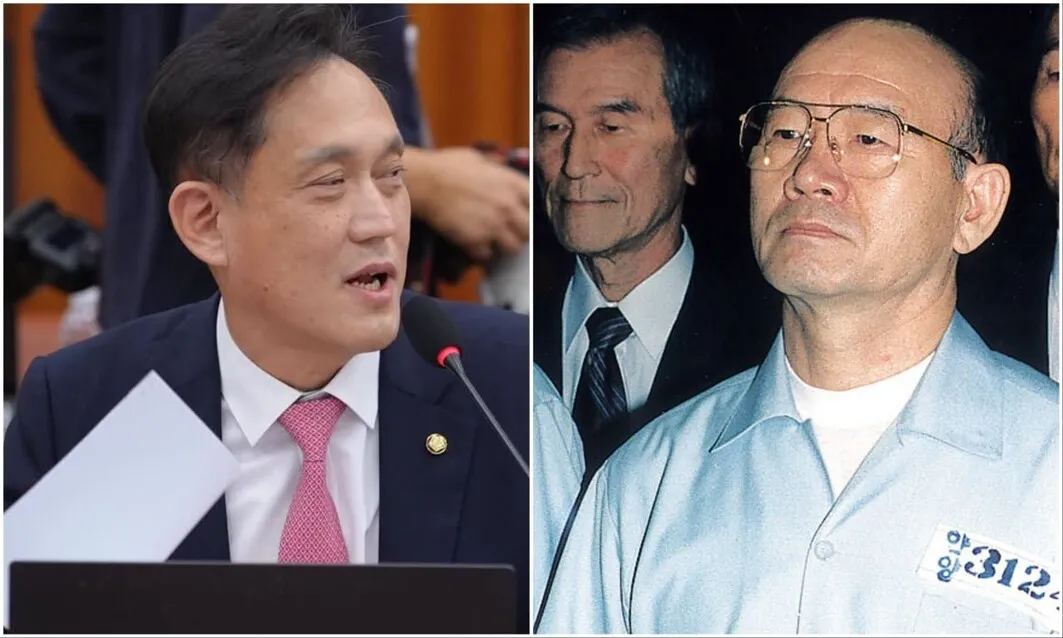
A judge denies a coup
Kim Tae-gyu is a former prosecutor and judge. He has served as a constitutional research fellow and currently sits on the National Assembly’s Legislation and Judiciary Committee. On December 30, appearing on a JTBC YouTube channel, he was asked whether former dictator Chun Doo-hwan committed treason in seizing power in 1980.
“It is not treason,” Kim said.
When pressed that the Supreme Court had already ruled on the matter, he held firm: “I personally think it is not.” He added that the historical assessment needed more discussion and that he could not readily accept a definitive conclusion.
Then the interviewer asked about Yoon Suk-yeol’s December 3 emergency martial law declaration. Kim gave the same answer.
Not treason.
The symmetry was striking. In the span of a single interview, Kim effectively nullified two of the most consequential legal findings in South Korean history—a 1997 Supreme Court conviction and a 2024 constitutional crisis—under the same logic. No distinction was drawn between a military uprising and a parliamentary impasse. No caveat was offered about the role of democratic backlash in either case. The result was an erasure not just of history but of the legal hierarchy that makes such history legible.
Kim’s comments arrived at a moment when the PPP was already navigating the political fallout from Yoon’s 55-minute martial law order, which triggered mass protests, an impeachment motion, and a constitutional court trial. By placing Chun and Yoon on the same plane, Kim did more than make a controversial statement—he reframed the terms of the debate around accountability itself.
The legal ground beneath him vanishes
In April 1997, the Supreme Court’s full bench convicted Chun of rebellion and treason, sentencing him to life imprisonment. The verdict has stood for nearly three decades. It was upheld on appeal, affirmed by every subsequent court that reviewed the case, and has shaped South Korea’s post-authoritarian legal identity. Kim’s position requires either that the court erred fundamentally or that its judgment carries no weight—a stance no former judge would normally take without explaining why.
He offered no explanation.
This silence is itself significant. Kim has never publicly questioned the Court’s reasoning before. His professional record includes work on constitutional interpretation and legislative drafting, both of which presuppose respect for stare decisis. To reject a precedent without argument is not skepticism—it is defiance. And when it comes from someone who has helped shape the laws governing treason and emergency powers, the gesture carries institutional weight far beyond a partisan talking point.
The opposition response was immediate and fierce. Han Byeong-do, the Democratic Party’s floor leader, called the remarks “a challenge to history and the people” and said he doubted his own ears. “I never thought we would see a colleague in the National Assembly defend a dictator who pointed guns at his own citizens,” he said, adding that serving alongside such a person felt “insulting and shameful.”
Chun Jun-ho demanded Kim’s expulsion. Chun Eun-soo called the comments “an outrageous denial” and asked whether the PPP officially endorsed them. Kim Byung-ju went further, writing on Facebook that those who deny treason open the door to future treason and calling for the PPP’s dissolution.
Im Myeong-hee of the革新 Party labeled Kim a “treason apologist” and said his remarks defiled judicial justice and trampled the memory of citizens who died for democracy.
What struck observers was the velocity and unanimity of the condemnation. Opposition figures across the spectrum—liberals, progressives, and centrists—spoke with the same urgency, suggesting that Kim’s remarks crossed a line that had previously been considered inviolable in Korean public life.
Why this matters beyond partisan fighting
This is not typical Korean political sparring. Kim is not a fringe figure making a careless remark. He is the PPP’s senior deputy spokesman, a committee member on legislation and judiciary affairs, and a man whose professional credentials make his denial structurally significant. He is not confused about the law. He is rejecting it.
What makes this episode more disturbing than a standard controversy is the symmetry of his denial. Kim did not single out Chun to protect conservatives or Yoon to attack liberals. He denied treason for both—the military dictator who bombed a city and the elected president who suspended civil liberties. That parallel suggests an ideological direction, not opportunism.
A lawmaker who dismisses both a confirmed military coup and an emergency martial law decree is effectively arguing that treason is a label that does not apply when your side holds power. If treason can be rewritten, then accountability becomes conditional. That is the logic of authoritarian governance, not democratic restraint.
The implications extend beyond the courtroom. South Korea’s transition from military rule to democracy rested on a social contract: the state would acknowledge past crimes, the courts would deliver verdicts, and those verdicts would become the foundation of a new political order. When a sitting member of the legislature repudiates that contract, the foundation is no longer secure. Citizens can no longer assume that historical truth will be preserved by the institutions meant to guard it.
The PPP’s dilemma
The People Power Party now faces a choice. Stand with Kim and normalize the denial of South Korea’s most foundational trauma—the Gwangju massacre—or distance itself and risk alienating the conservative base that has long harbored sympathy for Chun’s era. The party has not yet clarified whether Kim’s remarks reflect its official position, a silence that speaks loudly.
That silence is politically calculated. The PPP knows that repudiating Kim outright would anger a segment of its base that views Chun as a modernizer rather than a tyrant. But embracing him openly would alienate moderates and international allies who view the March 1997 verdict as a cornerstone of Korean democracy. The party’s hesitation reveals how deeply the question of historical accountability has become entangled with its electoral survival.
For an international audience, the implication is straightforward: South Korea’s democratic consolidations are not irreversible. The party that once championed democratic transition now includes members who reject the legal consequences of the military regime that preceded it. That reversal has real consequences for how allies and adversaries read Korean institutions.
Allied governments, particularly Washington and Tokyo, have long treated South Korea’s democratic record as a model for the region. Kim’s comments complicate that narrative. They signal that even within a functioning democracy, there exists a serious political current willing to dismantle the historical framework that makes accountability possible.
Second-order effects
The fallout from Kim’s remarks is already rippling outward. Legal scholars have begun publishing op-eds and working papers revisiting the 1997 Supreme Court decision, questioning whether its reasoning can withstand renewed political scrutiny. Some are arguing that the Court should have rested its treason finding on narrower grounds—a move that, if successful, could undermine the verdict’s authority without formally overturning it.
Historians are watching closely. The Gwangju massacre has long been the moral bedrock of South Korea’s democratic identity. Undermining its legal characterization does not merely rewrite history—it weakens the ideological pillar that has held the country’s democratic settlement together. If Gwangju can be relabeled, what else becomes negotiable?
Civil society groups have responded with protests and declarations affirming the sanctity of the Court’s ruling. The Federation of Korean Journalists issued a statement condemning “the politicization of judicial precedent” and warning that “the erosion of historical truth is the first step toward authoritarian restoration.” Student organizations at several universities have organized vigils and panel discussions, signaling that the younger generation sees Kim’s remarks as a direct threat to the democratic gains they inherited.
Within the PPP, the reaction has been mixed. Some lawmakers have called for Kim to apologize or step down from his committee posts. Others have defended him as exercising his right to free expression. A small but vocal faction has gone further, arguing that the 1997 verdict was itself politically motivated and that “reopening the question” is a legitimate exercise of democratic debate. This last argument is the most dangerous: it disguises historical revisionism as open inquiry.
What happens next
Kim will likely face internal PPP discipline. Expulsion is possible but not guaranteed. The Democratic Party may push for a formal censure or removal from his committee posts. Regardless of procedural outcomes, the public record is now set: a sitting lawmaker with judicial credentials has publicly denied treason twice in one interview.
Historians and legal scholars will revisit the 1997 Supreme Court ruling. Opposition lawmakers will cite Kim’s comments in every debate about rule-of-law protections. Allies will note that a major Korean party’s leadership is uncomfortable with the word coup applied to its own side’s recent actions.
The deeper question is whether Kim’s stance represents a growing current within Korean conservatism or a marginal position that will be contained. The speed and unanimity of the opposition’s condemnation suggests they see it as existential. Whether the PPP sees it the same way will determine the trajectory of Korean democracy in the months ahead.
What is clear is that the line between historical accountability and political convenience has been blurred. Once that happens, the next question is not whether the line will be tested again—but when, and how far.