The DMZ Landmine Incident No One Is Talking About
South Korean soldiers witnessed North Korean anti-personnel mines at a September explosion site in the DMZ, yet the government has refused to formally confirm it. The delay and the silence reveal a military trapped between escalation and appeasement.
Six days and a silence
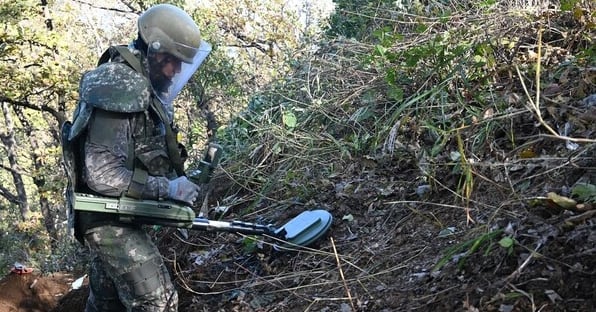
Three South Korean soldiers were injured on September 21 when an explosion ripped through the western front of the Demilitarized Zone. The joint investigation team from the South Korean military and United Nations Command did not enter the DMZ until September 27 — six days later. And even then, they reached only the area surrounding the blast site, not the origin point itself.
The reason the government and military have not formally confirmed that North Korean landmines caused the explosion is almost more revealing than the incident itself.
Soldiers at the scene told investigators they saw North Korean wooden-casing anti-personnel mines — the same type used in the 2015 fatal incident that killed two US soldiers and injured dozens of South Korean troops near Panmunjo. Multiple sources within the military confirmed these witness statements to the Chosun Ilbo. Yet the Joint Chiefs of Staff have stopped short of attribution, saying only that both North Korean and South Korean landmine possibilities are under investigation.
This is not a gap in evidence. It is a policy choice.
The six-day window allowed rain to wash away fragments, footprints, and debris that might have been recovered at the exact epicenter. By the time investigators arrived, the terrain had shifted — a detail the military cited when justifying the restricted scope of their access. Only the perimeter was secured; the blast origin remained off-limits, ostensibly for safety reasons but effectively preserving ambiguity about where the mines were positioned and which side planted them.
Why the delay
The Chosun Ilbo reports that the joint investigation task force was not formed until September 24 — three days after the explosion. By then, rain on September 24 may have contaminated or destroyed physical evidence. Critics called it a deliberate slowdown, a pattern of caution so extreme it borders on institutional paralysis.
One ROK general put it bluntly: “If we lose trust in the investigation process, whatever result the military produces will be met with public skepticism.”
The military responded by moving the investigation date forward from September 29 to September 27. It was a face-saving adjustment, not a fundamental change in posture.
Behind closed doors, defense officials acknowledged that rushing the inquiry risked creating a political scandal if the findings were later challenged. But waiting risked losing the evidence entirely. The decision to delay was therefore framed internally as a compromise between accuracy and relevance — a compromise that ultimately sacrificed both. By September 27, the muddy terrain had obscured the very details that would have made attribution straightforward.
The 2015 echo
The 2015 landmine incident along the Military Demarcation Line was a watershed. North Korea had been fortifying its side of the MDL with layered fences and minefields since 2024, a slow and deliberate tightening of the border. After the 2015 blast, Seoul’s response was limited: resumed loudspeaker broadcasts toward the North. That was it.
President Lee Jae-myung dismantled those loudspeakers after taking office. The option is now gone.
What remains is a military without a credible response toolkit for exactly this kind of provocation. Warning shots across the MDL are theoretically possible but politically toxic. Preemptive mine-laying on the South Korean side is unthinkable under the armistice framework. Targeted strikes on North Korean fortifications would risk escalation no government in Seoul wants to manage alone.
The echoes of 2015 are not just historical; they are structural. Back then, the absence of a meaningful response taught Pyongyang that provocation carried minimal cost. The current administration inherited that lesson deeply embedded in inter-Korean dynamics. Every day of silence reinforces the same calculation on the other side of the border.
The trilateral calculus
Here is where the DMZ incident intersects with something larger: the accelerating security coordination between Seoul, Washington, and Tokyo.
Any formal attribution of this blast to North Korea would strengthen the case for deeper trilateral intelligence sharing and joint rapid-response protocols along the western front — precisely the area most vulnerable to covert provocation. A formal confirmation would also put pressure on Washington to reconsider its own rules of engagement in the DMZ, particularly around the UN Command’s historical role in mine clearance and border monitoring.
But Washington and Tokyo will watch Seoul’s silence carefully. If Seoul refuses to name the attacker, it signals either an inability to verify or a deliberate refusal to escalate. Both readings weaken the trilateral framework. Japan, already sensitive to North Korean abduction and missile issues, will interpret silence as weakness. Washington will wonder whether Seoul is managing escalation on its own terms or abandoning the issue to chance.
There is a secondary effect as well: China. Beijing watches closely any move that hardens the US-Japan-ROK triangle. Seoul’s hesitation may be calculated partly to avoid giving Beijing a pretext to criticize what it would call provocative alignment with American strategy. But hesitation also invites suspicion from allies who expected the United States’ closest partner in East Asia to stand firm.
The domestic trap
The South Korean military is caught between two impossible demands. One camp wants a forceful response that demonstrates resolve. The other wants to avoid any action that could be interpreted as provocation — especially ahead of what some analysts see as a period of intended North Korean restraint before further tests or negotiations.
The result is a third way that satisfies no one: an investigation that produces a result but not a conclusion, evidence that is gathered but not published, and a public narrative that emphasizes caution over clarity.
A military insider told the Chosun Ilbo that senior officials privately believe there is enough “circumstantial certainty” to move toward attribution within the week. But the formal language — the kind that would trigger diplomatic consultations with Washington and Tokyo — has not come.
That gap between what officials know and what they are willing to say is where this story lives now. It is a quiet signal, not a shout. And in the DMZ, where the last loud signal produced a landmine attack, quiet may be the most dangerous option of all.
The real cost of this silence will not be measured in days or weeks. It will be measured in the erosion of deterrence — the slow accumulation of calculated risks taken by a adversary that learns, from every unacknowledged provocation, that it can test the boundary without consequence.