Inside Korea's DMZ Mine Crisis: The Forensic Gap That Could Trigger
A forensic report found no iron fragments from a fatal DMZ explosion—even as the military says North Korean mine evidence is overwhelming. The gap between fields readings is a live signal of political pressure and an upcoming escalation decision.
The Forensic Gap
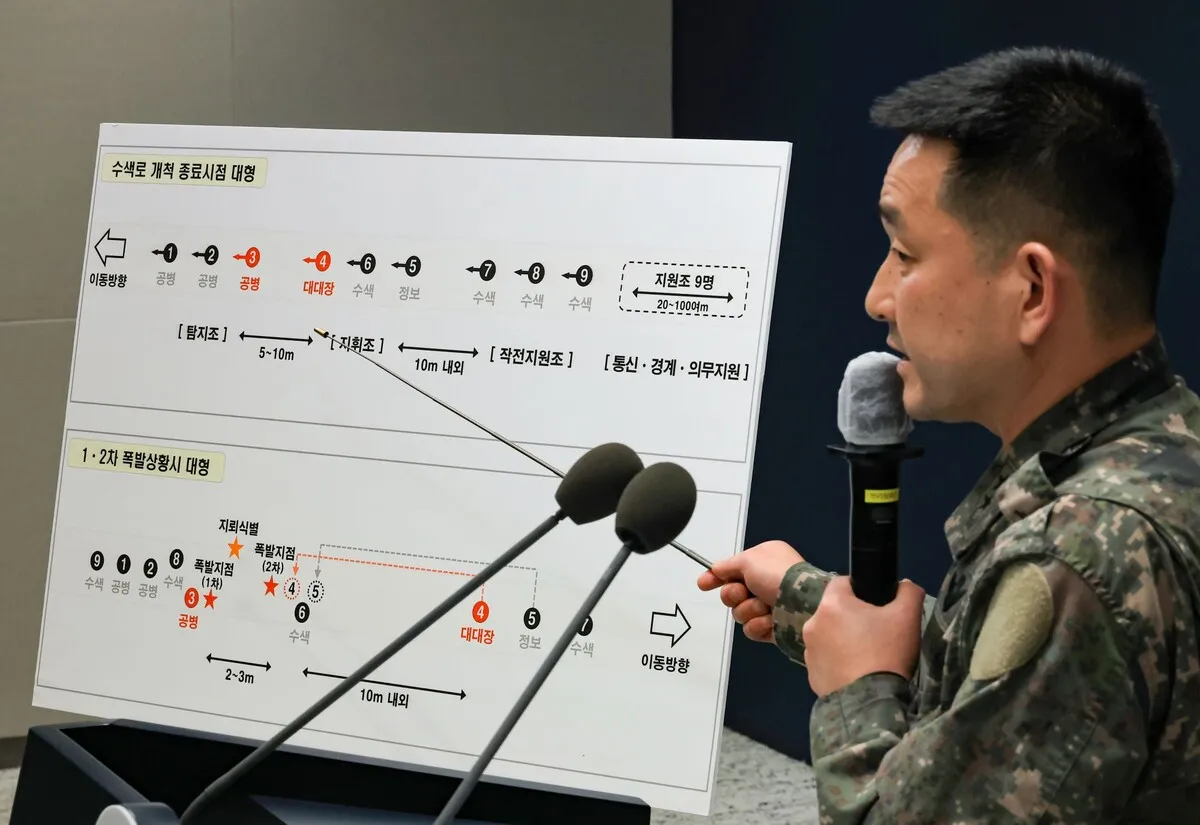
Three soldiers were blown off their feet in the western DMZ on a routine patrol. One sergeant lost part of his left foot. A company commander suffered a severe ankle wound while trying to drag him free—and triggered a second explosion that cut his face with shrapnel. Eighteen soldiers were on that search-path clearance mission. Only two walked away intact.
The military says the device that killed them was almost certainly a North Korean mine. The national forensic agency, the National Forensic Service, found no iron fragments in its initial examination—only a brown residue and TNT traces. Those are different signatures. South Korean mines, the military explained at a September 28 briefing, generate large quantities of steel fragmentation and have a lethal radius exceeding 20 meters. What was found at the scene did not match that profile.
That gap matters more than a dispute over lab results. It is the single most important variable in a decision Seoul has not yet made: whether to treat this as an accident involving decades-old ordnance or as a deliberate provocation by North Korean forces.
Who Decides the Read
Joint Chiefs of Staff Vice Chief of Staff Kwon Dae-won laid out the case publicly. The brown substance detected by forensics, he said, points away from South Korean origin. NCOs who viewed photos of North Korean mine types at the scene identified them as closely resembling the device that exploded. The explosive residue was TNT—but TNT is not exclusive to either side. What matters is the absence of steel casing fragments, which are a hallmark of South Korean landmine design and are absent from the forensic record.
The military is also weighing burial depth and detection data. Engineers reported no mine on the surface. Sapper detectors did not ping. Seven or eight soldiers walked over the same ground without triggering the device—suggesting it was buried at a depth that only someone stepping in an unusual position would set off. That pattern, the military says, points to a planted device rather than a stray round from decades of mined borders.
But here is where the politics tighten. The final determination still needs to distinguish between a mine buried by North Korean forces decades ago and one laid recently. That distinction alone determines whether the incident falls under accidental discovery or armistice violation.
Why Timing Is Everything
North Korea has produced the Suji anti-personnel mine since 1969. Both sides have been laying mines along the DMZ since the 1953 armistice. Hundreds of thousands of devices lie buried on both sides of the line. When a soldier steps on one now, it could simply be old ordnance finally giving way after fifty years of soil shift and weathering.
The 2015 Ipseok incident is the reference point everyone is measuring against. That time, North Korean troops planted wooden-cased mines 440 meters south of the Military Demarcation Line in a path South Korean patrols used regularly. The intent was unmistakable. Four soldiers were killed or maimed. The world took notice.
This September’s blast site is different terrain—dense brush, not a well-worn patrol track, and roughly ten meters south of the MDL. Ten meters is critical. South and North Korea do not agree on where the MDL runs. Pyongyang may consider that strip its own territory. If so, a mine there could be routine border mining rather than an act of war. Determining intent requires knowing when the device was placed, which forensic science cannot currently resolve with certainty.
The Political Pressure Inside the Report
The Hani report frames the forensic gap as a question of accountability—and the language is telling. Lawmakers are already pushing for urgent National Assembly questioning. The military called the findings an “interim” assessment. The word interim is doing heavy lifting here. It means the forensic result is provisional, not final, and that the government still reserves the right to adjust its conclusion as more evidence emerges.
That reservation is not transparent. It is a pressure valve. If the final forensic report comes back confirming the military’s reading, Seoul faces intense domestic demand for a response. If the forensics hold firm on the absence of steel fragmentation, the government gains space to characterize the incident as accidental and avoid escalation. Either outcome serves a political purpose.
Defense Minister Kim Won-hong has already signaled the shape of the response calculus. He told reporters that if the final investigation confirms a North Korean mine, the government will take “corresponding measures”—a phrase carefully chosen to leave the option open without committing to anything specific. In Korean security circles, that phrase usually means a calibrated military response short of armed conflict: artillery drills near the MDL, suspension of certain inter-Korean exchanges, or a targeted show of force. It does not mean invasion. It does not mean disarmament. It means signaling.
Who Wins, Who Loses
If the military’s assessment prevails and Pyongyang is found to have recently planted mines south of the MDL, Seoul wins the narrative— Pyongyang is the aggressor, the armistice is under active violation, and international sympathy shifts. But Seoul also inherits the burden of response. Every option carries risk. A military drill near the border could be read as provocation. Lifting sanctions or reopening dialogue sends the wrong signal to hardliners in Seoul. Doing nothing invites further testing of the red line.
If the forensic evidence undermines the military’s claim—if the final report refuses to confirm North Korean origin—the government loses face. The families of the wounded soldiers will not accept ambiguity. Lawmakers will demand answers. And Pyongyang gains the perfect ambiguity it has always preferred: no admission, no apology, just confusion that bleeds into inaction.
The soldiers on that patrol did not die for a press conference. They died because a device—whether fifty years old or fifty days old—was in the ground where they walked. The difference between those two scenarios will determine whether this tragedy becomes a footnote or a turning point.
What Comes Next
The final investigation report is expected soon. Once it arrives, the Joint Chiefs will brief the National Assembly and the Defense Ministry will announce its response framework. The window between report and response is where the real drama unfolds. In that window, allies will watch closely. Washington will signal whether it views this as a contained incident or a threshold breach. Beijing and Tokyo will adjust their own posture accordingly.
The most likely outcome is a measured response—enough to register disapproval, not enough to risk wider conflict. The least likely outcome is nothing at all, which is also the most dangerous outcome, because it tells Pyongyang that ambiguity is a strategy that works.
For now, three soldiers are recovering from wounds that will define the rest of their lives. The rest of us are waiting for a report that will decide whether their sacrifice becomes a chapter in a longer conflict—or a warning that was heard too late.