All Five DNA Letters Found in an Ancient Asteroid — What It Means for
All five genetic letters have been detected in pristine samples from asteroid Ryugu, strengthening the case that life's building blocks form naturally across the Solar System and raising the stakes for upcoming ocean-world missions.
The quiet completion of a cosmic checklist
For decades, the search for the origins of life has hinged on a narrow question: did the raw materials arrive on Earth from space, or did they form here?
The answer keeps tilting toward space.
A new study published in Nature Astronomy confirms that all five nucleobases — adenine, guanine, cytosine, thymine, and uracil — are present in the asteroid Ryugu, carried back to Earth by Japan Aerospace Exploration Agency’s Hayabusa2 mission. That matters far more than simply adding one molecule to a growing list. Nucleobases do not appear in nature by accident. They are the molecular alphabet of genetic code, the structural foundation on which every organism on this planet builds its blueprint for survival.
Finding them all, intact, inside a rock that predates the solar system itself, changes the framing of an already-charged debate.
A clean sample from deep time
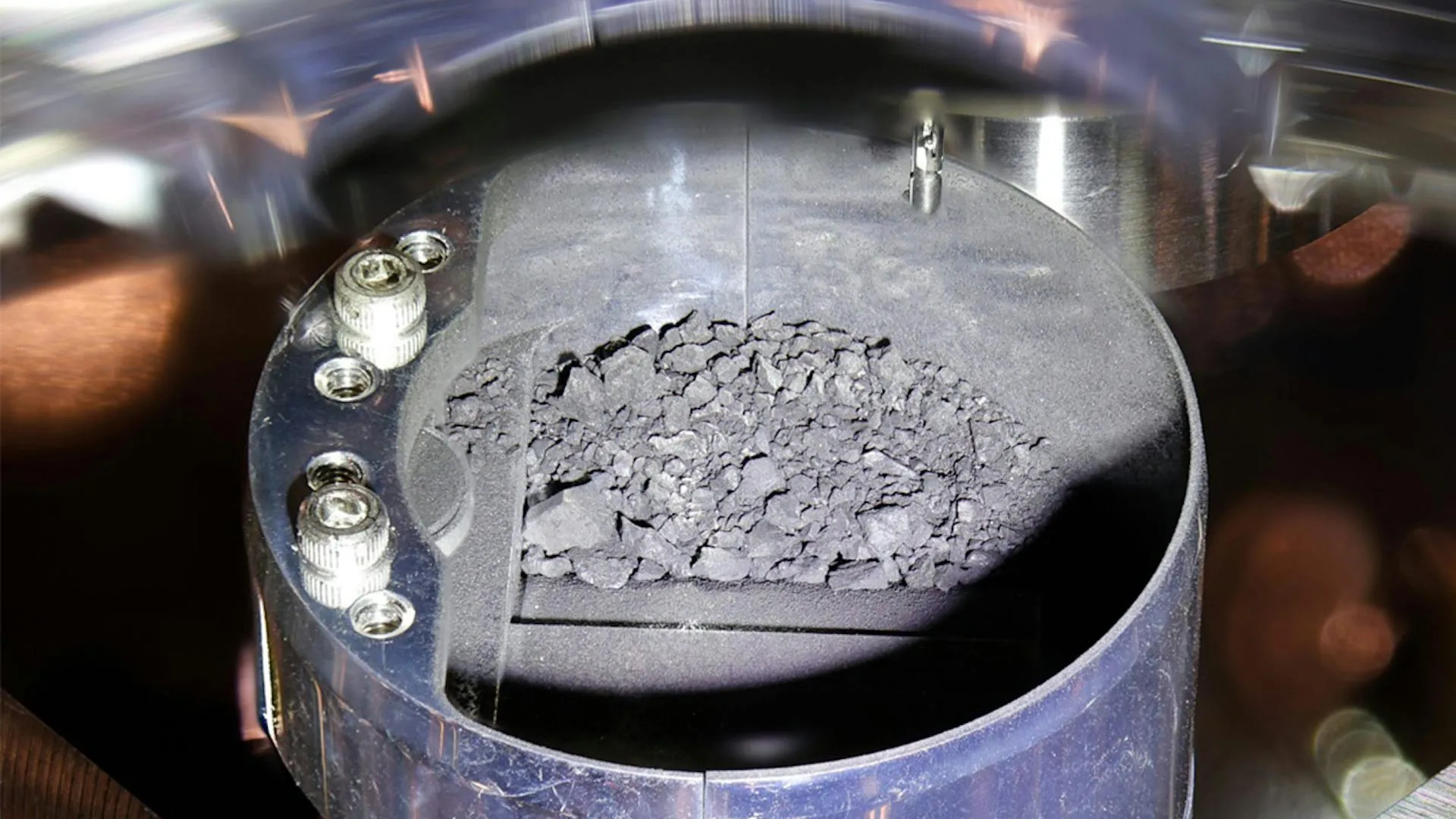
The Hayabusa2 probe delivered 5.4 grams of Ryugu material in December 2020. Since then, laboratories worldwide have fought a meticulous battle against contamination — any terrestrial contact can irreversibly blur the record of what lived in that dust before it ever touched Earth.
Earlier work identified uracil among those fragments. The new study closes the gap by confirming the remaining four bases are present too, each in comparable quantities. Adenine and guanine fall on the purine side; cytosine, thymine, and uracil are pyrimidines.
These chemicals likely formed inside Ryugu’s parent body long ago, in an environment rich in liquid water and ammonia that persisted for millions of years before the asteroid broke apart and drifted inward. Ammonia, it turns out, may be the invisible dial that determines which nucleobases survive: earlier analyses suggest purine-heavy bodies like the Murchison meteorite sit alongside pyrimidine-dominant ones like Orgueil and Bennu. The chemistry varies, but the outcome is consistent — the ingredients assemble themselves under the right conditions.
The implications run deeper than asteroid mineralogy.
Who wins, who loses, and what shifts
This discovery does not settle the origin-of-life question single-handedly. It removes a significant obstacle. Critics of the panspermia hypothesis — the idea that life’s precursors could have been delivered extraterrestrially — always had room to argue that even if some nucleobases reached Earth by impact, others might not have made the journey, leaving an incomplete toolkit for biology to work with.
That argument now carries far less weight. A body as cold and dark as Ryugu, which never ventured anywhere near Earth’s habitable zone, contained all five bases. This suggests the process that produces them is not rare or localized but broadly distributed across early solar system environments. If ammonia, liquid water, and basic carbon chemistry can generate complete nucleobase sets in one asteroid, the same combination likely operates in many places simultaneously.
Researchers who specialize in prebiotic Earth chemistry should feel no threat from this. It does not undermine research into terrestrial synthesis pathways. Rather, it reframes the timeline. Life’s components may have been pre-assembled before biology had anything to do with them, arriving already partially cooked.
What also becomes clearer is the role asteroids played during the Late Heavy Bombardment, the period roughly 4.1 to 3.8 billion years ago when the inner solar system was pummeled by impacts. The same deliveries that struck Earth hard enough to strip atmospheres may have delivered enough organic stock to seed emerging chemistry without erasing it entirely.
Why Europa and Enceladus suddenly look more interesting
The most consequential ripple from this finding extends outward, past Mars, toward the icy moons orbiting Jupiter and Saturn.
Both Europa and Enceladus harbor subsurface oceans beneath thick ice shells. Ocean worlds like these have become primary targets for astrobiology precisely because liquid water exists where it used to be considered unlikely. Finding nucleobases in a dry, rocky asteroid reinforces one additional point: water alone is insufficient to guarantee complex organics. Ammonia, radiation processing, and extended aqueous alteration matter too.
Europa’s ocean, however, is believed to interact chemically with a silicate seafloor, while Enceladus vents plumes containing organics detected by Cassini. Neither moon’s interior composition has been sampled directly. But knowing that asteroid interiors can manufacture complete nucleobase sets suggests that similar processes in the oceans beneath these moons could produce the same building blocks — provided the right combination of water, ammonia, and thermal activity persists.
NASA’s Europa Clipper will begin studying the Jovian moon in 2030. The European Space Agency’s JUICE mission, also aimed at Jupiter’s systems, arrives around the same window. These probes will map ice thickness, measure plume composition remotely, and characterize surface chemistry. None will land and drill. Getting confirmation that subsurface nucleobases exist there will require future missions capable of reaching below the ice.
Japan, having proven it can return pristine samples from an asteroid, is well positioned to pursue that next step — though such a mission would demand vastly greater investment and technical risk.
What remains uncertain
The new paper analyzed two Ryugu samples. Five nucleobases were confirmed in both. The amounts detected are nanogram-level quantities, tiny by any standard but chemically significant. It is still unknown whether those bases occurred free-floating in the asteroid matrix or were incorporated into larger structures such as RNA analogs. Identifying whether they participated in prebiotic polymerization inside Ryugu would move this from a chemical inventory to evidence of active molecular evolution.
Another open question is timing. When exactly these bases formed within the parent body and whether they degraded over billions of years of cold storage remains unresolved. The fact that they survived this long is encouraging; reconstructing their original concentrations is not yet possible.
What happens next
This result joins a small but growing set of observations drawn from actual spacecraft-sampled asteroids, not fallen meteorites that have sat on the ground exposed to air and moisture. Bennu yielded the same five bases in 2025. OSIRIS-REx returned nearly 200 grams. Together, these data points converge on the same conclusion: nucleobases are widely distributed in the early solar system, not confined to rare environmental niches.
The logical progression now moves toward sampling environments beyond the asteroid belt — icy moons, comets, possibly the outer planets’ atmosphere entry missions. The ingredients appear ubiquitous. Understanding how they transition from inert dust to self-replicating chemistry requires either returning samples from ocean worlds or building instruments precise enough to detect them in situ.
Ryugu handed Earth its first clean receipt of alien biochemistry. The real work starts when scientists figure out what to buy with it.