ESPN's Star Wars Super Bowl bet on IP over athletics
ESPN is wrapping the Super Bowl in Star Wars IP to hook younger Disney+ subscribers — a signal that sports media is now entertainment packaging first.
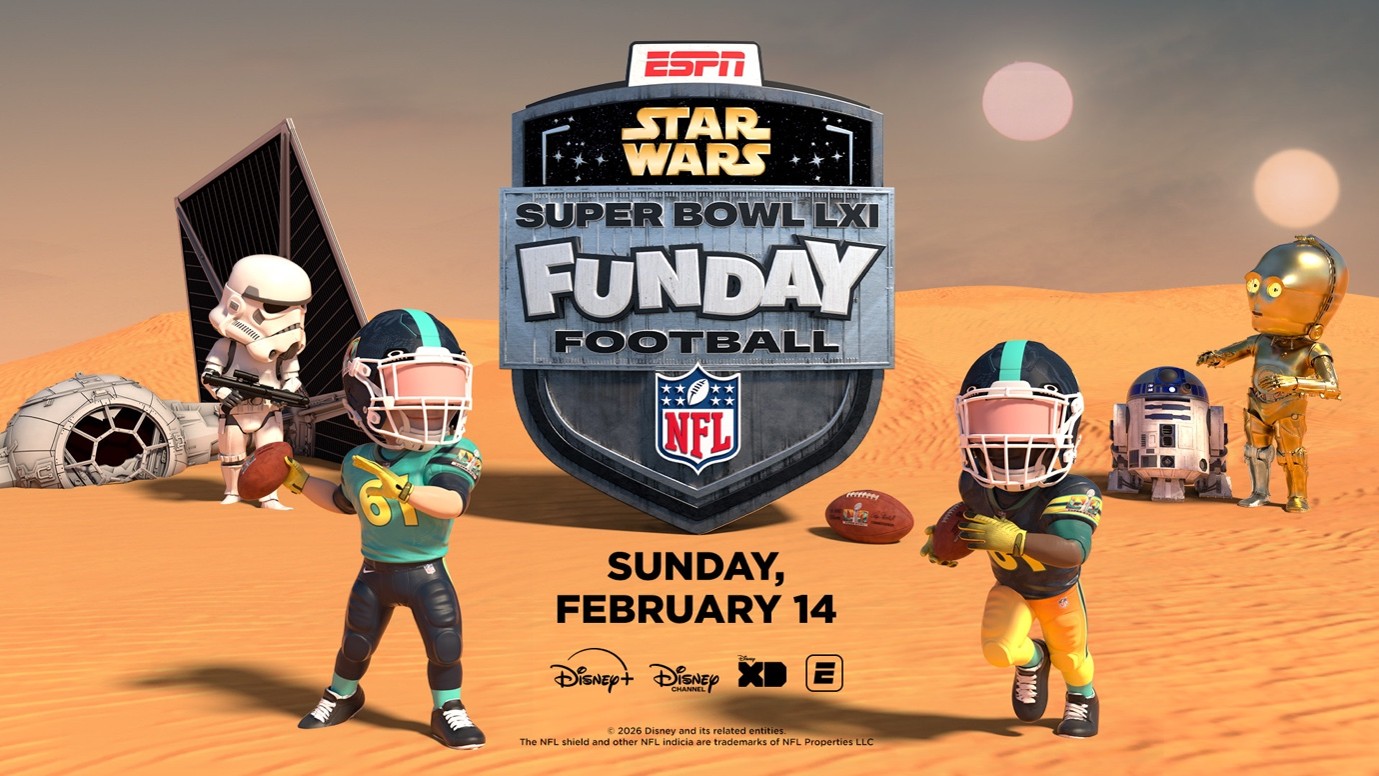
The Galaxy Is Bigger Than the Gridiron
The NFL and ESPN aren’t just adding another alternate telecast for Super Bowl LXI. They’re testing whether intellectual property can do what a traditional broadcaster can’t: make a football game feel like an event for people who don’t care about football.
Star Wars Funday Football will air simultaneously with the Joe Buck and Troy Aikman broadcast on Feb. 14, 2027. It will render every play in real time as animated avatars, populate key moments with Star Wars characters — including Anthony Daniels returning as C-3PO — and stream live on Disney+, Disney Channel, and Disney XD. It will also air in over 155 international markets.
This is the first animated alternate presentation of a Super Bowl. And it arrives after three lower-stakes experiments: Toy Story Funday Football in October 2023, The Simpsons edition in December 2024, and Monsters Funday Football in December 2025. Each earned its own viewership test. Each earned a Sports Emmy for the Toy Story iteration. This one is the culmination — and the one they’re betting on to prove the model.
Who This Is Really For
The target audience isn’t the 34-year-old fantasy football player streaming the main broadcast on ESPN. It’s the 12-year-old who watches Star Wars content on Disney+ but hasn’t yet developed a taste for NFL coverage. It’s the international viewer in Japan or the Philippines who engages with anime and Western pop culture but might not tune into a traditional football broadcast.
The NFL knows this mathematically. American football remains a niche sport outside the United States, even as the league pursues global expansion. Star Wars is one of the most recognized franchises in the world. Pairing them doesn’t just dress up football — it imports an existing audience into a product that would otherwise lose them.
The Data Pipeline Behind the Animation
What makes this different from a cartoon produced in a studio is the technology underneath. Sony’s Beyond Sports division is providing real-time data visualization that converts NFL tracking data — the same Next Gen Stats feed and Hawk-Eye optical tracking used for official league analytics — into animated gameplay as it happens. The avatars on screen mirror actual player movements from SoFi Stadium.
That means this isn’t a pre-recorded parody. It’s a live, data-driven re-rendering of the actual game. The players you see on the field as animated figures are making the same plays they’re making in reality. The Star Wars characters sub in during key moments as a narrative overlay — not a replacement for the action.
This distinction matters. It’s the difference between a novelty broadcast and a product that could eventually serve as a legitimate alternative viewing experience for casual audiences.
The Franchise Milestone Angle
The timing is deliberate. Super Bowl LXI falls five days before the restored 1977 Star Wars returns to theaters on Feb. 19, 2027, marking 50 years since the original film’s release. Lucasfilm is celebrating a half-century milestone, and the NFL is inserting itself into that cultural moment.
This isn’t accidental cross-promotion. It’s coordinated scheduling that maximizes media coverage and organic social conversation. The NFL gets association with a legacy franchise. Lucasfilm gets exposure to an audience that rarely engages with Star Wars through sports. Disney gets a Super Bowl event that reinforces Disney+ as a destination for more than just streaming library content.
What Comes Next
If Star Wars Funday Football performs well — and early indicators from the Simpsons and Monsters versions suggest it could — the model is repeatable. The infrastructure already exists: the Sony technology, the ESPN production pipeline, the character partnerships, the international distribution through Disney+.
The next question isn’t whether there will be another IP-themed alternate telecast. It’s which franchise gets the next Super Bowl treatment, and whether the NFL will eventually prioritize these alternate streams at the same promotional level as the main broadcast.
There’s also a longer-term signal here about how sports media is being packaged. The traditional linear broadcast model is under pressure from cord-cutting and shifting viewer habits. Alternate telecasts tied to popular IP represent a way to retain subscribers who might otherwise cancel Disney+ after the season ends. They’re retention tools disguised as entertainment.
The International Play
Perhaps the most strategically significant detail is the distribution reach. More than 155 markets will have access, including regions where the NFL has minimal organic viewership: sub-Saharan Africa, the Netherlands, Sweden, Malaysia, the Philippines, South Korea. The animated presentation removes language barriers and cultural friction. A cartoon about Star Wars characters playing football doesn’t require understanding the rules of American football to be entertaining.
That’s the real pitch. The NFL isn’t trying to convert casual viewers into football fans through this. It’s trying to give them a reason to open Disney+ on Super Bowl Sunday — and stay subscribed afterward.
The Bottom Line
The Star Wars Funday Football broadcast is not merely a gimmick wrapped around the biggest sporting event of the year. It’s a proof of concept for a new distribution model: sports content packaged through entertainment IP to reach audiences that traditional broadcasts can’t access. If it works — and the infrastructure suggests it’s built to work — it will change how leagues and networks think about alternate telecasts, subscriber retention, and global expansion.
The animated avatars on the field are a symptom of something larger. The future of sports broadcasting isn’t just about showing the game. It’s about convincing people who don’t care about the game to watch anyway.