Why Evangelion's Nagoya Collab Matters More Than You Think
The Evangelion 30th anniversary exhibition at Nagoya PARCO isn't just another anime museum show — it's proof that a 30-year-old mecha franchise still commands merchandise momentum in regional Japan. The Piyorin collab reveals where anime's commercial center of gravity actually sits now.
The Exhibition No One Overseas Will See
The 30th anniversary exhibition “ALL OF EVANGELION” opens at Nagoya PARCO on September 4, 2026, and will run through October 12. Tickets cost 2,100 yen for adults. It will be held entirely in Japan. There is no announced tour to Seoul, no stop in Los Angeles, no variant for the New York Comic Con crowd.
That alone is the story.
For three decades, Evangelion has been one of the few Japanese intellectual properties that genuinely translates across markets. The Rebuild films grossed over $300 million worldwide. Merchandise moves in every territory. Yet here we are, marking 30 years with an exhibition that exists only in one city — and that city isn’t even Tokyo.
A Regional Collab, Not a Global Launch
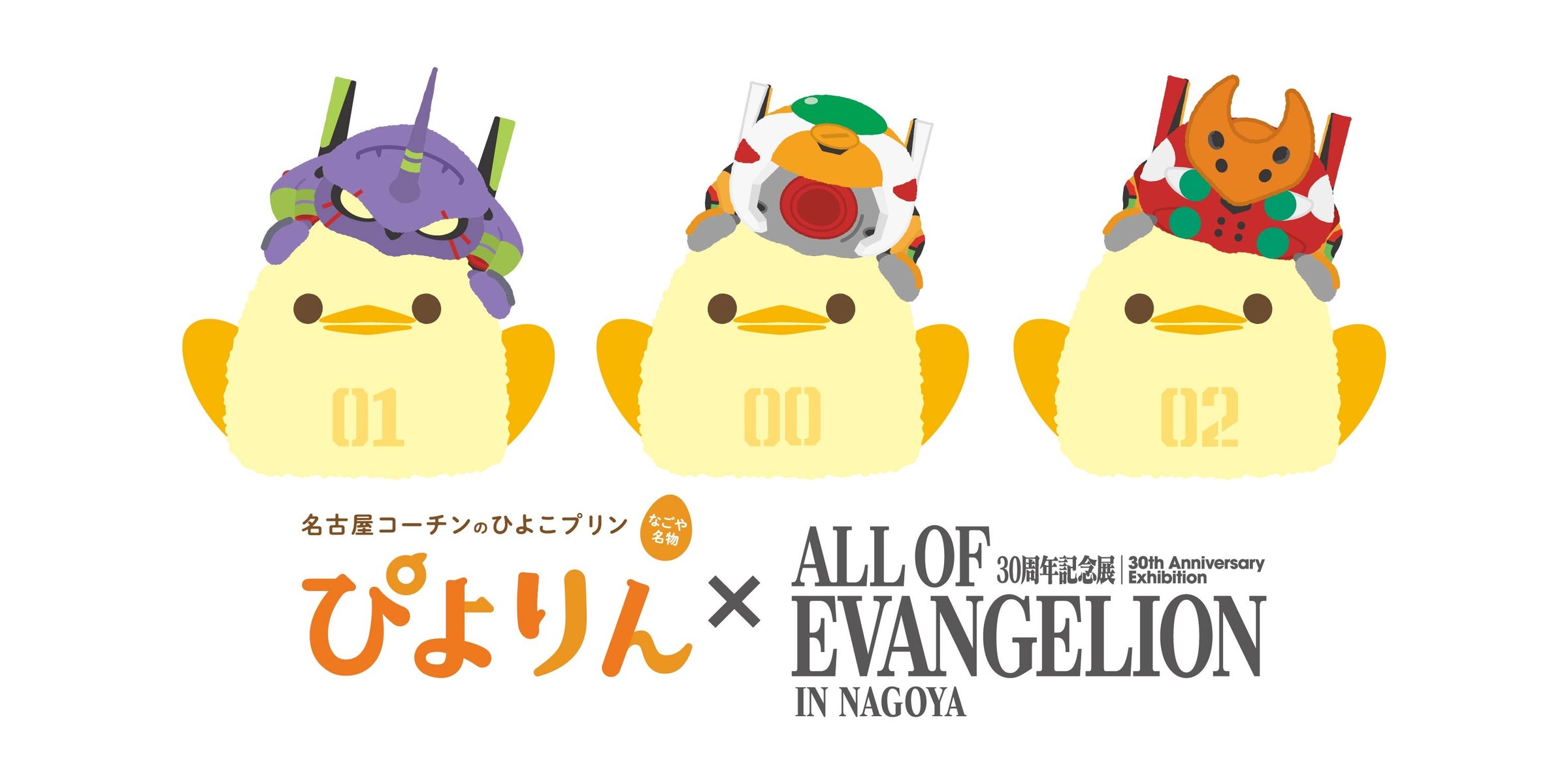
The Nagoya venue announced a collaboration with Piyorin, a sweet that debuted on July 1, 2011, and has since become what the Japanese press calls a “new Nagoya specialty.” It is shaped like a chick, dusted in powdered sponge, and filled with vanilla bavarois made using eggs from Nagoya Chicken — a regional breed that has protected its supply chain fiercely for decades. The collaboration artwork shows Evangelion Units 1, 2, and 3 riding Piyorin figures. The tote bag retails for 2,750 yen. The T-shirt is 4,180 yen.
No fresh Piyorin sweets will be sold at the exhibition. This is merchandise only.
A Western reader might glance at this and see a cute crossover. But the geography matters. Piyorin is manufactured in Kasugai, an industrial city inside the Nagoya metropolitan area, and sold primarily at Nagoya Station and at its own factory shop. It is not a Tokyo-brand product. It is not a national-brand product. It is a regional brand that has survived 15 years in a market where most food gimmicks die within two.
The partnership signals something specific: Evangelion’s commercial engine still operates through regional channels, not just through centralized Tokyo distribution.
Who Actually Runs This Thing
The exhibition is organized by TV Aichi, PARCO, and BV Communications. TV Aichi is a regional broadcaster based in Nagoya, part of the TBS network but with significant autonomy over local programming and partnerships. PARCO is one of Japan’s oldest department store chains, and unlike many of its competitors, it has maintained exhibition spaces inside its regional stores — the PARCO HALL in Nagoya is one of them. BV Communications handles anime exhibition production. The planning committee includes Asahi Shimbun and Movec, the merchandising arm of Kadokawa.
This is not a studio-led anniversary project. It is a consortium deal — broadcaster, retailer, publisher, and merchandiser all aligning around a property that no longer requires a new release to sustain relevance. Evangelion has not had a new theatrical film since 2021. The franchise ran on nostalgia and archive material for years before that.
The Real Number Is Three Decades
The original TV series premiered on October 4, 1995. Hideaki Anno was 31. The bubble economy had just collapsed. The show became a cultural touchstone not because of its mecha action but because of its psychological interiority — something Western audiences still tend to reduce to “depressed anime boy saves the world.”
Thirty years later, the property still commands paid admission at museum-grade exhibitions. It still produces collab goods that sell out. It still has regional partnerships that would make a marketing professor uncomfortable with how efficiently they work.
The exhibition will display cel artwork from the original TV series, production materials from the Rebuild films, and — for the first time — digital production records from the Rebuild era. These are materials that have never been grouped together in a single public showing. That is the curatorial hook. The commercial hook is whatever you pick up at the gift shop on your way out.
Why This Matters Outside Japan
Western entertainment coverage of anime tends to treat the medium as either a streaming commodity or a convention circuit attraction. Both frameworks miss the infrastructure underneath. Evangelion in 2026 is not surviving on overseas convention demand. It is surviving on a domestic ecosystem that includes regional broadcasters, department store exhibition halls, local food brands, and a fanbase that treats anniversary events as pilgrimage sites — not tourist stops.
The Piyorin collab is not a creative high point. It is a logistical one. It represents a property that can still activate partnerships across media sectors — animation, broadcasting, retail, food — without needing a new IP launch to justify the investment.
The exhibition runs 10:00 a.m. to 8:00 p.m. with no closing days. Ticket prices are tiered: 1,500 yen for students, 900 yen for children. A restricted-purchase policy limits buyers to three units per item, and trading-style random goods are capped at three boxes per person. These are not minor details. They are the operational signature of a franchise that has learned exactly how to manage scarcity and demand — a skill honed over three decades of releases, re-releases, and anniversaries.
What Happens Next
There is no indication that the exhibition will travel. If it does not, then the 30th anniversary celebration will have been geographically circumscribed — a domestic event marking a global property’s milestone. That is not a failure. It is a statement about where the franchise’s economic center of gravity actually lives: in Japan, in its regional networks, in partnerships that do not appear on any international calendar.
For readers who only track anime through Western convention circuits and streaming debuts, the Evangelion 30th anniversary looks smaller than it is. The property does not need the convention hall to survive. It built something else instead — a self-sustaining commercial ecosystem that includes a department store in Nagoya, a chick-shaped custard dessert, and three Evangelion units riding on top of it all.
That is the real exhibit.