Falcon 9 Booster B1067 Has 36 Flights and Proves a New Launch Logic
A single Falcon 9 first stage has flown 36 times in under five years — nearly matching the Space Shuttle Discovery fleet. The milestone is less about one durable rocket than it is about a fleet operating on a cadence that would have been impossible just a decade ago.
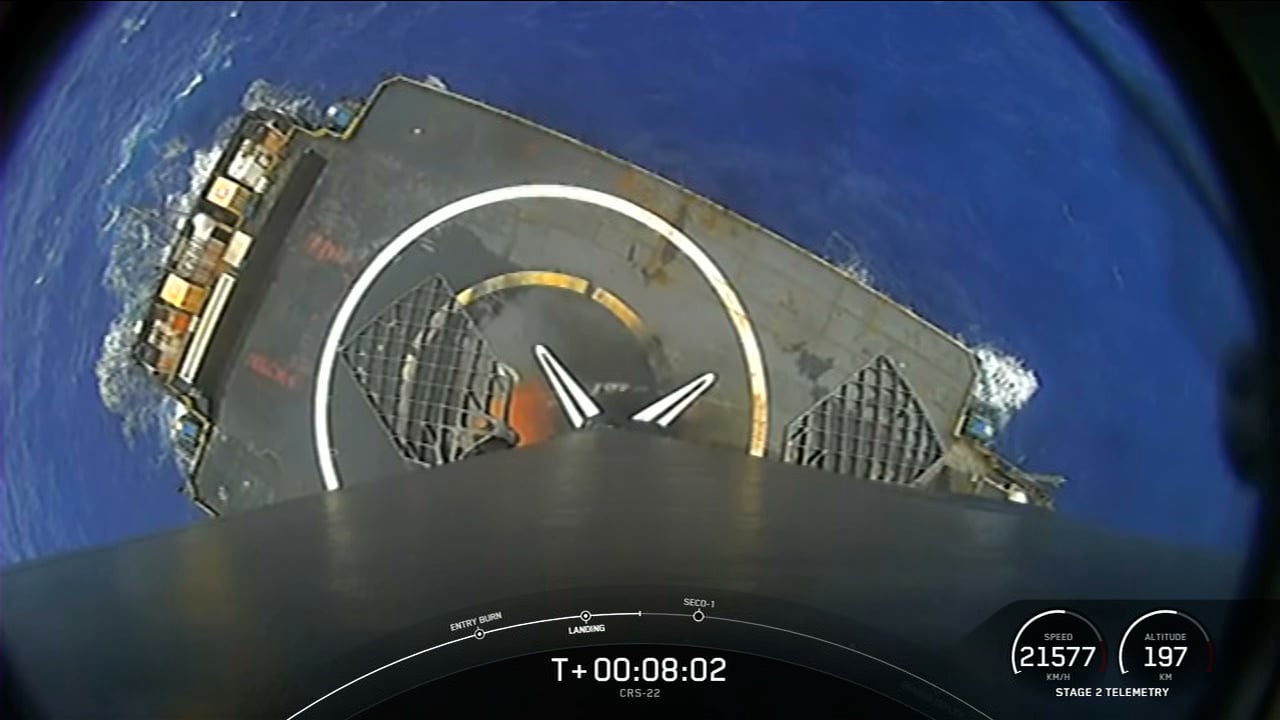
The Number That Shouldn’t Exist
A Falcon 9 first stage designed to fly ten times without major rebuilding now has thirty-six flights to its name. The booster started its career carrying NASA research hardware to the International Space Station in June 2021. Five years later, it landed yet again after lofting twenty-nine Starlink satellites from Cape Canaveral. There was no ceremony, no press pool waiting on the drone ship, no headline-generating drama. The landing closed out mission thirty-six and looked exactly like every other recovery in the current launch cycle.
That ordinariness is the point.
Thirty-six flights puts the booster, designated B1067, within three missions of Space Shuttle Discovery’s entire career total of thirty-nine. But stacking those numbers side by side invites a category error that obscures more than it reveals. Discovery was an orbital vehicle — a winged spacecraft with crew quarters, thermal tiles, main engines, and a payload bay that spent days in space before gliding to a runway landing. B1067 is a first stage, a cylindrical tube of engines and tanks that spends roughly eight minutes powered, then another eight minutes falling back through the atmosphere to land on a barge in the ocean. The comparison works only to illustrate cadence. One system accumulated thirty-nine missions over twenty-seven years. The other accumulated thirty-six in under five.
Ten Was a Starting Line, Not a Ceiling
When SpaceX introduced the Block 5 design in 2018, the public target was clear: at least ten flights without major refurbishment. The language made it sound like an expiration date. It was not. Ten was a qualification milestone, a threshold at which engineers would have enough flight data to decide how far reuse could stretch. Reporters and commentators flattened that nuance into a punchline that sounded like a record waiting to be broken.
B1067 broke it three and a half times over.
SpaceX hit a sixteenth first-stage flight in 2023, then a twenty-fourth in November 2024. Each new number added another layer of real-world telemetry on engine performance, thermal loads, structural stress, and landing dynamics. The original ten-flight estimate was never wrong. It was simply the floor of what the design could absorb.
The Maintenance Myth
Reusability does not mean maintenance disappears. It means maintenance changes shape. A Falcon 9 first stage endures combustion cycles at extreme temperatures, turbopump spin-ups, repeated tank pressurization, cold-soak conditioning, hypersonic re-entry heating, salt-air exposure from sea landings, and the mechanical shock of leg deployment and touchdown. Something has to give.
SpaceX managers described a tiered inspection system to Aviation Week in 2022. An A check follows every flight — downloading telemetry, visual inspection, fluid checks. A B check occurs periodically, roughly every sixth or seventh mission, with more substantial component evaluation. A C check targets life-leading stages and vehicles assigned to crewed launches. The framework replaces the vague word “refurbishment” with a spectrum of interventions calibrated to actual wear.
There is no public record showing which specific components on B1067 were replaced during its thirty-six-flight career. Claiming that every seal, valve, or engine installed for the CRS-22 mission still sits in place would be speculation. The verifiable achievement is narrower and still remarkable: the stage structure and vehicle identity have remained airworthy across thirty-six launches and thirty-six controlled returns.
Starlink Built the Rhythm
Reusable hardware has no economic value without frequent missions to fly. That is where Starlink matters. The satellite constellation is simultaneously SpaceX’s largest commercial customer and its internal flight laboratory. The company designs the satellites, operates the launch cadence, and controls the mission schedule. It does not need to wait for twenty-nine different paying customers to create demand.
Starlink missions provided the volume that turned booster reuse from occasional experiment into routine operations. They also offered a controlled environment for accumulating flight hours on aging stages. A company-owned payload can test a veteran booster on a demanding profile before assigning it to a higher-value commercial or government mission, though SpaceX has not disclosed the precise certification logic behind any individual flight.
The fleet context reinforces the picture. Of the one hundred and sixty-five Falcon 9 missions reviewed in 2025, one hundred and fifty-seven used flight-proven boosters. Reused first stages were not special cases inserted into a schedule built around new hardware. They were the schedule.
What This Means for Mars and Starship
The economics of interplanetary transportation rest on the same principle that made B1067 viable: frequency compounds value. A rocket that flies once a year costs fortune per kilogram to orbit. A rocket that flies once a week costs pennies per kilogram, assuming the hardware survives long enough to justify the investment. Mars missions require enormous mass in orbit, and that mass becomes affordable only when launch vehicles operate at commercial cadence rather than aerospace ceremony.
SpaceX’s next system, Starship, aims to extend this logic to the upper stage — recovering the full stack rather than discarding the second stage as Falcon 9 currently does. The tower-catch concept discussed in recent reporting represents one approach to that goal. Recovery is only the first step. The harder proof is whether a recovered vehicle can pass inspection, receive service, accept a mission assignment, and fly again within a timeframe that makes the economics work.
B1067 has supplied that proof for a first stage. It has done so inside a factory-to-pad-to-sea-to-factory loop that includes drone ships, transport trailers, hangar infrastructure, spare parts pipelines, range coordination, and inspection protocols. The booster itself is not the system. The system is the reason the booster can fly again.
The Three-Flight Gap That Isn’t
Discovery flew from 1984 to 2011. Its missions included the Hubble deployment and servicing, the first shuttle docking with Mir, the first shuttle docking with the International Space Station, and return-to-flight flights after both the Challenger and Columbia disasters. Twenty-seven years, thirty-nine missions, 5,830 orbits, roughly 149 million miles traveled. A national program with multiple orbiters, external tanks, solid rocket boosters, and a cadence constrained by safety investigations and fleet-wide stand-downs.
B1067’s thirty-six flights in under five years reflect a different architecture, a different risk envelope, and a different purpose. Comparing the two as equals understates the shuttle’s accomplishments and overstates what a first stage repeat-flown for satellite deployment actually shares with an orbital crewed spacecraft. The three-flight gap between them makes a headline. The distance between the systems that produced those headlines is the real story.
The Record Will Become Background Noise
Booster retirement is not determined by reaching an arbitrary flight count. A Falcon 9 stage leaves service because inspection finds damage, because a mission needs every ounce of remaining performance and expends the stage deliberately, because fleet economics shift, or because a newer vehicle supersedes it. In 2024, SpaceX expended a Falcon 9 core on its twentieth flight to carry extra mass to a Galileo navigation satellite — not because the stage had failed, but because the mission traded future flights for present performance.
B1067 may fly again. It may receive extended maintenance, wait for an assignment, or eventually be expended for a high-performance mission. Another Falcon 9 booster in the current fleet may also pass thirty-nine flights before it retires. The identity of the record holder will matter less as the fleet matures, because the method stops being confined to one unusually durable article and becomes the default operating model.
The most useful reading of B1067 is not that one rocket part nearly matched a space shuttle’s career. It is that a stage built when ten flights sounded ambitious has exceeded that number three and a half times, that its latest landing looked indistinguishable from every other landing in a program that now launches Falcon 9 more than three times a week, and that the infrastructure making that possible is the actual achievement — not the metal tube itself.