Fed Speeches Could Ignite Asia Bond Sell-Off
US Treasury yields are surging to multi-year highs even as short-term rates fall, steepening the curve ahead of a packed day of Fed commentary. The moves could trigger capital flight from Asia's most import-dependent economies.
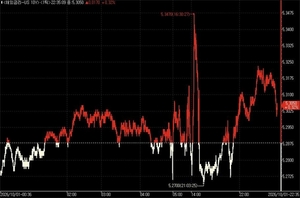
The Curve Is Bending Toward Trouble
The US Treasury market is sending a signal that most investors are still parsing too late.
On a single trading day, the 10-year yield climbed to 5.295% and the 30-year touched 5.653%, both the highest levels since mid-2002. Meanwhile the 2-year fell 2.3 basis points to 4.864%. The spread between the 10-year and 2-year widened from 40.6 basis points to 43.1 basis points. The curve is steepening, and it is doing so without any obvious catalyst.
That is the dangerous part.
Normally a steepening curve reflects a clear shift in expectations — perhaps the Federal Reserve is signaling rate cuts while inflation remains entrenched. Today there was no such clarity. US corporate layoffs hit a four-year low in September at 43,281, down 20% year over year according to Challenger, Grant & Christmas. The labor market is solid. Yet long-end yields continued their march upward.
What is moving markets today is something far more uncertain: a cluster of Federal Reserve speakers expected to weigh in on policy, and the fear that their words could force a repricing across every fixed-income desk in Asia.
Why Steepening Matters for Import-Dependent Economies
A steepening yield curve with falling short-term rates and rising long-term rates is a specific kind of stress signal. It means the market believes the Fed may eventually cut, but that inflation and term premia are pushing long-term borrowing costs higher regardless. That combination — expected future easing paired with current fiscal and inflationary pressure — is not a recipe for dollar weakness.
It is a recipe for a stronger dollar and higher global borrowing costs.
For South Korea, Japan, Taiwan and other import-heavy economies, the math is brutal. These countries run trade deficits in energy and food, depend on foreign capital to finance current accounts, and carry significant dollar-denominated debt. When US long yields rise and the dollar strengthens, three things happen simultaneously: capital flows out of local bond markets, import bills surge, and central banks face a impossible choice between defending the currency and supporting growth.
Korea is especially exposed. The won has already absorbed significant pressure this year. Any acceleration of US yield curves raises the cost of rolling over external debt and deepens the gap between domestic and foreign returns that drives capital outflows.
The ripple does not stop at bonds. A stronger dollar raises the price of imported energy and raw materials, which feeds directly into domestic inflation. That inflation then constrains monetary easing — the very tool these economies need to cushion growth slowdowns.
The Speakers Are the Story
Today is the kind of day that makes fixed-income traders nervous for reasons that have nothing to do with economic data.
Eight of the 19 Federal Open Market Committee members are scheduled to speak. Their remarks could collectively shift the market’s understanding of where rates are heading, how long the Fed will hold them steady, and what inflation trajectory it is pricing in. Even ambiguous language can move billions.
The timing is compounded by conflicting signals already in the data. The S&P Global manufacturing and services PMI last week came in well above expectations and had already sparked a leg up in Treasury yields. Today’s ISM manufacturing PMI and S&P Global manufacturing PMI for September could reinforce or contradict that move. But the real volatility will come from what the Fed speakers say — or avoid saying.
If they sound hawkish, the steepening accelerates. If they signal doubt about the durability of inflation, the curve may compress. The direction matters less than the speed of the move, because speed is what triggers forced selling in Asian bond funds that face redemption pressure regardless of fundamentals.
The Trump Layer
Adding to the noise, President Donald Trump gave a rare public intervention on rates in a Time magazine interview published today. He argued that growth would pay down the $40 trillion national debt and called continued rate hikes “quite bad” and more damaging than inflation itself.
That is a direct critique of the Fed’s policy path and a signal that political pressure on the central bank is intensifying. Markets do not always price in political pressure on the Fed, but they do price in the risk of institutional friction. A Fed that appears to be losing independence faces a credibility premium — and credibility premiums show up as higher long-term yields.
Who Wins, Who Loses
The winners in this scenario are US long-duration bond funds that are already positioned for higher term premia, and dollar holders who benefit from the carry.
The losers are clear. Asian importers face higher dollar costs. Emerging market sovereigns with dollar debt face tighter rollover conditions. Central banks in the region face a trilemma: they can let the currency depreciate and import inflation rise, raise rates and choke growth, or intervene in FX markets and deplete reserves. All three options hurt.
Korea’s export-driven growth model assumes a stable or weakening dollar and manageable borrowing costs. A steepening curve driven by Fed uncertainty breaks both assumptions at once.
What Happens Next
The immediate test is today’s Fed commentary. Eight speakers in one day is unusually dense. Their collective tone will determine whether this steepening is a temporary wobble or the start of a sustained repricing.
The secondary test comes later this week with the ISM data. If manufacturing remains resilient while the Fed sounds uncertain, the curve steepens further and capital flows accelerate out of Asia.
The tertiary risk is political. Trump’s public critique of rate policy is unusual and suggests the administration may push for faster easing — or threaten institutional changes. Either outcome adds a premium to long-duration US debt and keeps pressure on the dollar.
The source material is thin today. There is no fresh data driving the move. That is precisely why the next few hours of Fed speeches matter so much. When markets have no numbers to anchor on, words become the commodity — and words from the Federal Reserve carry the weight of trillions in portfolio repositioning.
For Asia’s import-dependent economies, the message is simple: when the US yield curve steepens on nothing but uncertainty, the bill comes due elsewhere first.