A Federal Block on Mail Ballots Is About to Test Every American Election
With 70 days until Election Day, a federal judge has no answers from the Postal Service on how it would enforce new mail-ballot rules — even as states are already printing and shipping envelopes. The legal standoff could determine whether millions of ballots reach voters at all.
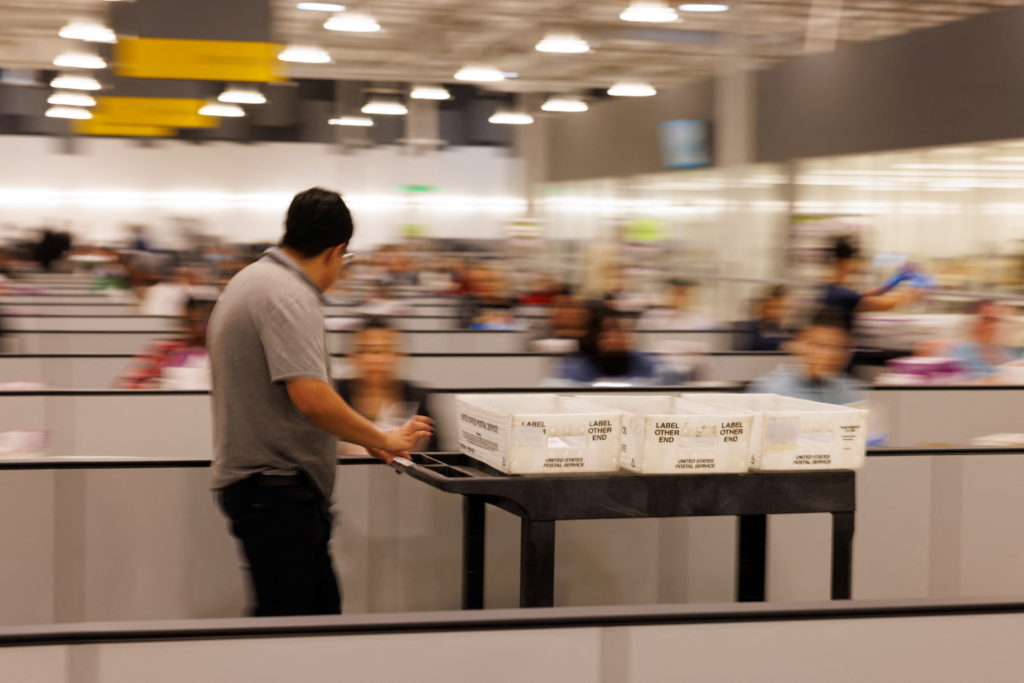
The Post Office Can’t Enforce Rules It Hasn’t Built Yet
Seventy days separate the current moment from Election Day. In that window, more than half of U.S. states will begin mailing ballots to voters. A federal judge in Boston has none of this information from the Postal Service — not timelines, not infrastructure plans, not even a yes-or-no answer on whether the agency can practically implement the regulations it published weeks ago.
U.S. District Court Judge Indira Talwani made that clear Thursday during a hearing with Michael Velchik, a Justice Department lawyer representing the Postal Service. She had imposed a 14-day temporary restraining order last week blocking the administration’s plan to regulate how mail ballots are processed. That order is about to expire. Velchik says the administration will most likely appeal to the Supreme Court before the week ends, seeking permission to resume implementing the rules.
But here is what makes this moment structurally fragile: the rules cannot be implemented even if the judge lifts the block.
The Postal Service’s new regulations require states to get federal approval on ballot envelope designs and upload voter lists to an online portal before any mail ballots can be shipped. Neither the approval process nor the portal exists. The DOJ offered a lifeline during the hearing — that states could opt into the system voluntarily. But according to Velchik himself, not a single state has opted in.
Meanwhile, Wisconsin municipalities have already mailed ballots this week. North Carolina begins full-scale mail-ballot distribution Friday. Election officials across the country say they simply cannot comply with directives that demand a complete operational overhaul, and whose implementing machinery has not been built.
How We Got Here
The regulatory chain runs from an executive order issued by President Donald Trump, who has long opposed mail voting despite regularly using it himself. The order directed the Postal Service to establish new rules for handling mail ballots.
In June, Talwani blocked implementation, ruling that changing election rules this close to a vote was unlawful. The Supreme Court overturned that decision in August, but on narrow procedural grounds: the Postal Service had not yet published its implementing regulations, so Talwani’s injunction was premature. Days after the high court’s ruling, USPS published the rules. Voting rights groups immediately re-filed lawsuits.
The core constitutional question remains unresolved — and it is the one that will define this case going forward. States hold the primary authority to set election rules under the Constitution, and in some cases Congress shares that power. Democrats and civil liberties groups argue the president has no authority to unilaterally reshape how mail ballots are handled, regardless of whether the Postal Service frames the changes as voluntary opt-ins.
Talwani’s latest order extends the June-style block, but only temporarily. The hearing was explicitly about whether to extend that prohibition in the weeks before Election Day.
The Whistleblower Warning
A whistleblower report made public this week adds a concrete operational risk to an already legal tangle. The report warns that the new postal requirements could result in millions of mail ballots never being sent.
Under the new rules, every ballot must be physically delivered to a post office before being mailed to voters. If a single barcode on a batch registers an error, the entire batch is discarded — even if it contains tens of thousands of legitimate ballots. There is no partial salvage. No correction mechanism. A single scanning glitch could nullify an entire county’s mail-vote operation.
This is not a hypothetical edge case. It is the logical consequence of layering a federal processing system onto an election infrastructure that was never designed to interface with it, on a timeline measured in weeks rather than months.
Who Wins, Who Loses, What Comes Next
The immediate loser is clarity. The administrative law doctrine that should govern this — agencies must provide reasonable implementation timelines before enforcing new rules against regulated parties — is being tested against an election calendar that does not bend.
The administration appears to be betting on speed over compliance. Filing a Supreme Court appeal within days suggests it wants the higher court to resolve the constitutional question before the election, potentially forcing ballots through the new system under a last-minute injunction. But the Supreme Court has historically been reluctant to intervene in election administration so close to voting day, particularly when lower courts have already found the rules unworkable.
States are the other loser. Election officials in North Carolina, Wisconsin, and dozens of others are being asked to comply with rules that require infrastructure which does not exist. Some have already printed envelopes. Some have already mailed ballots. The administrative chaos of trying to halt, redesign, and re-submit under federal supervision is not theoretical — it is happening now.
The winner, if this goes to the Supreme Court, depends entirely on how the court defines presidential authority over election administration. If the justices uphold the executive order, the Postal Service gains de facto control over how every state handles mail voting — a power that has traditionally rested with state election boards. If they side with the plaintiffs, the status quo returns and the existing mail-ballot systems continue operating under pre-existing rules.
Either way, the November election will not be decided by a clean legal outcome. It will be decided by who files first, who moves faster, and which system — the one already in operation or the one still being built — actually reaches voters on time.
The judge has 70 days to decide whether to keep the block in place. The Postal Service has 70 days to build a portal that does not exist. The states have 70 days to decide whether to comply with rules they cannot implement. And the Supreme Court has 70 days to resolve a constitutional question it has not yet agreed to hear.
When the clock runs out, someone will lose. The question is whether that someone is the judiciary, the executive, or the voters.