Fire Emblem Fans Turned Bananas Into Console Currency
A discount workaround shared by gaming deal poster Wario64 sent Fire Emblem fans adding bananas to their Walmart carts — and out of stock they went. The story reveals how a niche gaming community can redirect a global supply chain with a single tweet.
The Banana That Broke Walmart
Fire Emblem: Fortune’s Weave launched this week as the first entry in Nintendo’s long-running strategy RPG series on Switch 2, and it also accidentally became the cause of an online banana shortage at Walmart. The connection between a B-tier tactical role-playing game and a shelf in Walmart’s produce section runs through a single tweet from an account called Wario64, a social media figure who operates something like a wire service for gaming deals.
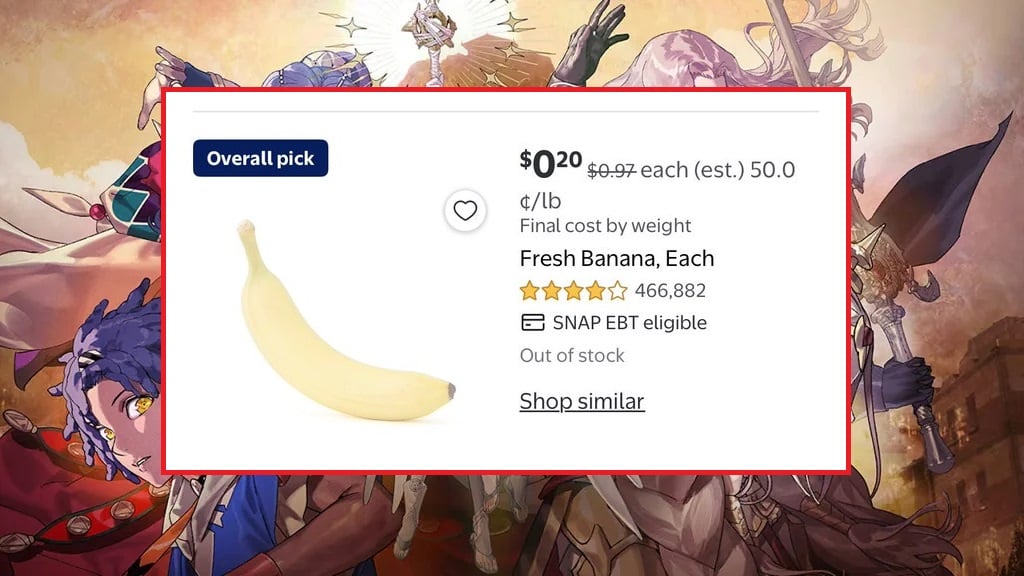
Wario64 posted about a Walmart promotion offering $10 off online pickup or delivery orders, which would knock the $70 digital version of Fortune’s Weave down roughly 15 percent. The discount code, however, was finicky. It did not always work. So Wario64 shared a workaround: if the code failed, try switching the order to pickup. If that still failed, add a banana to the cart. The note about the banana was casual — “weirdly this worked for me with FAST30” — and was accompanied by a link to Walmart’s online listing for a single banana.
Fans did exactly what was suggested. Some posted photos of their Fire Emblem purchases sitting next to the bananas they had added to clear the checkout. Whether or not it is possible to count how many people followed through is impossible to say, but the result is visible: as of now, Walmart’s banana page lists the item as out of stock for online shipping.
The bananas were not being eaten. They were being used as keycards — low-cost trigger items whose sole purpose was to unlock a discount threshold on orders that would otherwise fall short. A $59.99 game becomes $49.99 once you add a $0.59 banana. The math is immediate, the incentive is clear, and the behavior it produced was exactly what any rational economic actor would mimic. The absurdity of the mechanism only made the story more shareable, which made it more effective.
Within hours, screenshots circulated across Reddit threads, Discord servers, and Twitter reply chains showing the banana-as-deadweight approach in action. Some users added bananas and kept them. Others removed them after checkout completed successfully, a move that occasionally triggered discount recalculation and forced a second checkout attempt. Walmart’s system appeared to flag the banana-only cart modifications, which led to a secondary workaround: adding a banana alongside a small grocery item like a bottle of water, creating the appearance of a legitimate multi-item order while still achieving the discount. This secondary adaptation spread even faster than the original tip.
A Community That Moves Inventory
The immediate story here is absurd, which is why it spread. But the deeper story is about coordination. Gaming communities, particularly around Japanese strategy RPGs, are not the kind of audience that tends to generate headlines. They are small, dedicated, and deeply familiar with the systems they engage with — whether that is game mechanics or retail pricing structures.
Wario64’s account functions as a kind of decentralized distribution network. When he posts a deal, thousands of people see it within minutes. The banana workaround was not a corporate marketing campaign. It was not engineered by any retailer or publisher. It was a tip shared voluntarily by someone whose income depends on directing attention to discounts, and it moved a measurable quantity of bananas through Walmart’s online inventory system in a single evening.
This is not the first time gaming deal communities have created real-world friction. The pattern appears periodically whenever a discount is narrow enough to attract coordinated attention and broad enough to include everyday items. But the banana incident is notable because it links a Nintendo exclusive to a staple grocery item, exposing how thin the membrane is between digital consumer culture and physical supply chains.
The second-order effects rippled outward quickly. Grocery delivery riders reported confusion about orders containing a single console game and a dozen bananas. Some fulfillment centers flagged the pattern internally. A few Walmart store managers reportedly asked whether they should restrict banana purchases per order, though no formal policy change was issued publicly. The produce team, working independently of the digital commerce division, had no visibility into why banana demand had spiked — a structural gap that highlights how disconnected brick-and-mortar inventory operations remain from the behavior of online shoppers.
This is not the first time gaming deal communities have created real-world friction. The pattern appears periodically whenever a discount is narrow enough to attract coordinated attention and broad enough to include everyday items. But the banana incident is notable because it links a Nintendo exclusive to a staple grocery item, exposing how thin the membrane is between digital consumer culture and physical supply chains.
The Physical Copy Puzzle
While the banana shortage is the flashier detail, there is a second thread running through this launch week: physical copies of Fortune’s Weave are difficult to find. The boxed version retails for $80 at Walmart and has been listed as low stock on Walmart’s website. It has cycled through out-of-stock status on Amazon between launch day and now.
It is unclear whether this shortage reflects genuine demand surge or constrained initial manufacturing. Nintendo may simply have pressed a limited number of physical copies, a common practice for strategy RPG titles that target a core audience rather than chasing mass-market volume. The comparison to Pokopia, another Nintendo release that faced physical shortages in its first month before restocking kicked in, is useful. Pokopia’s scarcity was temporary. Whether Fortune’s Weave follows the same arc remains unknown.
What is clearer is that a segment of the player base chose to pay well above the digital price for a physical copy, suggesting that for this audience, ownership format matters more than cost. That willingness to absorb a $10 premium speaks to the kind of loyalty that exists inside the Fire Emblem fanbase — a franchise that occupies a middle tier in Nintendo’s catalog but commands fierce devotion from its players.
Some buyers appear to have been motivated by the same discount-seeking logic that drove the banana workaround. If a $70 digital game could be acquired for $50 through a convoluted promo path, then a $80 physical copy purchased at full price represents either a different buyer profile or a failed attempt at the same optimization — someone who wanted a cartridge but could not navigate the loophole, and so paid the premium to avoid the friction.
Who Wins, Who Loses
Wario64 wins by staying relevant. His account grows every time he can connect a deal to a community action, and the banana post was a clean example. Walmart wins on attention, even if the banana shortage creates minor logistical noise. The publisher likely wins too, since the publicity, however sideways, keeps Fortune’s Weave in conversation during its most critical launch window.
The casual fan loses nothing. The person who wanted a $60 digital copy and ended up navigating a discount maze probably lost a little patience. And Walmart’s online inventory team, whoever is watching banana SKU data in real time, may have lost a quiet afternoon.
There is a third party that benefits quietly: the banana growers and distributors who saw their inventory move faster than expected. A single viral tweet generated demand for thousands of additional units of a commodity that, at retail, costs less than a dollar each. No advertising budget produced that result. No promotional partnership was negotiated. The supply chain absorbed the shock and moved on, as supply chains do.
What Happens Next
Banana stock will replenish. Online grocery supply chains are robust enough that a short-term demand spike from a gaming community will not alter global commodity flows. The physical copies, depending on Nintendo’s print run decisions, may remain scarce longer. The more enduring question is whether retailers will start treating gaming deal influencers as a force to be managed rather than ignored.
Walmart could respond by tightening the conditions around its discount codes — requiring minimum cart values that exclude low-cost trigger items, or implementing purchase limits on high-turnover produce during promotional windows. These measures would reduce the effectiveness of future banana hacks but would also signal to the community that the retailer is aware of and reacting to coordinated behavior, which could dampen participation in subsequent deals. Retailers walk a narrow line between preventing abuse and appearing hostile to bargain-seeking customers who are, after all, spending money.
Nintendo, for its part, may reconsider its distribution strategy for future Fire Emblem releases. The physical shortage created frustration that the banana deal amplified rather than resolved. A clearer alignment between digital pricing and physical availability could reduce the incentive for customers to seek workarounds.
Wario64’s post included a banana hack. Two weeks from now, someone else will share a similar tip for a different product, and some aisle somewhere will run dry. That is the signal this story carries: gaming communities are no longer just consumers. They are coordinators. And coordination, at scale, is a kind of power.
The banana shortage will be forgotten by next week. But the infrastructure it revealed — the ability of a niche community to convert social capital into purchasing leverage, to turn a grocery item into a discount key, to coordinate action through a single social media post — that infrastructure remains. The next time a retailer launches a promo with a narrow eligibility window, the community will be ready. And the next product to disappear from the shelf will not necessarily be a banana.