How US Tech Giants Are Bankrolling a Nuclear Renaissance
Amazon, Microsoft, Meta and Google aren't just buying AI compute — they're becoming utility-scale nuclear customers, signing deals that bankroll reactor restarts, output boosts and new builds. Here's what that means for the energy market, and for countries like Korea watching closely.
The Deal Is the Infrastructure
Forget supply chains for a moment. The most important infrastructure race in AI right now is not about chips, racks, or cooling systems — it is about who owns the kilowatt-hours at the bottom of the grid.
In just the past two years, the four largest American technology companies have quietly become the utility-scale nuclear customers the industry never expected to have. Their deals are not speculative hedges or green-washing add-ons. They are 20-year power purchase agreements with names, megawatt figures, and financial consequences that ripple outward to plant operators, regulators, and ultimately ratepayers.
The pattern is stark once you lay them out side by side.
Amazon signed a contract with Constellation Energy last month for 690 megawatts from the Calvert Cliffs plant in Maryland. Nineteenteen0 megawatts of that comes from an output boost Amazon is effectively funding — Constellation says it will invest more than $3 billion in facility upgrades and capacity increases, financed in part by that long-term buyer commitment. The output increase targets 2030 to 2032, right when Amazon’s own data center expansion plans are supposed to come online.
Microsoft reached a similar deal with Constellation in 2024: 835 megawatts for 20 years, tied to the restart of Three Mile Island Unit 1. That unit was shut down in 2019 because it was losing money. A decade of economic unviability ended when a cloud company promised to buy its electricity for two decades. Microsoft’s deal does not just save a plant — it changes the economics of nuclear in America by converting an stranded asset into a contracted one.
Meta moved first in June 2024, locking in 1.1 gigawatts from Illinois’s Clinton Nuclear Plant for 20 years. Clinton had been staring at an uncertain future after state subsidy programs expired, with closure likely by 2027. Meta did not stop at the existing plant: it is also backing next-generation reactor development, with a target of securing up to 6.6 gigawatts by 2035.
Google partnered with small modular reactor developer Kairos Power, committing to as much as 500 megawatts by 2035. This is still earlier stage than the other deals — it is a bet on reactors that do not yet exist — but the direction is unmistakable.
Taken together, these commitments represent roughly 8.6 gigawatts of nuclear capacity either preserved, expanded, or newly funded. That is more than the entire installed nuclear fleet of some OECD countries.
Why Nuclear, Not Wind or Solar
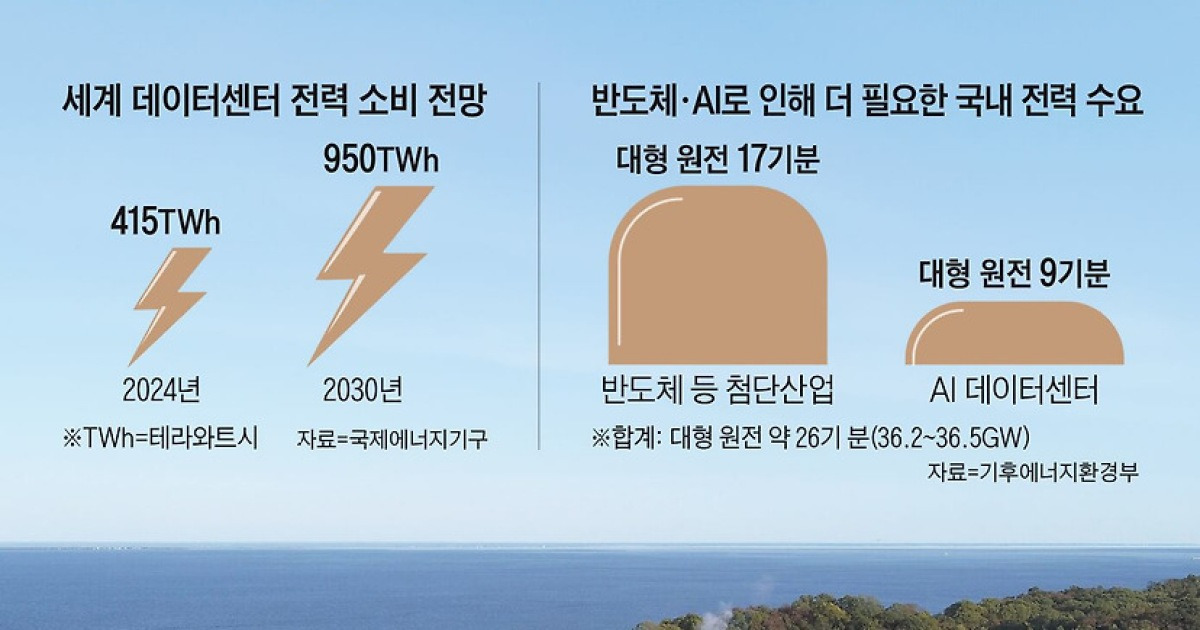
The International Energy Agency projects global data center electricity consumption will more than double between 2024 and 2030 — from 415 terawatt-hours to roughly 950 TWh. In the United States alone, data center demand is expected to jump from about 180 TWh to 420 TWh in the same window. That is a bigger increment than the total electricity consumed by the American steel and aluminum industries combined.
Solar and wind generate significant volume in aggregate, but they do not generate it on demand. Data centers run 24 hours a day, 365 days a year. Intermittent generation requires either massive storage — which remains expensive at grid scale — or a dispatchable partner. Nuclear provides baseload power that does not care about weather, time of day, or season.
The tech companies are not choosing nuclear because it is the cheapest source of electricity on a standalone basis. They are choosing it because it is the only source that can guarantee the capacity factor they need, backed by a contract that spans the amortization period of the asset on both sides.
The Korean Parallel
Korean tech media has been tracking these deals with particular attention, and for good reason. Korea is facing the same structural squeeze, just with a different regulatory setup.
The August release of South Korea’s 12th Electricity Supply and Demand Basic Plan estimated that additional peak demand from semiconductors and AI data centers by 2040 would total more than 36 gigawatts — roughly the equivalent of 26 large pressurized water reactors, each rated at 1.4 gigawatts. Half of that增量 (11.9 GW) comes from AI data centers alone.
The government has already signaled that long-term nuclear power purchase agreements between corporations and generators should be on the table. Korea Hydro & Nuclear Power, the state-owned utility that dominates the sector, would benefit from contracted revenue streams that make financing new reactors simpler. Corporations would gain certainty on capacity and cost for factories and data centers that otherwise could not be built without guaranteed power.
There is a legal obstacle, however. Under current Korean law, long-term power purchase agreements between generators and private companies are permitted only for renewable energy. Nuclear and fossil fuel contracts with end users require regulatory and legislative changes that have not yet been enacted.
The Fairness Question
Here is where the Korean debate diverges from the American one, and where the real policy tension lives.
Korea Electric Power Corporation buys electricity from a portfolio of nuclear, coal, LNG and renewable generators, then resells it to households and businesses at regulated rates. If large corporations begin purchasing cheap nuclear power directly through long-term contracts, the remaining customers are left with a higher average cost of supply. The subsidized megawatts walk away, and the bill for the rest grows.
Several proposals are circulating to manage this. One is to tie corporate nuclear PPA eligibility strictly to new reactors or output augmentation projects, so that existing low-cost capacity is not simply redirected away from the general rate base. Another is to require the contracting company to bear a share of the transmission and substation costs needed to deliver the power, rather than leaving those as a public expense.
Jeong Yeon-je, a professor at Seoultech, argued publicly that the explosive growth in demand makes corporate participation in nuclear investment and long-term contracts necessary, but that the social discussion on contract structure and cost-sharing principles must start now.
The American experience offers a partial blueprint and a partial warning. The US model works because nuclear plants operate in deregulated markets where corporate PPAs are already legal and price signals can flow. It works less well as a direct template for Korea, where the single-buyer utility structure and regulated retail tariffs create a different set of distributional consequences.
What Happens Next
The most consequential shift is not technological — it is institutional. Tech companies have moved from being electricity buyers to being balance-sheet participants in nuclear generation. That changes who has leverage over plant operations, timeline decisions, and regulatory approvals.
For Constellation, Amazon and Microsoft are not just customers; they are de-risking assets that otherwise would not have been revived. For Kairos and other SMR developers, Google’s commitment provides the kind of early-stage offtake signal that traditional utilities have struggled to offer alone.
Korea is watching because its own semiconductor and AI buildout cannot proceed without a parallel energy strategy. The 36-gigawatt gap is not theoretical — it is the difference between building fabs and shipping containers, between attracting investment and relocating it. The question is whether Seoul moves quickly enough to adapt its regulatory framework before the next round of corporate facility announcements, and whether it designs the cost-sharing rules before the first deal is signed.
The nuclear renaissance these deals are funding is not driven by climate policy or energy independence in the traditional sense. It is driven by the fact that artificial intelligence, at current scales, requires a lot of power and cannot wait for the sun to shine or the wind to blow. The companies that understand that — and structure their energy strategy accordingly — will have a structural advantage. Everyone else will be negotiating from a position of scarcity.