The First Fully AI-Produced Korean Feature Film Isn't the Threat You Think It Is
Steelay became Korea's first 100% AI-produced 90-minute feature, yet its production company used entirely foreign AI tools. The story it tells about Korean cultural ambition is far more complicated than the headline suggests.
The Number That Should Make You Pause
Fifty to sixty percent of Steelay’s total production cost was spent on AI tool usage fees.
Not on actors. Not on location scouts. Not on cameras, lighting rigs, or craft services. On tokens. On API calls. On the right to generate video through systems owned by companies in California, Shenzhen, and elsewhere—platforms that currently have no Korean-made competitor for high-end generative video.
That detail is buried in the press coverage of the film’s blind screening at CGV Yongsan on September 7. It matters more than the headline fact that Steelay is Korea’s first 100% AI-produced 90-minute feature film.
What Steelay Actually Is
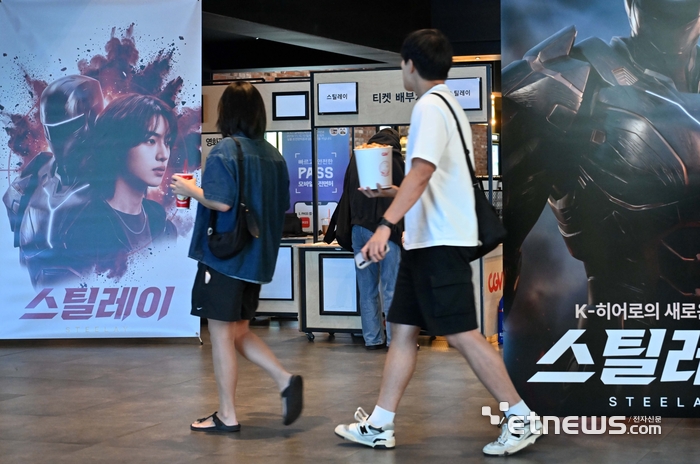
Directed by Seol Woo-in and produced by iNo Studio alongside Raon Company Plus, Steelay is a robot science-fiction action film. The production began in December 2024 and took roughly six months. iNo Studio CEO Ham Seul-gi said the total budget came in under 1 billion won (approximately $700,000 USD), a fraction of what a conventional Korean genre film would cost.
The workflow was brutal in its simplicity: generate tens of thousands of 15-second video clips using foreign AI tools, then curate 13,000 of them into the final cut. SiDance, Kling, HixsField, and Google Veo provided the raw video generation. No Korean enterprise currently offers a commercial AI video-generation service.
Ham’s team chose to stay entirely within AI post-production rather than fall back on CG augmentation—even though they had the capability to do so. They also rejected AI-synthesized voices in favor of a trained voice actor, performing precise lip-sync work. Director Seol Woo-in told attendees the goal was minimizing the uncanny-valley effect and approaching live-action fidelity.
The result is imperfect but functional. Character consistency in visual design and voice held across the 90 minutes. Some movements and facial expressions carry the telltale artificial stiffness that still haunts current generative video. But the gaps are narrowing.
The Real Story Is Where the Tools Came From
Korea’s government is treating Steelay as proof of concept for AI-driven cultural leadership. Vice Chairwoman Ha Jeong-woo of the National AI Strategy Committee attended the screening—the first private event she has appeared at since the committee’s formation. Her remarks were unmistakable: Korea should become a global leader in media and content through AI, and the government will actively support the industry to get there.
But here’s what Ha Jeong-woo’s statement didn’t address: the AI tools that made Steelay possible are not Korean. The entire production pipeline—script development through final post—relied on foreign platforms. If those platforms change their terms, raise their prices, restrict access, or shut down, Steelay’s production model evaporates overnight.
This is the central contradiction of the moment. Korea is investing in AI-native content as a vector for Hallyu expansion while having zero domestic capability in the underlying video-generation infrastructure. The country can direct and curate AI output, but it cannot generate it at scale with its own systems.
Who Wins and Who Loses
The winners are clear. iNo Studio demonstrated that a 90-minute narrative feature can be produced for under $750,000—a budget that would buy a single day of filming on most mid-tier Korean productions. The cost structure is fundamentally different. No locations to scout. No crew to house. No permits to secure. The marginal cost of a retake is a prompt and a token balance.
Platforms like Kling and Veo win too. Every Korean production like this is another data point proving their tools can handle long-form narrative continuity, a capability that traditional Hollywood VFX pipelines were built to provide at 100 times the price.
The losers are harder to name because the disruption hasn’t fully landed yet. But the trajectory is visible. Storyboarding, concept art, animatic creation, background generation, and even some pre-visualization work—roles that traditionally sustain hundreds of mid-career crew members in the Korean film ecosystem—are the first tasks to become programmable. Steelay didn’t eliminate those jobs. It made it possible to imagine a future where you don’t need them.
Why This Matters Beyond Korea
Korean cultural exports already dominate globally. K-dramas, K-pop, and Korean cinema have proven that narrative quality transcends language barriers. Steelay represents a different proposition entirely: the possibility that the cost floor for ambitious genre storytelling collapses so dramatically that new producers in new markets can enter the conversation without the capital infrastructure that previously gatekept it.
The question isn’t whether AI film is inevitable. It already exists. The question is who controls the tools that make it. Korea has a strategy committee and a policy vision. It does not yet have a domestic video-generation platform competitive with its foreign counterparts. That gap determines whether AI becomes a tool for Korean cultural sovereignty or merely another channel for exporting demand to Silicon Valley and Shenzhen.
What Happens Next
Steelay screens in Korea this October. Its longer-term significance depends on what follows. If iNo Studio can deliver a second feature under similar conditions, the production model moves from experiment to repeatable blueprint. If the Korean government follows through on its promise of audience-expansion support—as Ham Seul-gi explicitly requested—the film may reach viewers it wouldn’t have found otherwise.
The more consequential timeline runs differently. Within two to three years, the gap between AI-generated and live-action footage will close further, possibly past the point where casual viewers can reliably distinguish the two. When that happens, Steelay will look like a beta version. The 15-second-generation constraint that defined this production will seem quaint.
But the economic argument will remain: even imperfect AI-generated video, assembled at this scale and cost structure, changes what a $700,000 budget can achieve. That is the number that will reshape the industry. Not the visuals. The arithmetic.
Steelay proves the arithmetic works. Whether it strengthens Korean cultural autonomy or deepens its dependence on foreign AI infrastructure is a question the country hasn’t yet answered.