Footprints Rewrite Paranthropus boisei Story
Fossil tracks in Kenya reveal a large, socially complex group of Paranthropus boisei, challenging assumptions about body size and behavior of this extinct human relative.
Eight Adults, One Lake
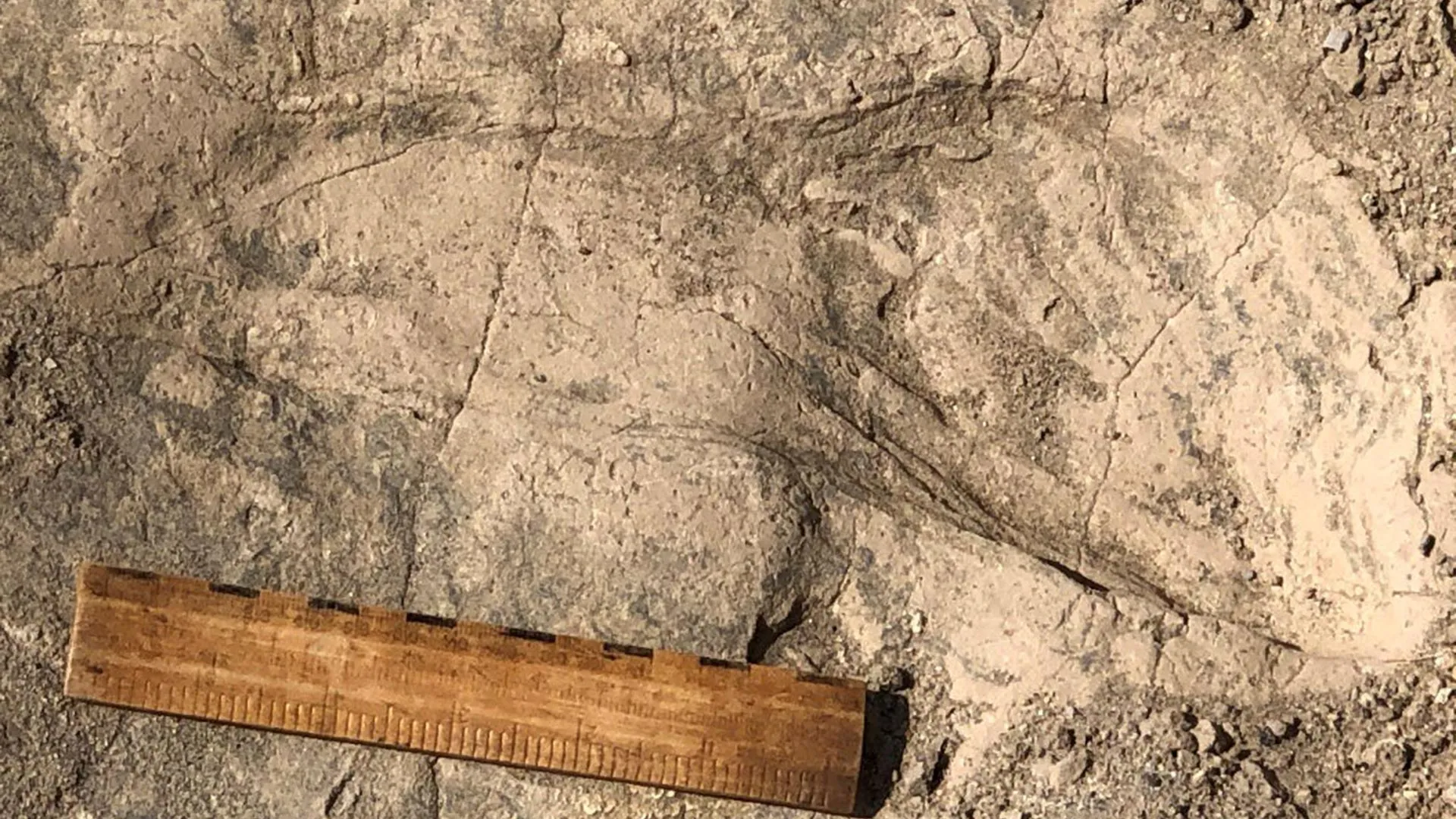
Eight adult male Paranthropus boisei, each nearly 1.8 meters tall, walked together across a lakeshore 1.4 million years ago. Fossil footprints uncovered in northern Kenya capture a scene that upends long-held assumptions about this extinct human relative—and forces a rethink of where large-bodied hominins fit in the early human story.
The tracks, preserved in fine-grained lake-margin sediments near an ancient shoreline around Lake Turkana, represent a rare behavioral snapshot. Unlike bones, which can accumulate over millennia through multiple catastrophic events, footprints freeze a brief moment in time. Here, that moment appears to show a cohesive group moving as one across wet sediment, leaving behind a trail that would remain undisturbed until its discovery by researchers.
Most were likely adult males, with no obvious females or juveniles in the assemblage. That composition hints at a social structure far more complex than the solitary, female-led groups once imagined for robust australopithecines—a finding with ripple effects across the field.
The Size Surprise
For decades, knowledge of Paranthropus boisei rested almost entirely on craniodental specimens. Those skulls boast massive jaws, colossal molars, and sagittal crests adapted for chewing tough, fibrous vegetation. But they told us remarkably little about body proportions, posture, or locomotion.
The new footprints change that equation. Using analytical techniques refined by the same research team in 2024, scientists linked the tracks to P. boisei based on distinctive foot anatomy and gait patterns consistent with known specimens from the region. The sizes were startling.
“The sizes of the footprints indicate human-like body sizes—up to 1.8 meters tall and around 75 kilograms,” said lead author Kevin Hatala of Chatham University and the Max Planck Institute for Evolutionary Anthropology. “These are dimensions we haven’t associated with robust australopithecines before.”
That places P. boisei squarely in the size range of early Homo erectus, a species often considered a direct ancestor of modern humans. Previous estimates, drawn from sparse postcranial fragments and extrapolations from smaller australopith bodies, suggested P. boisei was substantially more diminutive—perhaps closer to 1.3 meters and 40 kilograms. The gap between those estimates and the new data is not minor; it represents a fundamental recalibration of what this lineage looked like.
The discrepancy matters for more than one specimen sheet. If robust australopithecines were larger than thought, they may have occupied ecological niches previously reserved for early Homo—a shift that could redraw maps of who lived where, and when. It also raises questions about how body size influences dietary strategy, energetics, and competitive dynamics between coexisting hominin species.
A Group of Males
The social implications are equally provocative. Eight adult males traveling together, without females or children, suggests a level of tolerance among rivals that is difficult to reconcile with models built on great ape behavior.
“They may have lived in large groups, where males competed for mates, but also tolerated each other at times for safety in a dangerous environment,” said co-author Neil Roach of Harvard University. “The key word is tolerance. These animals weren’t constantly fighting. There’s room for coalition formation here.”
Such behavior is uncommon among great apes, where adult males are typically solitary or form loose, competitive associations marked by aggression. The Kenyan tracks imply that P. boisei may have forged coalitions—a capability once thought rare outside the Homo lineage. If confirmed by additional trackways, this could force paleoanthropologists to reconsider the timeline for complex male sociality in human evolution.
That doesn’t mean these hominins were peaceful. The lakeshore was likely a hotspot of competition and predation, shared with crocodilians, big cats, and possibly other hominin groups. Traveling in numbers could have been a survival strategy, one that required a degree of social flexibility and communication not previously attributed to robust australopithecines.
Why the Lake?
Lake Turkana has yielded hundreds of hominin footprints across more than half a dozen sites, making it one of the richest trackway localities on Earth. The new discovery sits in a landscape where the same lake-margin deposits appear at locations 40 kilometers apart, dating to roughly the same period. This isn’t a one-time visitation event. The pattern points to repeated return visits over millennia, suggesting the lakeshore functioned as a reliable resource hub.
“To me, it is amazing that we have the same kind of lake margin deposits in two areas of East Turkana that are 40 kilometers apart, at about the same age,” said co-author Kay Behrensmeyer of the Smithsonian Institution. “This implies a landscape that hominins learned to navigate and returned to repeatedly.”
Behrensmeyer expects that deciphering the geological conditions that preserved these tracks will reveal why hominins kept returning to the lake shore for more than 100,000 years. The answer could rewrite our understanding of early hominin habitat selection, showing that resource predictability—not just resource abundance—may have driven landscape use patterns.
Rewriting the Tree
Does this footprint find force a rewrite of the human family tree? Not entirely—but it does demand corrections.
Morphologically, P. boisei appears larger and more robust than skeletal fragments alone suggested. Behaviorally, it shows signs of complex social grouping, a trait not traditionally associated with robust australopithecines. Geographically, the discovery reinforces East Africa as a stage where multiple hominin lineages coexisted and interacted. P. boisei and early Homo shared the same lakeshore environments, yet followed different evolutionary paths—suggesting niche partitioning rather than simple replacement.
The team plans to return to Kenya this year to continue investigating the sites, with particular attention to identifying additional trackmakers and documenting whether mixed-sex or family-group footprints exist in adjacent strata. Each newly documented surface adds another frame to the slow-motion movie of human evolution.
“Each site represents a snapshot of our past, and we are quickly building a photo album with several different windows to hominin anatomy, locomotion, behavior, and environments during the Early Pleistocene,” Hatala said.
Purity Kiura of the National Museums of Kenya emphasized the regional significance: “The discovery of these fossil footprints along the margins of Lake Turkana reinforces the region’s global importance in understanding human evolution, preserving remarkable evidence of how our ancient relatives lived 1.4 million years ago.”
The real shift may be methodological. For years, paleoanthropology relied heavily on bones, which preserve anatomy but obscure behavior. Trackways offer a different kind of evidence—one that captures living movement, social proximity, and environmental context in situ. As techniques improve and more sites are excavated, additional snapshots will emerge from the dust of Lake Turkana, and with them, a richer, messier picture of our early ancestry.
What wins here is not a single revelation but a change in perspective. Paranthropus boisei was not a small, isolated oddity clinging to a dead-end branch. It was a large, socially adept hominin that walked alongside early Homo in one of the cradles of humankind—competent, adaptable, and part of a community far more complex than the fossil record alone ever implied. The footprints tell us that the story is more interconnected, and more surprising, than we ever pictured.