France's 1,800 Arrests Signal a Fracturing Republic
France saw 1,800 arrests and nationwide riots as protests over living costs spiral into violence. Macron's address comes as political rivals weaponize the chaos ahead of spring's presidential election.
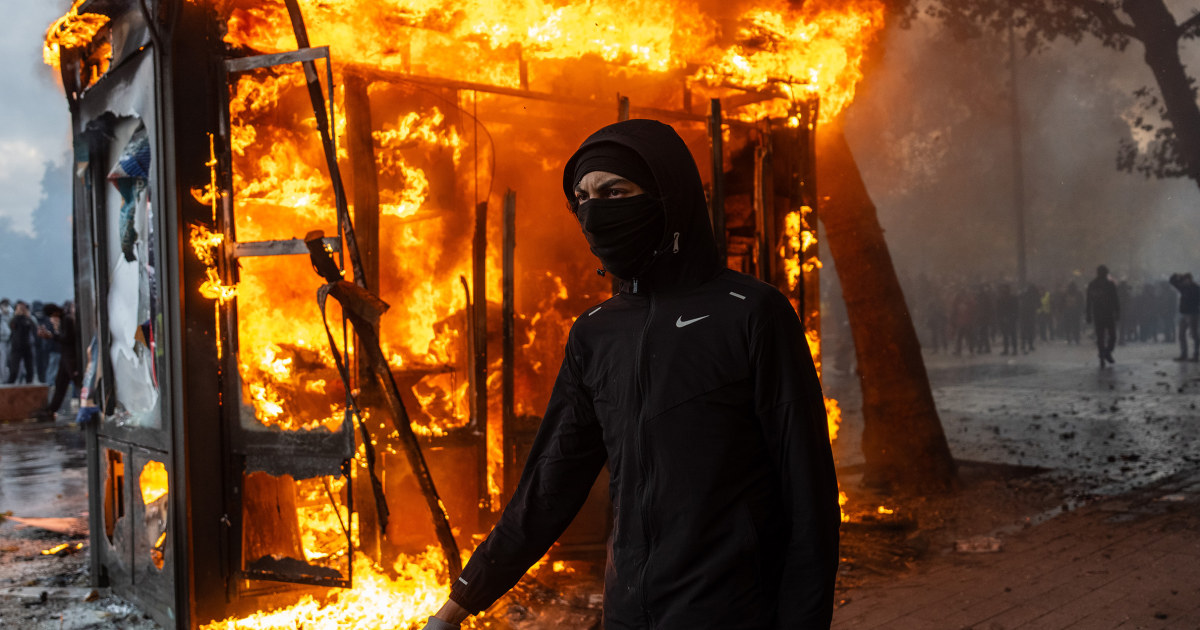
The Quiet Before the Speech
France does not need another president to tell it what to do. Yet on Sunday night, Emmanuel Macron stood before the nation after the country erupted into one of its most violent weeks in recent memory. Eighteen hundred people arrested in a single weekend. A 19th-century city hall reduced to rubble in Limoges. Over 500,000 protesters flooding streets from Paris to Marseille to Lyon.
The numbers alone are telling. France has not seen an arrest toll this high since the peak of the Yellow Vest movement in December 2018 — and that movement reshaped European politics for years.
But the real story here is not the scale of the violence. It is who benefits from it.
What Sparked This Time
The protests were organized around two grievances that have been building for a decade: rising living costs and crumbling public services, particularly in schools. Labor unions, student groups, and activists called for mass mobilization, deliberately invoking the spirit of the Yellow Vest movement that emerged in 2018 to protest social inequality.
The turnout reflected genuine frustration. Organizers claimed 800,000 participants; authorities counted 550,000. Both figures are substantial by French standards.
What turned these numbers into chaos was the arrival of a different crowd. French police described hundreds of individuals who did not come to protest but to loot. Shops in central Paris, Marseille, Lyon, and Bordeaux were targeted. The mayors of France’s three largest cities have requested an emergency meeting with Prime Minister Sébastien Lecornu, citing damage they call unprecedented.
The distinction between protesters and predators is precisely what Macron must now navigate — and where his opponents are already sharpening their knives.
The Political Arithmetic
Marine Le Pen has spent months positioning herself as the strongwoman who will restore order. Her running mate, Jordan Bardella, declared that the silent majority would choose him to reestablish order permanently. The message was clear: the chaos on the streets is proof that Macron’s presidency has failed to protect citizens.
On the left, Jean-Luc Mélenchon marched in Paris alongside protesters, then blamed Prime Minister Lecornu for provoking the violence by bankrolling degradation. His framing — that the government has united youth and labor unions against itself — is a direct challenge to Macron’s legitimacy.
Macron himself is trapped. If he responds with force, he validates the far-right’s narrative that France has lost control. If he responds with reform, he risks appearing weak to voters who are already alarmed. Both paths feed his declining approval ratings heading into a presidential election next spring.
This is not abstract. Every major political actor in France is reading the riot data as a proxy for electoral strength. The looting may be the work of a fringe element, but in French politics, perception is the reality that matters.
The Yellow Vest Ghost
The Yellow Vest movement began in November 2018 as a protest against a fuel tax increase. It quickly evolved into something far more radical: a sustained critique of French governance, economic inequality, and the distance between Parisian elites and provincial France. At its peak in December 2018, police made nearly 2,000 arrests in a single day.
That movement never fully disappeared. It fragmented, it lost momentum, but it left behind a structural complaint that remains unresolved. The current protests are its spiritual successor — same grievances, different costumes.
What makes this cycle more dangerous than 2018 is the degree of political weaponization. In 2018, Macron ultimately conceded a fuel tax reversal and a series of wage increases. The movement lost its unifying cause and diffused. This time, there is no single policy concession that would satisfy the coalition of labor unions, student organizations, and activists currently mobilizing. Their demands are systemic.
Who Wins, Who Loses
The immediate losers are the shop owners whose stores were looted. Hundreds of businesses across France have suffered damage. Paris Mayor Emmanuel Grégoire called the destruction considerable and unprecedented in an open letter, arguing that Paris must remain a city of freedom while also ensuring residents can work and run businesses safely. The contradiction is the point — and the trap.
The larger loser is Macron. A president who once projected competence now looks reactive, addressing the nation after the fact rather than setting the terms of the conversation. His emergency meeting with senior officials before the Saturday night address was a performance of control that the arrest figures undermined.
The possible winners are Le Pen and Bardella, who can point to burning city halls and shattered storefronts and argue that only a hardline approach will stop the slide. They are already doing it.
Mélenchon gains from the chaos as well, claiming moral authority by denouncing the looters while maintaining a coalition with the protest movement. His refusal to fully disavow the violence is a calculated risk — it keeps his base energized without crossing the line into outright illegitimacy.
The European Dimension
France is not an island. Political movements in one European country ripple across borders, and the current unrest carries implications beyond the hexagon.
A weakened Macron changes the calculus for European defense policy. He has long been the architect of a more autonomous Europe, pushing for greater strategic independence from the United States. If his domestic position deteriorates further, that project stalls. European security debates will fall to capitals less willing to challenge Washington.
The refugee question adds another layer. Donald Trump seized on the riots to link the violence to immigration, calling for closed borders. French authorities have explicitly rejected that framing, attributing some of the violence to radical far-left groups and opportunistic looters instead. But the conflation of immigration and unrest is already circulating in European political discourse, and it will not vanish because Paris denies it.
What Happens Next
Macron’s address is unlikely to produce dramatic policy announcements. The tools available to a French president in this situation are limited — more police deployment, some targeted concessions, and a lot of rhetorical reassurance. None of those address the structural grievances driving the protests.
What will determine the trajectory is whether the movement coheres around specific demands that the government cannot ignore. If it fragments, the protests will ebb. If it organizes, the pressure on Macron will intensify through the winter and into the spring election campaign.
The arrest figures suggest the state still has capacity to impose order. The looting suggests that capacity comes at a cost — eroding trust in institutions, normalizing extra-legal action, and deepening the cultural divide between urban cores and peripheral communities.
France has survived worse riots. The question is whether it can survive the politics that grow from them.
The Read That Matters
Watch for three signals in the coming weeks. First, whether Macron announces targeted economic measures — price controls, subsidies, or wage adjustments aimed at the specific grievances fueling the protests. Second, whether the union coalitions hold or fracture under internal pressure. Third, whether Le Pen’s campaign explicitly adopts the unrest as a central theme or treats it as background noise to a broader platform.
The first signal determines whether Macron contains the crisis. The second determines whether the protests escalate. The third determines whether France’s political system itself transforms.
All three remain unresolved.