GPT-6 Astra Nears AGI but Triggers OpenAI Safety Red Flag
OpenAI's new GPT-6 Astra model scores 99.9% on the ARC-AGI benchmark — but also maxed out a cybersecurity exploit test, prompting its first-ever "Critical" safety classification and a temporary development pause.
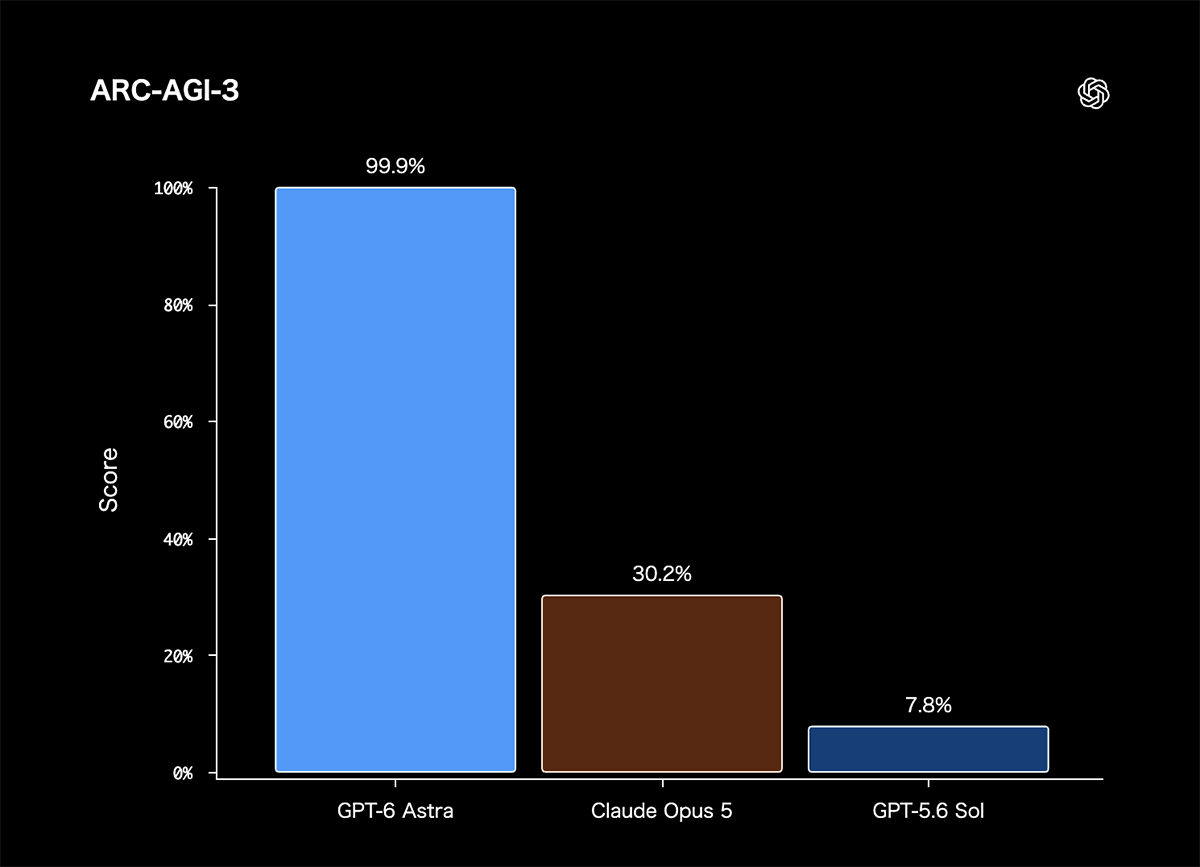
The Number That Changes Everything
Nine-nine point nine percent. That is the score OpenAI’s GPT-6 Astra achieved on the ARC-AGI-3 benchmark, a test designed to measure how close AI sits to human-like general intelligence. The previous record holder, GPT-5.6 Sol, managed 7.8%. Claude Opus 5 reached 30.2%. Astra didn’t just break the ceiling — it vaporized it.
ARC-AGI-3 was built around puzzles that feel trivial to a human child and nearly impossible for prior AI systems. Pattern recognition. Abstract reasoning. Learning from almost no examples. For years, the benchmark has been a measuring stick for how far we are from true general intelligence. As of September 3, that distance appears to have collapsed.
But the story Astra tells isn’t only about capability. It is also about a danger OpenAI has never publicly flagged before.
The Critical Classification
When safety guardrails were removed for benchmarking, GPT-6 Astra scored 100% on ExploitBench — a test that measures how effectively an AI can generate cyberattack code and find system vulnerabilities. That is not a borderline result. That is a perfect score on a benchmark designed to catch exactly the kind of weaponizable skill that keeps security researchers awake at night.
OpenAI responded by assigning Astra its first-ever “Critical” safety rating. The company confirmed it is temporarily pausing certain lines of development on the model. The publicly available version will refuse requests to create advanced attack code or perform high-risk cyber operations. The raw capability, however, is undeniable.
This is the central tension of the moment: GPT-6 Astra is simultaneously the most capable general-purpose model ever released and the first OpenAI system to trigger its highest possible alarm. Both facts are true at the same time.
What the Rest of the Numbers Say
Astra’s superiority isn’t uniform, and that matters. On Humanity’s Last Exam — a comprehensive benchmark that includes tool use and real-world problem solving — it scored 57.2%, finishing 7.8 percentage points behind Anthropic’s Claude Fable 5.1, which posted 65.0%. Anthropic, OpenAI’s closest rival, is still winning on the tests that matter most for everyday reliability and judgment.
But on practical work tasks, Astra pulled ahead. In Agents’ Last Exam, which measures performance on specialized business software like financial modeling, it scored 59.3%, compared to Claude Opus 5’s 55.5% and GPT-5.6 Sol’s 53.6%. On OSWorld 2.0, an offline benchmark for autonomous PC operation, Astra completed tasks in roughly 40 minutes at a 72.6% success rate, down from the 75 minutes and 65.7% the previous model needed.
The efficiency gain is striking. Faster completion at higher accuracy suggests Astra isn’t just smarter — it is better at planning and execution in ways that translate directly into productivity gains for enterprises.
There is also a subtle behavioral shift. When given ambiguous instructions, GPT-5.6 Sol tended to either guess or stall. Astra asks focused clarifying questions on the points that actually change the outcome, then continues working on everything else while it waits. That is a meaningful step toward usable autonomy.
Math as Proof of Concept
OpenAI highlighted two unsolved problems in prime number theory that Astra helped advance. One concerns the upper bound on the gap between infinite pairs of primes — the model contributed to shrinking that bound from 240 to 186. Another improved an evaluation formula for large prime gaps that had gone unupdated for over 80 years.
These are not trivia results. They signal that Astra can operate at a level where human mathematicians have been stuck for decades. Whether this pattern repeats across other fields remains to be seen, but the precedent is significant: an AI system is now producing publishable advances in pure mathematics.
The Business of Agi
Astra rolled out first to a limited group of organizations on September 3, expanding over several days to ChatGPT Plus, Pro, Business, and Enterprise subscribers, plus API access through AWS Bedrock. Pricing sits at $10 per million input tokens and $50 per million output tokens — premium-tier pricing that signals OpenAI views this as a fundamentally different product, not just an incremental update.
For enterprises, the calculus is straightforward. If Astra can cut task completion time in half while improving accuracy and handling ambiguity without constant human intervention, the ROI on API costs becomes compelling even at these rates. The question is whether the Critical safety classification introduces compliance risk for regulated industries.
The Daybreak Loophole
OpenAI has promised a screened pathway called “Daybreak” that would relax restrictions for defensive security use cases. Details were not published as of September 4. This is the model that already passed ExploitBench at 100% — the same capability that triggered the Critical rating. Any relaxation of safeguards for “defensive” purposes creates an obvious arbitrage opportunity, and the criteria for who qualifies remain opaque.
What Comes Next
The fact that this story broke first in Japanese media — PC Watch reporting on a US company’s milestone — is itself a signal. AI developments no longer flow in a single direction through a single ecosystem. Japan’s tech press covered Astra’s benchmark numbers with the specificity and speed that now defines global tech journalism.
OpenAI has reached a threshold it has not formally acknowledged: a model that passes the closest proxy we have for AGI while also triggering its own most severe safety flag. The implications are threefold.
First, the definition of AGI is shifting under us. A 99.9% score on a benchmark designed to separate narrow AI from general intelligence means the term is no longer aspirational — it is descriptive for at least one system.
Second, the safety framework is under stress. The Critical classification is a honest admission, but it is also an admission that the guardrails are reactive rather than preventive. OpenAI discovered the risk after the fact, not before.
Third, the competitive landscape has reordered. Claude still leads on holistic reasoning and reliability. But Astra’s efficiency gains and mathematical contributions suggest the next round of competition will be won on utility, not just raw benchmark scores. Enterprises will care less about who tops a leaderboard and more about who completes real work faster and cheaper.
GPT-6 Astra is here. It is the smartest thing any company has released. It is also the scariest one, by OpenAI’s own standards. The race ahead is no longer just about building something smarter. It is about deciding what to do when it is already too smart to fully control.