Why Hanwha's Climb to #16 Changes the Global Arms Game
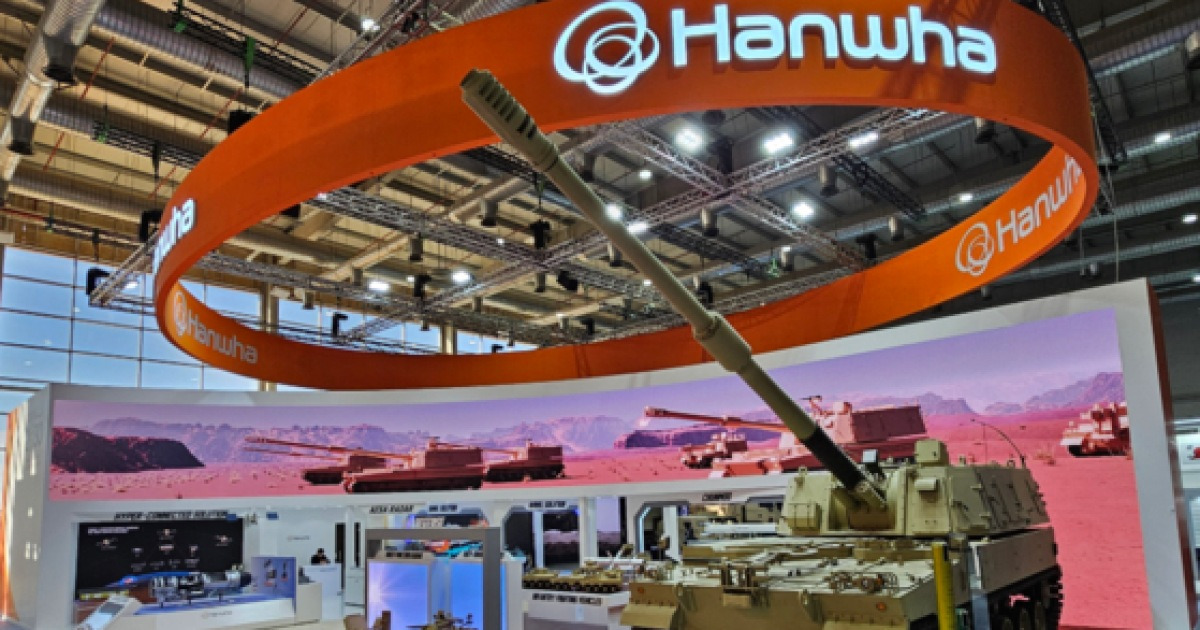
Four South Korean defense firms made Defense News' 2026 Top 100 — a signal of structural change most Western coverage is underestimating. Hanwha's jump six spots to #16 with over $10 billion in sales shows K-defense has moved from regional supplier to global tier-one player.
The Number That Western Outlets Are Treating as Routine
Hanwha posted $10.4 billion in defense revenue last year. That is not a rounding error on the global defense spreadsheet — it is the mark of a company that has graduated from regional contractor to a top-20 global defense name.
Defense News released its 2026 Top 100 list on Aug. 31, and four South Korean firms appeared for the second straight year. Hanwha jumped six spots to No. 16. LIG Nexon rose to No. 52. Hyundai Rotem climbed to No. 61. Korean Aerospace Industries slipped to No. 74.
Read the list without context and you see five numbers that do not belong to the main story. Read them with context and you see something else entirely: a structural realignment of global arms supply chains that is happening faster than most Western coverage acknowledges.
What the Ranking Actually Means
Defense News ranks companies by their total defense sales in the preceding calendar year. Lockheed Martin leads again at $72.1 billion. RTX, General Dynamics, and Northrop Grumman round out the American top four. Beyond that, BAE Systems, Boeing, China Aviation, L3Harris, Leonardo, and Airbus make up the rest of the top ten.
Hanwha is the highest-ranked non-Western firm outside China and Russia. It is also the only Asian company in the top 20. That gap between Hanwha and the rest of the non-Western world is the most important detail in this list.
Hanwha’s defense business now accounts for roughly 20 percent of its total corporate revenue — up from a fraction a decade ago. The $4 billion year-over-year increase in defense sales alone is larger than the total defense budget of several NATO member states. This is not incremental growth. It is a repositioning.
The Ukraine Effect — And What Western Analysts Miss
The obvious explanation for K-defense’s rise is the war in Ukraine. South Korean weapons — the K9 Thunder howitzer, the CH-4 Haegung drone, the T-55 upgrades sold to Poland — became visible on European soil. Governments that spent decades relying on Western suppliers suddenly had an alternative. South Korea could deliver fast, at lower cost, without the political conditionality that accompanied American or European transfers.
But the Ukraine story gets told so often that its deeper implication is lost. K-defense proved something European and American manufacturers have struggled to demonstrate since 2022: the ability to ramp production at scale in a crisis. Western defense firms are constrained by legacy procurement processes, unionized workforces, and industrial bases that atrophied over decades of peacetime budgets. South Korean firms have built their capacity on continuous production runs for domestic customers and a government strategy that has treated defense exports as a national industrial priority since the 2010s.
Poland is the clearest case. It has ordered hundreds of K9 howitzers and is building a local production line with Hanwha. That contract did not come from a sudden whim — it came from a supplier that could commit to delivery timelines Western firms could not match.
Who Wins, Who Loses
The winners are straightforward: Hanwha, LIG Nexon, Hyundai Rotem, and the South Korean government, which saw defense exports surpass $10 billion in annual sales for the first time. Saudi Arabia, Poland, Norway, the Netherlands, and other customers who previously had to choose between expensive Western systems and Chinese仿製品 now have a third option that does not come with strings attached.
The losers are less dramatic but significant. European defense contractors feel the squeeze first — Leonardo and other mid-tier players compete directly with K-defense on the same contracts. In the Middle East, where South Korea has been gaining share for years, European firms are losing ground to Korean competitors who offer comparable technology at lower prices. The U.S. benefits less directly: American firms still dominate the high-end fighter, missile, and naval segments where Korean companies do not yet compete. But the long-term trend favors diversification, and customers who can buy from Seoul are less dependent on Washington’s political calculus.
The K-Defense Triad Is Taking Shape
What makes this year’s list notable is not any single ranking — it is the pattern across four companies in a single market.
Hanwha dominates artillery and ammunition. LIG Nexon controls naval systems and electronic warfare. Hyundai Rotem produces main battle tanks and armored vehicles. KAI builds combat aircraft and transport planes.
Together they cover the full spectrum of conventional ground and air combat systems. No other country outside the United States has assembled a defense industrial base with that kind of breadth — and that kind of speed. Germany spends more on defense but produces less internationally. France has Rafale and naval exports but lacks the artillery and armor depth that South Korea now offers.
What Happens Next
Expect the rankings to keep moving. Hanwha’s trajectory suggests it will challenge the top 15 in the next two years. LIG Nexon and Hyundai Rotem could both crack the top 50 within three. KAI’s slip this year — eight positions downward — reflects the volatile nature of aircraft export cycles, where long development timelines and geopolitical dependencies create lumpy revenue.
The more consequential shift is institutional. South Korea’s Defense Acquisition Program Administration has spent years building export infrastructure — bilateral security agreements, offset negotiations, foreign production partnerships. Poland is the first major example. The Philippines, Indonesia, and Mexico have signaled interest. The model is replicable.
America’s position at the top of the list remains unchallenged. The gap between Lockheed Martin and Hanwha is nearly $62 billion. But the companies surrounding Hanwha — in the 40-to-80 range — are where the competitive dynamics matter most. That is the tier where European mid-cap defense firms live, and where South Korean exporters are now making sustained gains.
The 2026 Top 100 is a snapshot. The story it tells is about momentum. South Korea did not become a defense exporting power by accident. It became one by design — and the data is finally catching up to the strategy.