Hitachi's 25-Year Space Return Bets on 3D Satellite Imaging
Hitachi is re-entering the satellite Earth-observation market after a quarter-century absence with a proprietary 3D imaging technology that could carve out space in an industry dominated by SpaceX and Airbus. But can an IT giant out-innovate aerospace specialists?
The Question Hitachi Isn’t Asking Itself
When Hitachi announced its return to the space business on September 2, 2026, the company framed it as a natural evolution of its IoT strategy. Kozo Watanabe, project leader at NextResearch, described it as one of several space-related R&D themes chosen through a backcasting exercise targeting 2030. But the real story isn’t about which theme was selected first—it’s about whether a company that exited the space equipment business in 2001 can now credibly compete against firms that never left.
Hitachi’s withdrawal from space in 2001 wasn’t a defeat. It was a strategic retreat toward its core businesses: industrial machinery, rail systems, and IT services. Twenty-five years later, the logic has flipped. The Earth observation data market is projected to generate $700 billion in economic effects by 2030, according to Hitachi’s own figures. The United Nations Office for Disaster Risk Reduction estimates that issuing warnings 24 hours before a disaster strikes can reduce damage by 30 percent. Applied to Japan’s annual disaster recovery costs of ¥1.73 trillion between 2018 and 2025, that translates to roughly ¥518 billion in potential savings—a number large enough to justify a corporate gamble.
But the market isn’t empty. SpaceX’s Starlink constellation is already expanding into Earth observation through partnerships, and Airbus Defence and Space has decades of SAR satellite heritage. Hitachi isn’t entering a greenfield. It’s entering a field where it has no launch vehicles, no orbital infrastructure, and no customer relationships.
What Hitachi Actually Has
The technology itself is the only thing that distinguishes this move from another Japanese conglomerate dabbling in space buzzwords. Hitachi’s structured electromagnetic wave technology, or kozouka densha in Japanese, produces three-dimensional images from orbit—a capability that existing SAR and optical cameras fundamentally cannot deliver.
Current SAR satellites use circularly polarized plane waves, which capture range and cross-range data to create two-dimensional imagery. They work around the clock and through cloud cover, which is their entire value proposition. But they cannot measure height. When you look at a SAR image of a city, you cannot distinguish a building from a flat structure of the same radar cross-section. You cannot measure how fast an object is moving vertically. You get a shadow map, not a model.
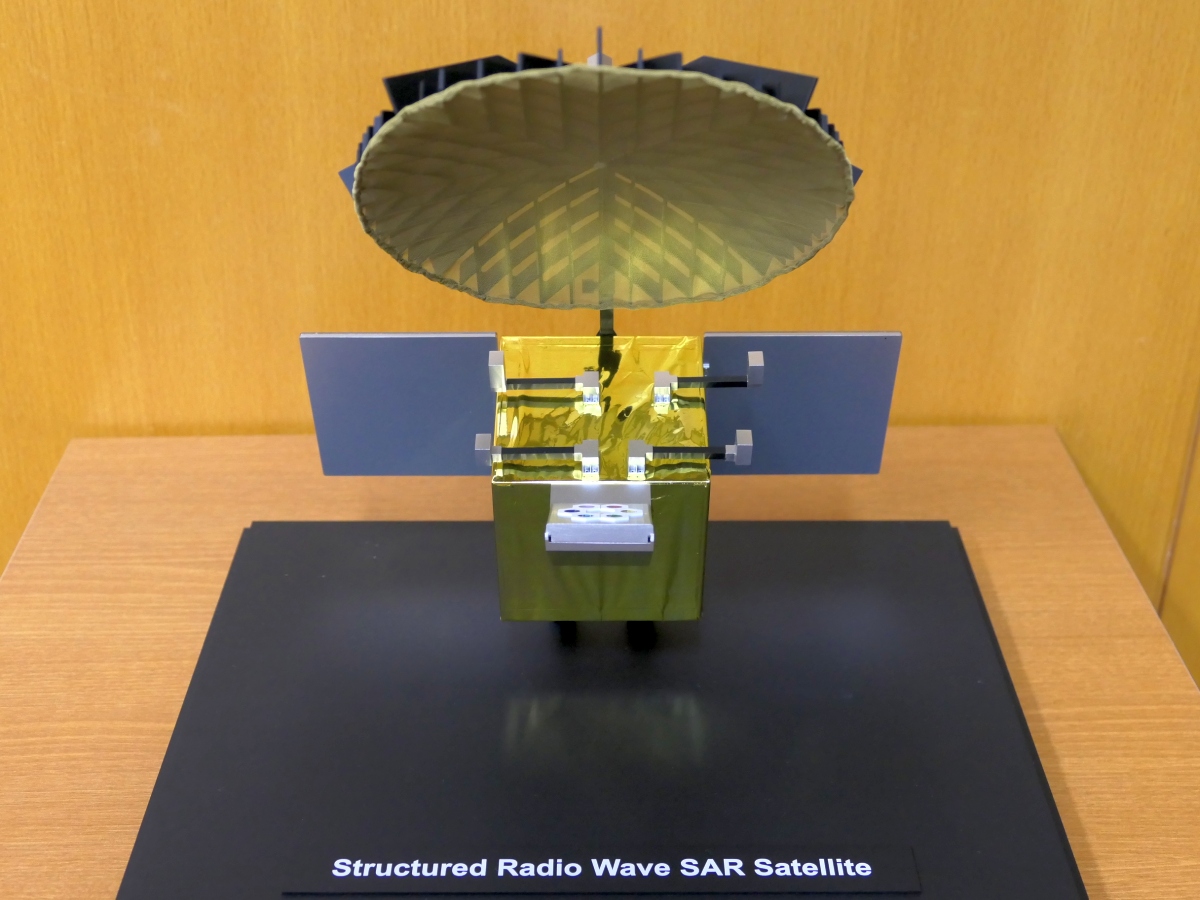
Hitachi’s approach uses vortex waves with orbital angular momentum—essentially spinning the electromagnetic field in a corkscrew pattern—and combines multiple such waves through a proprietary method. The result carries azimuth detection capability, which means the system can resolve height and vertical velocity. A parabolic antenna model shown at the press conference was scaled at one-seventh, indicating a full-size dish of roughly one meter in diameter.
This is not incremental improvement. It is a different kind of measurement. If Hitachi can ship this to orbit and prove it works at scale, the companies that built their business on 2D SAR data suddenly have a competitor offering something those satellites physically cannot produce.
The Gap Between Demo and Revenue
The timeline tells the real risk. Static verification in radio anechoic chambers and outdoor ground tests is complete. Dynamic demonstration using aircraft begins in 2028. Commercial satellite operations are not expected until around 2035. That is nine years from today to first revenue from the technology, and every year between now and then is a year where Hitachi is spending money without a space customer base, without launch contracts, and without operational flight heritage.
The aircraft demonstration is the critical inflection point. Ground-based static tests prove the physics works. In-air dynamic tests prove the system can handle vibration, thermal cycling, and the motion compensation required for coherent processing from a moving platform. Getting that right on an aircraft is hard. Getting it right on a satellite in orbit is another order of magnitude. If the 2028 airborne test produces clean 3D data, Hitachi gains credibility. If it does not, the project may quietly join the list of Japanese corporate space initiatives that announced ambitions and never flew.
There is also the antenna problem that Hitachi acknowledged but did not fully address. Vortex waves radiated from a circular array antenna tend to have low directivity—they spread out. From orbital altitude, you need high directivity to deliver sufficient signal strength to the ground. A one-meter dish is modest by SAR satellite standards, where apertures often exceed three meters. Hitachi will need to demonstrate that its structured wave technique can achieve the gain and resolution that a larger conventional antenna would provide, or find a way to make the one-meter system work at orbital altitudes with acceptable signal-to-noise ratios.
Who Wins If This Works
If Hitachi ships a working 3D Earth observation satellite by 2035, the immediate beneficiaries are Japanese disaster management and infrastructure monitoring agencies. Japan’s aging infrastructure crisis is acute—bridges, tunnels, and dams built during the postwar construction boom are entering replacement cycles, and early detection of structural degradation could save billions. Traditional 2D SAR can spot subsidence and surface displacement. A 3D-capable system could potentially detect internal structural shifts that precede visible surface deformation. That is a different class of early warning.
The secondary beneficiaries are Hitachi’s existing IoT and industrial customers. The company’s stated strategy is to win on IoT data, and structured electromagnetic wave data from orbit is the kind of proprietary input that locks customers into a vendor ecosystem. A construction firm monitoring a bridge project with 3D SAR data from Hitachi’s satellites is less likely to switch to a competitor than a firm buying commoditized imagery.
Airbus and SpaceX are the losers if Hitachi succeeds, at least in Japan. The European group dominates the SAR satellite market with its TerraSAR-X and Cosmo-SkyMed constellations, and its next-generation Sentinels feed the Copernicus program. SpaceX controls the distribution channel through Starlink’s ground station network and is moving upstream into data services. Hitachi does not need to beat them globally to be successful. It needs to beat them in Japan, where local procurement rules, language, and relationships favor a domestic supplier—and where the disaster and infrastructure markets are large enough to sustain a single-player operation.
The Real Test
The technology is legitimate. The physics of using orbital angular momentum for 3D SAR is documented in academic literature, and Hitachi’s progression from static tests to airborne demos follows a standard development path. The question is execution speed and capital discipline.
Japanese engineering firms have a pattern of building impressive prototypes and struggling to convert them into commercial products. Toshiba, Fuji Electric, and others have launched space initiatives that never reached revenue. Hitachi’s 25-year absence from the business means it has no institutional memory for the operational challenges of space: radiation hardening, orbital debris mitigation, ground segment integration, customer support cycles that run decade-long.
The $700 billion market projection is real, but it is an aggregate. Hitachi is not trying to serve it. It is trying to serve the slice of that market that values 3D data over the cheaper 2D alternative—and that slice is still undefined. No company has proven that customers will pay a premium for height-resolved SAR imagery at scale. If Hitachi can be the first to demonstrate that premium exists, it wins. If it cannot, it joins the graveyard of well-funded space prototypes that never found buyers.
The next twelve months will determine which path this takes. The airborne demonstration in 2028 is not just a technical milestone. It is the moment when Hitachi moves from theory to evidence, and the moment when investors and customers decide whether to take the project seriously.