Hormuz Ship Sinking Threatens Global Shipping Costs
A Singapore-registered container ship sank in the Strait of Hormuz amid escalating Iranian attacks, pushing oil transit down 40% from pre-war levels and raising fears of further insurance spikes and rerouting through Africa.
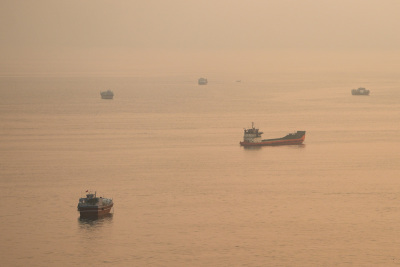
The Third Sinking in Weeks
The Singapore-registered container ship GFS Pride sank on October 14 after being struck by an unidentified projectile in the Strait of Hormuz. All 21 crew members evacuated safely. A second vessel, also Singapore-registered — the GFS Giselle — was hit the same day and made it to port with hull damage but no injuries.
This marks the third merchant ship sunk since the Iran conflict began, according to the International Maritime Organization. Over 20 vessels have been attacked this month alone across the Hormuz Strait, Persian Gulf, and Gulf of Oman. Two crew members are missing and more than ten are injured.
Iran’s Revolutionary Guard claimed the Pride hit a naval mine and exploded. Maritime security firm MarineTraffic found no independent evidence supporting that claim. More importantly, MarineTraffic noted the statement fits a pattern: repeated assertions of mine warfare designed to sow fear, inflate uncertainty, and discourage commercial shipping through one of the world’s most critical chokepoints.
The GFS Pride was carrying approximately 4,200 twenty-foot equivalent units at the time of sinking, including electronics components bound for European distribution hubs and automotive parts moving in the opposite direction. Its cargo, valued at an estimated $87 million, is now either recovered from debris fields or written off entirely. No environmental incident was reported — container ships carry significantly less fuel than tankers, and the Pride’s bunker reserves were small enough that even a complete spill would remain contained to a localized area.
What distinguishes this episode from previous months of harassment is the pace. Three sinkings in under four weeks compresses what might have been a gradual risk escalation into something resembling a crisis. Insurers do not price events they can model; they price events that break models. The Pride’s loss pushes the Hormuz corridor closer to that threshold.
What the Numbers Show
Oil transit through Hormuz has not recovered to pre-war levels despite a brief rebound in September. That month, U.S. Navy escorts for tankers pushed throughput back up, but renewed attacks have reversed that progress.
Data from Kpler shows crude passing through the strait averaged 8.5 million barrels per day in the week ending October 12 — roughly 40 percent below normal pre-war volumes. Including pipeline shipments via Oman and the Red Sea corridor, total Gulf output stood at 14 million barrels per day, still about 20 percent under baseline. In a single three-day stretch, daily Hormuz passage dropped from 6 million barrels on October 9 to 3 million on October 12.
International oil prices rose on October 14. Brent crude gained $2.18 per barrel in early trading, while WTI climbed $1.87. The moves were modest compared to the spikes seen during peak escalation periods, but they were sustained — the market absorbed the news rather than spiking on panic, which suggests priced-in risk rather than shock pricing. Still, every additional sinking adds to the risk premium embedded in those benchmarks.
Natural gas flows through the strait have been even more affected. Liquefied natural gas tankers originating from Qatar’s South Pars field — the world’s largest gas reserve — have reduced sailings by an estimated 30 percent since hostilities intensified. Buyers in India and Bangladesh, which depend on Qatari LNG for nearly half their supply, have begun negotiating spot contracts from alternative sources, including Australian and U.S. exports. Those contracts carry higher unit costs and longer lead times, creating a secondary inflation channel that operates independently of oil prices.
Who Loses When Insurance Rises
The immediate mechanical consequence of these attacks is not the loss of individual ships — 21 crew evacuated is the best-case outcome — but the recalibration of war-risk insurance premiums. When a Singapore-registered vessel sinks in a recognized shipping lane under attack, insurers reset their pricing models. Premiums for the Hormuz zone and adjacent waters have been climbing throughout the conflict. Each new incident pushes them higher.
The War Risks Insurance Committee in London, which sets standard rates for the region, has not issued a formal advisory since mid-September, but market sources indicate that underwriters are pricing the Hormuz corridor at levels approaching those seen during the height of the Red Sea crisis in early 2024. Some specialist firms have quietly withdrawn from the zone entirely, leaving their vessels to be absorbed by a smaller pool of remaining underwriters who can spread the risk. That concentration itself raises premiums, as the remaining capacity becomes scarcer.
Higher premiums do not stop ships from entering the strait. They redistribute costs. The companies that absorb them most painfully are not the vessel owners — many of whom can shift war-risk surcharges into charter rates — but the manufacturers and traders who rely on just-in-time delivery through Asian manufacturing hubs. South Korean and Japanese automakers, Chinese electronics exporters, and Indian petrochemical importers all route significant volume through Hormuz. A premium spike narrows margins across those sectors.
The second-order effect is subtler but potentially more damaging. When insurance costs rise sharply, carriers do not simply absorb the hit — they begin to decline coverage for certain cargoes, certain origins, or certain destinations. A container line might agree to sail through Hormuz for automotive parts but refuse to insure electronics shipments from specific Chinese ports, effectively redlining entire trade lanes. That fragmentation forces shippers to find alternative routes even when the direct threat is localized, creating cascading delays across interconnected supply chains.
The Africa Reroute Question
The alternative to Hormuz is the Cape of Good Hope around Africa. That route adds roughly 10 to 14 days to Asia-to-Europe container transit and significantly more for Middle East-bound tankers. It also consumes more fuel, which means higher bunker costs on top of insurance.
Rerouting already happened on a smaller scale during the Red Sea disruptions in 2023 and 2024 when Houthi attacks sent container lines away from the Suez Canal. The industry absorbed the extra time and cost but did not collapse. Hormuz is a different problem because it carries far more oil than container traffic. Rerouting tankers around Africa is physically possible but economically brutal — a single VLCC carrying 2 million barrels around the Cape instead of through Hormuz burns tens of thousands of additional dollars in fuel and ties up capital for weeks.
The financial mathematics are unforgiving. A VLCC on a Hormuz-to-Ningbo transit covers roughly 4,500 nautical miles. The same vessel rounding the Cape adds approximately 5,000 extra nautical miles. At a typical consumption rate of 250 tonnes of heavy fuel oil per day, that extension requires an additional 300 to 400 tonnes of bunker, costing between $180,000 and $240,000 per voyage on top of the fuel already consumed. Add the opportunity cost of tying up $150 million in cargo for an extra two weeks, and the economic penalty becomes substantial enough that some tanker operators have simply opted to idle vessels rather than attempt the southern route.
For container ships, the decision is simpler but still costly. Lines that have avoided the Red Sea may now face a choice between Hormuz at elevated insurance rates or the longer southern arc. Neither option is free. Maersk and MSC, which already rerouted significant capacity around Africa during the Red Sea crisis, now face the prospect of maintaining dual routing — some vessels through Hormuz at premium rates, others around the Cape at higher fuel and time costs — splitting capacity across two expensive corridors rather than consolidating through one efficient chokepoint.
The Bunker Market Connection
There is a secondary channel through which these attacks propagate costs that receives less attention than insurance or transit time: bunker pricing. When a significant portion of global tanker capacity redirects away from Hormuz or idles rather than reroute, the demand for heavy fuel oil in affected regions shifts unevenly. Ports that served as refueling nodes for Hormuz-bound tankers — Fujairah, Sohar, Jeddah — see reduced bunker sales, while Cape-bound traffic increases demand at South African ports like Walvis Bay and Cape Town, which lack the storage and bunkering infrastructure to handle the surge.
This geographic mismatch creates localized fuel price spikes that feed back into shipping costs. Bunker operators in the eastern Mediterranean and Gulf regions have reported order book declines of 20 to 30 percent since September, while terminals in southern Africa are struggling to meet the increased demand from rerouted vessels. The resulting imbalance pushes bunker differential spreads wider, meaning that even ships not directly affected by Hormuz disruptions feel the price signal through the global fuel market.
Why This Matters Beyond the Region
The Iranian strategy appears calibrated. Attacks are concentrated on commercial shipping rather than military targets. Crews are being evacuated — not captured or killed in large numbers — which limits diplomatic escalation while still making the strait feel unpredictable. The effect is not to block all traffic but to make every passage expensive and stressful.
That strategy works precisely because the global economy runs on predictable shipping lanes. When unpredictability rises, capital prices it in. Insurance premiums are one visible price. Slower transit times, cancellations, and diverted cargo are others. The aggregate cost shows up later — in factory input prices, in consumer goods, in trade balances.
Asian manufacturers are already operating under margin pressure from overcapacity and trade friction. A sustained Hormuz disruption adds another layer. The question is whether this episode accelerates a broader shift toward alternative supply routes or long-term rerouting, or whether it remains a seasonal risk that markets absorb until the next incident.
The GFS Pride sinking is not an isolated event. It is part of a pattern. And patterns, not individual incidents, determine how seriously insurers, shippers, and governments price the Strait of Hormuz going forward. The question no longer is whether the strait will remain dangerous — it is how long the global supply chain can absorb the cost of that danger before structural changes begin to replace routine transit with permanent rerouting.