Hormuz Recovery: The US Is Rewriting Gulf Energy Security
The Trump administration believes it has reasserted control of the Strait of Hormuz and aims to restore 70% of pre-war oil transit by mid-September. But the real story is what a US-escorted shipping corridor means for Asian importers and Iran's fading leverage.
The Strait Is Open — On Someone Else’s Terms
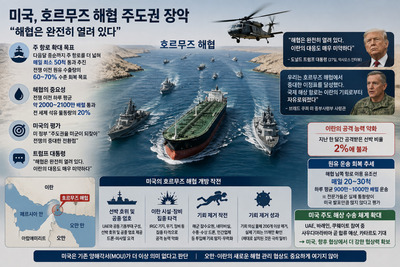
Donald Trump told Axios on September 27 that the Strait of Hormuz is “fully open” and that Iran’s response has been “very weak.” He added a detail that matters more than the quote itself: “They do not want us to respond strongly again.”
That phrasing — passive, almost weary — may be the clearest read on the new status quo in the Gulf. The US Central Command confirmed the same assessment the same evening. Brigade General Brad Cooper, commander of CENTCOM, posted a video stating that the international shipping lane has been freed from Iranian mines and that recovery momentum is underway. In diplomatic language, that is a declaration of victory without calling it one.
What the Numbers Actually Say
The math behind the claim is worth untangling. Before the war, Hormuz handled roughly 20 to 21 million barrels per day — about 20 percent of global oil throughput. The US target now is to restore 60 to 70 percent of that volume by mid-September, which translates to roughly 12 to 14.7 million barrels per day across the main channel.
The US says daily traffic through the southern corridor has climbed to 20 to 30 tankers, moving 9 to 10 million barrels per day. Oil market analysts and vessel-tracking firms, however, say the actual number of transiting ships falls short of Washington’s figure. The gap between the two readings matters. If the lower estimate holds, the 70 percent recovery target is ambitious to the point of being aspirational. If the higher estimate is right, Iran’s chokepoint strategy has effectively collapsed.
One data point is unambiguous: in the past month, only about 2 percent of vessels passing through Hormuz were attacked. That is a dramatic drop from the earlier escalation phase and suggests the US-escorted corridor is working as intended — or at least, that Iran no longer possesses the capacity to inflict meaningful disruption on a sustained basis.
How the US Got Here
The timeline is instructive. The US and Iran had negotiated a memorandum of understanding on June 17, brokered through Oman, that would have kept the strait open under a managed framework. By mid-July, Washington regarded that accord as effectively void. Rather than try to salvage it, the US moved to impose its own terms.
In cooperation with the UAE, the US formed a joint task force to escort commercial vessels through the southern route, providing air cover and intercepting Iranian drones and cruise missiles. Simultaneously, US forces concentrated strikes against IRGC installations, weapons stocks, and equipment near the strait. Naval demolition teams, Navy SEALs, underwater and surface drones, and private contracted firms conducted mine-clearance operations. US officials say they have removed over 200 objects suspected of being mines from the strait; only 11 proved to be actual mines, and most of those were improperly placed.
This was not a diplomacy-first approach. It was a brute-force re-establishment of freedom of navigation — or, from Tehran’s perspective, an occupation of the approaches to its coast.
Who Is Actually Protecting the Corridor
The US is not carrying this alone. The UAE, Bahrain, and Kuwait have already joined the US-led escort framework. Saudi Arabia is expected to enter shortly. Qatar, meanwhile, is watching from the sidelines and hoping to begin shipping LNG through the protected corridor — a sign that even Gulf states with strained ties to Washington are recalibrating around the new reality.
For East Asian importers — Japan, South Korea, Taiwan — this creates a complex dynamic. All three depend heavily on Gulf energy. Japan and South Korea together account for roughly a third of global LNG imports and a significant share of crude oil purchases from the Middle East. Their security calculus has always been shaped by the assumption that the US Navy would keep Hormuz open as a public good. The war complicated that assumption; the US response has clarified it in a narrower sense.
The US is no longer simply guaranteeing open passage. It is managing it. The protected corridor runs through the southern channel, and access depends on cooperation with the US and its Gulf partners. Iran’s northern approach — the side closer to its own coastline — remains contested and unescorted. That distinction will shape routing decisions for shippers.
Why Seoul and Tokyo Should Pay Attention
Korean media coverage of the Hormuz situation tends to focus on immediate supply disruption. The deeper story is structural. The US has effectively replaced the pre-war multilateral framework with a bilateral-security model centered on Washington and the Gulf Cooperation Council states. Iran has been pushed out of the management table. Oman, which had served as mediator, is now sidelined. The June MOU is dead. New negotiations between Oman and Iran over strait management are being dismissed by US officials as irrelevant.
For Asian importers, the consequence is a shift in leverage. Previously, the threat of Iranian disruption gave Tehran a degree of coercive power over energy markets — a form of asymmetric influence disproportionate to its military capacity. That lever has been largely removed. The US has demonstrated that it can neutralize Iran’s mine and drone arsenal and enforce passage through the strait without seeking Iranian consent.
This changes the pricing dynamic. If the 70 percent recovery target is met, the risk premium embedded in Middle Eastern crude should compress. But if the actual transit figures lag the US claims — as independent trackers suggest — prices may remain elevated well into Q4, creating headwinds for import-dependent economies.
What Happens Next
Three scenarios are plausible. In the first, the US-escorted corridor stabilizes and transit recovers to the 60 to 70 percent range by mid-September, as Washington intends. Oil prices ease, and the strategic environment locks into a new normal: US naval dominance in the strait, Iranian marginalization, and Gulf states aligned with Washington’s shipping framework.
In the second, the recovery stalls. Tracking data remains below official claims, shipping companies hesitate, and the 70 percent target slips. Iran, though weakened, retains the ability to intermittently threaten vessels outside the escorted corridor, keeping risk premiums alive. Asian importers face prolonged uncertainty and higher insurance costs.
In the third scenario — less likely but not negligible — Iran finds a way to escalate beyond mines and drones, perhaps through direct strikes on Gulf infrastructure or attacks on escort vessels. That would redraw the entire calculus and could pull the US back into a wider conflict.
The Trump administration’s reading is clear: it has won the immediate contest for control of Hormuz, and it does not expect Iran to force a rematch. The question for the rest of the world is whether that control is durable — or whether the US has simply traded a war of attrition for a war of logistics, and whether Asian economies are prepared for either outcome.
What is certain is that the old order — where the US Navy kept the strait open as a routine public good and Iran could flex its chokepoint leverage at will — is gone. The new order is being built around US escort fleets, GCC participation, and a marginalized Tehran. The 70 percent target is not just a number. It is a declaration of what the US believes it can now enforce.