Houthi Strike on Saudi Oil Is a Market Wake-Up Call
A Houthi attack on Saudi Arabia's Jizan oil facility marks a dangerous geographic expansion of the Yemen war. With Hormuz Strait traffic at its lowest since May, oil is approaching $100 — and the next escalations may come from Tehran.
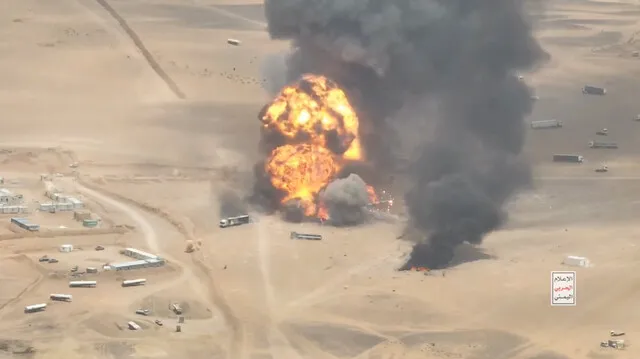
The strike moved inland.
For months, the war between the Saudi-led coalition and Houthi rebels played out mostly along the Red Sea coast — at sea lanes, ports, and air defenses. The pattern felt contained. Then on November 7, Houthi forces struck the Jizan oil facility in southwestern Saudi Arabia, part of the infrastructure network operated by state giant Aramco. Seventy-three civilians were wounded in coordinated attacks across Abha, Jizan, and Najran that same day, according to coalition spokesperson Colonel Turki Al-Malki.
Bloomberg cited sources saying the damage to the Jizan complex was not catastrophic. That matters for immediate supply. What does not matter less is the message: Houthi firepower has reached deep into Saudi territory, past the border regions where the conflict has largely been fought.
The geographical expansion of this war is the quieter story behind the oil price spike. Markets are reacting to numbers — Brent crude touched $98.45 on November 8, its highest level since late July. But the real shift is in the widening theater.
Hormuz is the louder danger.
While the Houthi strike grabbed headlines, a parallel escalation was unfolding 800 miles to the northeast. Iran’s Supreme National Security Council secretary, Mossa Rezai, told state television on November 6 that Iranian forces had test-fired new anti-ship missiles at a US warship stationed in the Gulf of Oman — outside the Hormuz Strait. He warned that Iran would soon declare a formal “control zone” stretching from the US-determined blockade line in the Gulf of Oman all the way into Persian Gulf waters near the Strait of Hormuz itself.
Ships entering that zone would face sanctions listing. Iran is effectively trying to replicate the Houthi playbook — asymmetric naval disruption — but against the single most critical oil chokepoint on the planet.
The US responded on November 5 by striking three Iranian tankers in the Persian Gulf. The White House insisted on November 7 that Hormuz remains open and under US control, that mined areas have been cleared, and that tanker traffic to non-Iranian ports is increasing. The data tells a different story.
Shipping tracker Kepler reported that only seven tankers passed through Hormuz on November 7 and eight on November 6 — the lowest daily average since May. That is not a trend that moves quickly. When tanker traffic through a strait handling roughly 20 percent of global oil supply begins to thin, markets price in the possibility before the supply shock actually arrives.
Japanese and Korean desks saw it first.
Western financial media focused on the $98 Brent quote. But Seoul and Tokyo were already connecting the dots between the Red Sea, the Gulf of Oman, and the shrinking traffic through Hormuz. Korean outlet Han Kyungil reported the Houthi strike and the Iranian missile test on the same day, treating them as linked signals rather than separate incidents. Japanese energy analysts at Phillips Nova flagged the tanker slowdown as an early warning sign of a broader supply disruption.
The reason is structural. Japan and South Korea import the vast majority of their oil through the Strait of Hormuz. A disruption there is not a market rumor — it is an existential logistics question. Their reporting treats Middle East energy security as a live operational problem, not a macro backstory. Western desks, watching from a safer geographic and economic distance, tend to react after the connection is made.
That gap in attention is itself a signal. If Japanese and Korean trade ministries are quietly stress-testing alternative routing — through the Indian Ocean corridor to the Red Sea, or even exploring pipeline offsets from the Middle East to the Arabian Sea — then the market’s current pricing of Brent near $100 may understate the risk.
Who wins, who loses.
Saudi Arabia loses credibility. The kingdom has spent years building out defensive layers against Houthi drone and missile strikes. The Jizan hit proves those layers are penetrable at key economic nodes. Riyadh’s response — promising “all operational measures” — sounds tough but buys nothing in forward markets. Investors price in the probability of another strike within days, not the coalition’s rhetoric.
Iran gains leverage without firing a full salvo. The missile test was labeled a demonstration. The control zone declaration has not yet been formalized. But the mere announcement compresses shipping schedules, raises insurance premiums, and slows throughput — all without crossing the threshold that would trigger a direct US military response. It is coercion by gradualism.
The Houthis gain strategic relevance. Their ability to strike inside Saudi Arabia and threaten Red Sea shipping elevates them from regional militia to actors reshaping global energy flows. Each successful strike reinforces their bargaining position in any future Yemen settlement — one that has been stalled for years.
Consumers in Asia lose the most. South Korea and Japan already run narrow energy margins. A sustained Brent price above $100, let alone the $120 per-barrel scenario Goldman Sachs flagged as possible if attacks intensify, would feed directly into industrial costs, electricity prices, and trade balances across the region.
What happens next.
The near-term risk is additive: another Houthi strike on Saudi infrastructure, an Iranian formalization of the Hormuz control zone, or a US strike that escalates beyond the November 5 tanker attack. Any of these could push Brent toward $120, as Goldman Sachs projected.
The medium-term risk is structural. The conflict has stopped being a regional war and become a multi-front disruption of the world’s two most critical oil transit routes — the Red Sea and the Strait of Hormuz — simultaneously. That did not happen six months ago. It is happening now.
Markets are pricing in the fear of disruption. The question is whether they will price in the reality fast enough.
Goldman Sachs’ $120 warning is not alarmist. It is the number at which alternative supply routes — pipelines, ship-to-ship transfers, longer sailing times around Africa — become economically viable for some shippers and impossible for others. That is the threshold where energy insecurity stops being a price problem and becomes a rationing problem.
We are not there yet. But the Jizan strike and the Hormuz standoff, reported side by side in Seoul and Tokyo, suggest the march toward that threshold has already begun.