The Houthis Just Exposed Trump's Oil Promise
Trump wagered his credibility on military victory delivering plummeting gas prices. The Houthi attacks on Saudi Arabia reveal why that bet may collapse before November.
The Bet That Won’t Age Well
Donald Trump stood before cameras Monday night and tied the fate of American gas prices to a military outcome he hadn’t yet achieved. Victory over Iran, he promised, would send oil prices falling “precipitously.” He painted a picture of $3-a-gallon gasoline, and eventually, below $2 — all happening “quickly.” The timing was notable: just hours later, the Houthis struck Saudi Arabia with renewed force, sending a signal that the war Trump has championed was not stabilizing the region but rather unraveling it further.
The contradiction between rhetoric and reality is stark. American drivers are paying north of $4 a gallon for regular gasoline, with diesel nearing $6, according to AAA. Trump’s own prediction, made from a position of unfulfilled promise, now looks less like a forecast and more like a political gamble — one that could determine whether Republicans keep Congress in November. The stakes extend beyond semantics. Energy policy under this administration has been reframed as a binary proposition: apply enough pressure on Iran, and the market rewards you. But the Houthi strikes suggest that the mechanism Trump is counting on — coercion leading to compliance — may not function the way he expects.
Who Controls the Flow
The Strait of Hormuz is the artery through which roughly one-fifth of global oil and gas supply moves. It is narrow, vulnerable, and already a flashpoint. When the United States and Israel launched military operations against Iran in February under the stated goals of preventing a nuclear weapons program and neutralizing Tehran’s regional threat, oil prices spiked. That spike wasn’t an accident. Markets price in risk, and the risk in the Gulf has only compounded since. The Persian Gulf’s energy infrastructure — ports, refineries, export terminals — sits within striking distance of a conflict that has yet to produce a clear exit strategy.
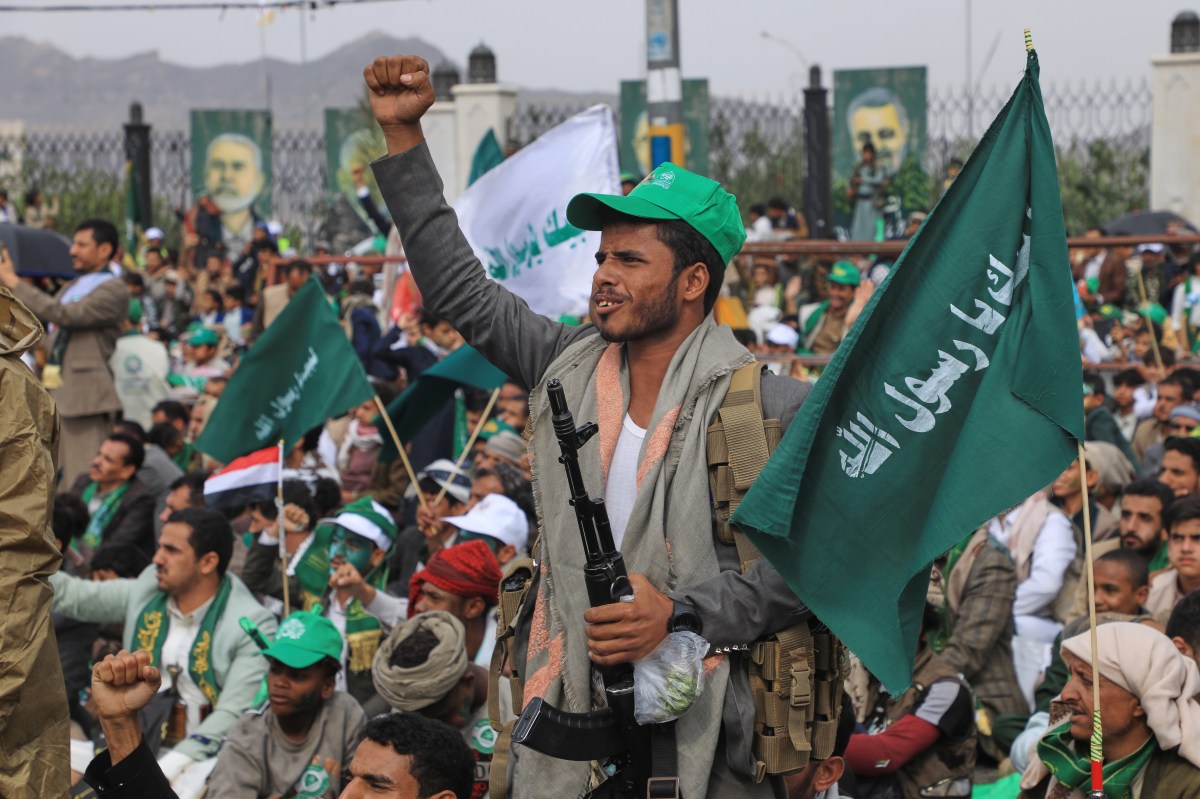
The Houthis, backed by Iranian weapons and doctrine, have made it clear they intend to disrupt that flow. Their attacks on Saudi Arabia aren’t merely symbolic — they target infrastructure that feeds directly into the energy supply chain. Every strike raises the insurance costs on shipping, narrows the safe corridors, and reminds buyers from Tokyo to Berlin that the Strait is never truly secure under current conditions. War risk insurance premiums for vessels transiting the Gulf have already climbed above pre-February levels, and insurers are becoming increasingly selective about which cargoes they will cover. That selectivity translates into capacity constraints, which translate into higher freight rates, which translate into higher consumer prices downstream.
Trump’s strategy depends on coercing Iran into submission so that Hormuz opens fully again. But coercion requires leverage, and leverage requires the adversary to believe it can’t continue its current course. The Houthis’ defiance suggests Iran hasn’t lost that belief — and may still be willing to absorb pressure rather than concede. Tehran appears to be playing a longer game: using asymmetric proxy warfare to raise the cost of American military engagement without triggering a full-scale conventional conflict that would unite domestic opinion around regime survival.
The Second-Order Effects Nobody Is Pricing In
The ripple effects of these disruptions are multiplying faster than most analysts anticipated. Beyond the Strait of Hormuz, the Red Sea remains a contested corridor. Commercial vessels that once transited through Suez and Hormuz are being rerouted — some to the Cape of Good Hope, adding 10 to 14 days to delivery times between Asia and Europe. That delay doesn’t just inflate shipping costs; it compresses inventory buffers for manufacturers and retailers worldwide. Companies that had optimized their supply chains for just-in-time delivery are now holding larger safety stocks or absorbing margin compression.
The U.S. Strategic Petroleum Reserve, already drawn down during previous regional crises, faces renewed pressure. If Hormuz were to close entirely — even temporarily — the SPR would become the primary buffer against supply shock, and it was designed for a different era of consumption and reserves. Domestic refiners are also feeling the squeeze. The Gulf Coast refining complex, which processes a significant share of crude imported through the Strait, is operating with thinner margins as feedstock costs rise. Those margins get passed through or absorbed; either way, the economic friction lands somewhere along the value chain.
Meanwhile, OPEC+ is navigating its own internal tensions. Saudi Arabia, caught between its role as a stabilizer and its position as a target, has signaled willingness to offset any supply disruption with additional production — but only up to a point. Pumping at maximum capacity risks devaluing the very commodity the kingdom is trying to protect the price of. The calculus changes if Iran’s own production comes online more aggressively as a bargaining chip, which would further fragment cartel discipline.
The Politics of Pump Prices
This is no abstract energy policy question. Cost of living dominates American households right now, and fuel costs sit at the tip of the wallet. Midterm elections in November will be decided by voters who feel that pressure at the pump every single week. Polls consistently show gas prices as a top-tier concern for swing voters — especially independents and suburban Americans who don’t follow Middle East policy closely but notice the dollar amount at the gas station. A gallon crossing $4.50 in key states could shift Senate races and flip House seats regardless of the broader geopolitical narrative.
Trump’s equation was simple: military win equals cheap gas equals political reward. But the Houthi attacks expose the flaw in that logic. Even if the U.S. achieves its stated objectives against Iran, the regional actors willing to disrupt energy flows may not be deterred — and could escalate rather than comply. That means oil prices could stay elevated even after a declared “victory,” leaving Trump without the economic proof his campaign narrative demands. The administration’s defense secretary, Pete Hegseth, has publicly defended the strategy, but military operations alone cannot guarantee market stability. No secretary of defense has ever promised that airstrikes on Iranian facilities would lower the price at the pump, because the linkage is tenuous at best.
Who Wins, Who Loses
The winners in this scenario are few. Defense contractors see continued funding. Allies like Saudi Arabia and Israel get military reinforcement, but also become targets. Consumers in Europe and Asia face higher fuel bills that feed into inflation. In America, drivers absorb the cost at the pump while politicians debate who’s responsible. Shipping insurers profit from risk premiums but lose credibility when they can’t guarantee passage. Automakers planning electric vehicle transitions face headwinds as internal combustion remains dominant in global fleets.
The losers are more numerous. Trump’s political capital takes a hit if gas prices don’t follow his predicted trajectory. Republican voters who voted on economic promises see living costs climb instead. Global supply chains remain fragile. And the Houthis — long dismissed by some Western analysts as a peripheral nuisance — prove they can punch well above their weight by keeping the energy markets jittery. Iran’s regional opponents find themselves spending more on defense than ever, diverting resources from economic diversification projects like Saudi Arabia’s Vision 2030. The strategic investment boom that was supposed to follow normalization accords is now stalled in uncertainty.
What Happens Next
The immediate outlook is ugly for anyone betting on quick price relief. Insurance premiums on commercial vessels transiting the Gulf are climbing. Several major shipping companies have already rerouted cargo around the Cape of Good Hope rather than risk the Strait. That adds weeks to delivery times and billions to costs — none of which disappears overnight. Spot tanker rates have already moved sharply higher, and charter agreements signed today reflect the new risk environment.
If Trump’s administration responds with further military escalation, expect more volatility. If it pivots to diplomacy, the Houthis may interpret hesitation as weakness and press their advantage. Either path carries risk. The only path that avoids both is unlikely: a credible security guarantee for Saudi Arabia and the Gulf states that simultaneously deters Houthi action without provoking Iranian escalation. No administration has managed that trifecta in decades. The architecture would require sustained diplomatic investment, forward-deployed defenses, and a credible deterrent — none of which can be assembled before November.
There is also the question of domestic reserves. The administration could release additional SPR barrels, but that would lower prices temporarily without addressing the underlying supply risk. It would also deplete a cushion needed for a worse crisis. The Federal Reserve, meanwhile, faces a dilemma: rising energy costs feed inflation just as rate cuts were expected to support growth. Any pivot toward tighter monetary policy in response to energy-driven inflation would compound the economic weakness that already weighs on voter sentiment.
For American voters, the takeaway is straightforward. Campaign promises about energy prices mean little when the underlying mechanics — chokepoints, proxy wars, OPEC decision-making, shipping logistics, and insurer behavior — operate on a timeline far longer than an election cycle. Trump tied his political fate to a variable he cannot fully control. The Houthis just reminded everyone what that feels like.
The weeks ahead will test whether the administration can separate its electoral messaging from the actual trajectory of energy markets — or whether the gap between the two becomes impossible to ignore at the ballot box.