Houthis Seize Yemen's Last Energy Stronghold — And Washington Won't Stop Them
With the Houthis closing in on Marib, Yemen's final government-held energy hub, the conflict has crossed from the Red Sea coast into the heart of the country's oil economy. Trump is refusing Bin Salman's requests for intervention — and the world's energy markets are watching.
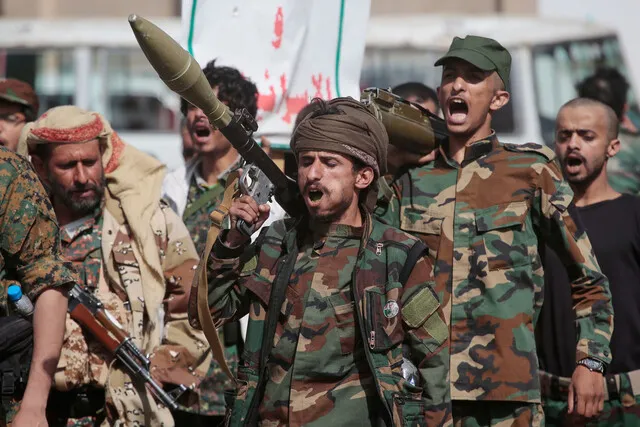
The Battle for Marib Changes Everything
For nearly a decade, the war in Yemen played out in predictable arcs. The Houthis took Sanaa in 2014. The Saudi-led coalition bombed them back. A stalemate settled over the desert like dust. Then October 2023 arrived, and the Houthis began firing missiles at shipping in the Red Sea — turning a civil war into a global chokepoint crisis.
Now, in September 2026, the conflict has moved inland with devastating speed. Al Jazeera reports that Houthi forces and Yemeni government troops are exchanging fire in Markaba, near the southern city of Taiz — the first major ground engagement since the Houthis seized the Bab el-Mandeb Strait coastal corridor on September 11. But the real prize is farther north: Marib.
Marib is Yemen’s last remaining energy stronghold under government control. It houses refineries, military depots, and the infrastructure that has kept the internationally recognized government solvent since it fled to Aden in 2014. If Marib falls, as multiple analysts warned, the government’s northern forces collapse entirely. The Houthis take Yemen’s remaining oil revenue. And the conflict transforms from a proxy war into a total territorial conquest.
Why 4% of Global Oil Is on the Line
Here is what English-language coverage of Yemen has largely missed: the Houthis are no longer just threatening shipping lanes. They are systematically eliminating Yemen’s remaining independent energy capacity — and the ripple effects reach far beyond the Arabian Peninsula.
Saudi Arabia’s Eastern Province pipelines, including the critical East-West pipeline that routes oil from the Persian Gulf to the Red Sea port of Yanbu, came under attack on September 12. That pipeline was never meant to be a permanent solution — it was an insurance policy after the Strait of Hormuz became unreliable. If it goes offline, Saudi Arabia loses its second major export route, and the world loses another 4 percent of daily oil supply that was already precariously allocated.
This is not theoretical. The Horn of Africa’s energy logistics are a house of cards. The Houthis control the southern shore of the Bab el-Mandeb, the narrowest point between Yemen and Djibouti. Shipping insurers have already flagged the strait as a high-risk zone. Commercial vessels are rerouting around Africa’s Cape of Good Hope, adding weeks to delivery times and billions to costs. Now the ground war is pushing toward the fields and refineries that feed those pipelines.
Trump’s Refusal Is the Real Story
The most consequential detail in this escalation is not military — it is political, and it is coming from Washington.
According to reports from September 11, Saudi Crown Prince Mohammed bin Salman called President Trump twice requesting direct US military intervention against the Houthis. Trump refused both times.
This is not the first time Washington has declined to re-engage in Yemen. The Biden administration ended US combat support for the Saudi-led coalition in 2023. The Trump administration, despite its generally hawkish posture on the Middle East, has shown no appetite for another nation-building project or a new chapter in American interventionism. But this refusal carries different weight now. Saudi Arabia is not asking for diplomatic backing or intelligence sharing — it is asking for the US military to stop a force that has just seized its ally’s coastal territory and is advancing on its energy infrastructure.
The calculation is clear: Trump sees no strategic value in defending Saudi energy assets from Houthi ground forces, even as those same assets underpin the global oil market. That message — deliberate, consistent, unapologetic — will reshape how regional allies calculate their own defense spending and security partnerships.
Who Wins, Who Loses
The Houthis win everything in this scenario. They hold the Bab el-Mandeb. They are closing in on Marib. They have drawn Saudi Arabia into a war of attrition it cannot win without American involvement — and America has just said it will not provide it. Iran, their patron, declared a “spectacular victory” after the Red Sea disruptions earlier this year. Marib would be a far more lasting trophy.
The Yemeni government loses its last foothold. Sultan Al-Arada, the governor of Marib province and a member of the Presidential Leadership Council, called recent setbacks “painful and regrettable” but insisted government forces are regrouping. Tareq Saleh, the vice president commanding the National Resistance Forces, vowed to continue fighting “until Yemen is liberated from Iranian proxy forces.” These are the words of a government that may soon have nowhere left to fight from.
Saudi Arabia loses its insurance policy. The East-West pipeline, the Yanbu terminal, the entire western flank of its energy export network — all of it now sits within range of a Houthi ground force that has proven it can move rapidly and seize territory. Riyadh’s security guarantees, long a cornerstone of its regional strategy, look increasingly theoretical.
The world’s energy markets lose predictability. Oil prices have already absorbed the Red Sea disruption. A full Houthi takeover of Marib would introduce a second shock — not just blocked shipping, but destroyed or captured production capacity in a country that was already producing under 200,000 barrels per day. The real damage is symbolic: it proves that a US-aligned government in Yemen can be erased by a Iran-backed militia, with Washington doing nothing to stop it.
What Happens Next
Three paths are plausible, and none are comforting.
First, the Yemeni government fractures entirely. Marib is not defensible with the forces currently in place. If it falls, Aden becomes the government’s only holdout — and even that is uncertain given the Houthi momentum along the coast. A collapsed Yemeni state would create a vacuum the Houthis could fill completely, turning the country into a permanent Iranian forward base.
Second, Saudi Arabia acts alone. Riyadh has conducted thousands of airstrikes in Yemen over the past decade. It could escalate massively — targeting Houthi command centers, troop concentrations, and infrastructure. But airstrikes alone do not hold territory. And without US logistical and intelligence support, Saudi air power has limits.
Third, the US changes its mind. This is the least likely scenario but the one that would send the strongest signal. A Trump reversal would depend on one thing: whether the energy market shock becomes unacceptable. Oil prices have been relatively stable through 2026, partly because OPEC+ has enough spare capacity to offset disruptions. But two simultaneous shocks — a blocked Red Sea and a collapsed Marib — could change that calculus fast.
The next 72 hours matter. Government forces are reinforcing Marib’s western approaches at Al-Mashaza and Al-Jur, according to Al Jazeera. The Houthis are pressing their advance. Every kilometer gained or lost here determines whether Yemen’s civil war ends in stalemate or annihilation — and whether the world’s leaders choose to watch or intervene.