How Climate Warnings About Nepal Hydropower Were Ignored — and What They Reveal About a Regional Pattern
An independent expert panel warned for years that a Korean-backed Nepali hydropower project needed climate reassessment after catastrophic floods. The recommendation went unfulfilled — a microcosm of how East Asian infrastructure finance continues to externalize Himalayan disaster risk.
The Recommendation That Never Landed
In 2024, an independent expert panel convened by the Asian Development Bank delivered a straightforward message about the Upper Trishuli-1 hydropower project in Nepal: the project needed a full climate resilience assessment. The panel had identified a growing gap between how the plant had been designed — based on historical rainfall and flood data — and what the climate was actually doing. Glacial lake outburst floods, intensified monsoon patterns, and compound geological events were making the old risk models obsolete.
By May 2025, the panel reported that the assessment still had not been carried out.
The Upper Trishuli-1 project sits roughly 80 kilometers northeast of Kathmandu, straddling the Trishuli River. It is a 216-megawatt facility backed by South Korea’s Donghae Power (남동발전) and built with construction from Doosan Enerbility. It is one of dozens of cross-border hydropower projects dotting Nepal’s river systems, but it has become a focal point because the documentation around it is unusually transparent — and unusually damning.
The ADB’s Independent Expert Panel (IPoE) does not typically release detailed critiques of individual projects. The fifth panel report, made publicly available through ADB’s documentation system, lays out a clear timeline: experts recommended a climate resilience assessment in September 2024; a major flood event hit the project area shortly after; the panel flagged continued failures to install reliable early warning systems for downstream communities; and by the time of the fifth site inspection in May 2025, the panel stated plainly that the assessment had still not been performed.
When Han Kyore asked Donghae Power about the gap between the panel’s recommendations and the project’s actions, the company responded that it was difficult to verify whether the recommendations had been properly implemented given local conditions. That response, understated as it is, opens a wider question: how common is this pattern across the region?
What Happened in the Trishuli Valley
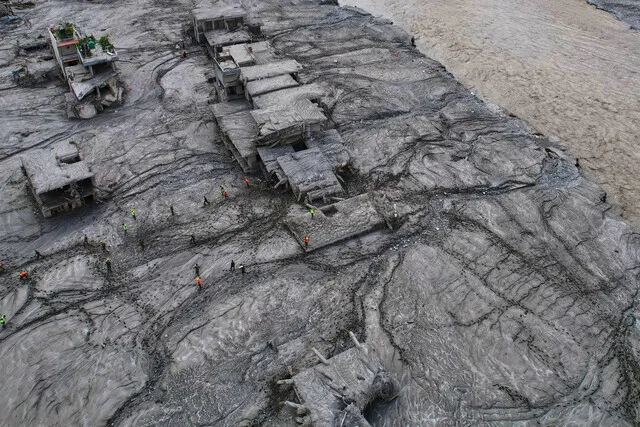
The flood that triggered the panel’s original recommendation in September 2024 was not a routine monsoon event. The IPoE described it as a compound climate-geological disaster — a scenario that should have been the very thing a climate resilience assessment is designed to evaluate. The rising waters of the Trishuli reached levels that threatened the stability of the construction worker camps near the site, putting laborers in direct danger. The panel characterized this as a failure of risk planning, not just bad luck.
What makes the Upper Trishuli-1 case notable is not that disasters occurred — disasters occur in the Himalayas with regularity — but that the institutional response to those disasters was documented, evaluated, and still not acted upon. The panel did not merely note the flood; it used the flood as evidence that the project’s existing risk framework was inadequate and called for a formal reassessment. Four months later, the reassessment had not happened.
The panel’s language is careful. It does not accuse Donghae Power or any specific entity of negligence. It does not call for the project to be halted. But the implication is clear: the project is operating on a risk model that the lenders’ own independent experts have declared insufficient, and the gap between that declaration and the project’s response has persisted for over a year.
A Pattern Across the Himalayas
Upper Trishuli-1 is not an isolated failure. It is a symptom of a structural problem in how East Asian state-backed developers approach Himalayan infrastructure.
India and China are locked in a decades-long competition for influence in Nepal, and hydropower is one of the primary instruments. Indian companies have financed and built numerous projects along Nepal’s southern rivers. Chinese state-owned enterprises, operating through the Belt and Road Initiative, have pursued similar projects from the Tibetan side. Korean developers, including Donghae Power and Doosan Enerbility, entered the market through ADB-financed projects and have since expanded their footprint. South Korea’s EXIM Bank and KEXIM provide significant financing for these ventures.
The competition drives speed. Projects are fast-tracked to establish physical presence and secure concessions before rivals move in. Environmental and social due diligence, particularly climate-risk assessment, is the first function to be compressed when timelines tighten. This is not unique to Korean developers — it is a regional pattern that affects Indian, Chinese, and other project participants as well. But the Korean case is notable because the project sits under ADB safeguards, which means there is an independent expert panel making its findings public. In projects financed through bilateral channels or smaller institutions, the same gaps may exist without any public record of them.
The Downstream Consequences
The implications of ignoring climate-risk reassessment extend far beyond the construction site. Nepal’s river basins feed into the Ganges plain, home to hundreds of millions of people. A dam that is not designed for current climate realities — one that relies on historical flood data that no longer applies — becomes a downstream liability. Sediment management, flood routing, and early warning systems are not localized concerns; they are regional ones.
The IPoE specifically flagged the delay in establishing reliable flood early warning systems as a “major risk” to nearby communities. This is not an abstract formulation. It refers to villages and towns along the Trishuli and, further downstream, the Kankai and Koshi river systems that depend on advance notice of dam releases and flood events to evacuate. When a project delays early warning infrastructure, it is effectively outsourcing risk to communities that have no seat at the table where the project is being evaluated.
The sediment question is equally consequential. Himalayan rivers carry enormous sediment loads, and climate change is altering erosion patterns in ways that are not yet well understood. A hydropower project that does not regularly reassess its sediment management plan risks both operational failure and downstream aggradation — the buildup of sediment that raises riverbeds and increases flood frequency for populations far from the dam itself.
The Accountability Gap
What distinguishes the Upper Trishuli-1 case is not the existence of the problem but the existence of the record. The ADB’s independent expert panel produces reports that are, by development finance standards, unusually candid. The panel’s fifth report does not mince words about the lack of action on climate resilience assessment. It is a rare example of multilateral project monitoring producing a document that can be used to hold implementers accountable.
The accountability gap lies in what happens after the report is written. The IPoE can recommend. It can flag. It can publish. But it cannot compel a borrower or a sponsor to act. The Upper Trishuli-1 project continues. The climate resilience assessment that was recommended over a year ago has not been performed. Donghae Power’s response — that verification is difficult given local conditions — suggests either a capacity constraint or a prioritization choice. The distinction matters, but the outcome is the same.
For the ADB and other multilateral lenders, the case raises a straightforward question: what leverage exists when independent experts identify a gap and the project sponsor does not close it? Safeguard compliance is supposed to be enforceable. In practice, the tools are limited — project suspension, financing holdbacks, reputational pressure. None of them are trivial, but none of them are automatic.
Why This Matters Beyond Nepal
Nepal holds an estimated 83,000 megawatts of economically viable hydropower potential. Only a fraction has been developed. The rush to build — driven by domestic energy needs, export revenue ambitions, and the geopolitical competition between India and China — will intensify. Korean developers are part of that rush, and the Upper Trishuli-1 case should be a reference point, not a footnote.
The lesson is not that hydropower projects in the Himalayas are inherently dangerous. They are essential to Nepal’s energy future and to regional decarbonization. The lesson is that speed without climate-risk reassessment converts infrastructure investment into long-term liability — for the project owner, for downstream communities, and for the lenders whose safeguard systems are supposed to prevent exactly this kind of gap from persisting.
The independent expert panel at Upper Trishuli-1 did its job. It identified a risk, recommended a response, and documented the failure to respond. The next question is whether the people and institutions responsible for acting on that recommendation will treat it with the seriousness it deserves — or whether the pattern of compressed due diligence will continue, with the costs outsourced to communities who never agreed to bear them.