Huawei's European-Style City Hides China's Chip Ambition
A Japanese journalist walked Huawei's red-brick campus in China and found something Western media rarely reports: a company quietly building alternatives to American semiconductors, industrial AI, and a smartphone empire under sanctions.
The Red-Brick Camouflage
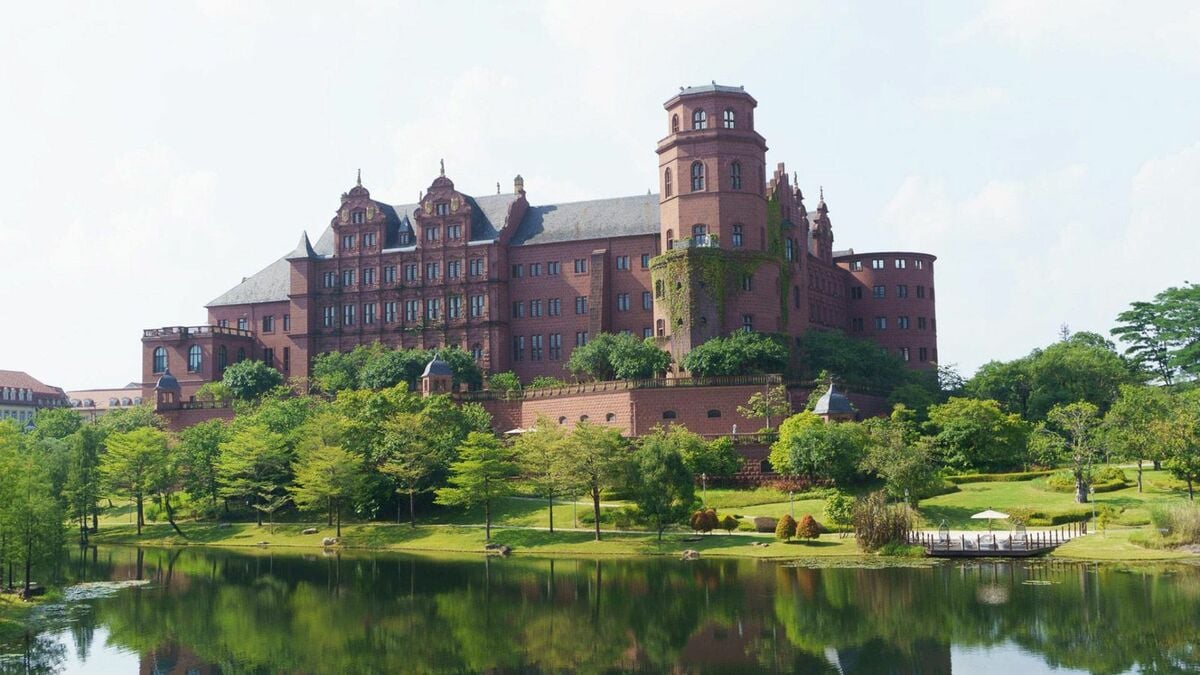
Walk through Huawei’s Songshan Lake campus near Dongguan and you’d swear you’d stumbled into a Bavarian fairy tale. Red-brick castle facades sit alongside glass-domed atriums. A manicured lake reflects the skyline of buildings that look as though they were airlifted from Oxford or Prague. The architecture is deliberate theater — Huawei designed the campus to look like a European research park, a subtle signal that despite Washington’s sanctions, the company is still casting itself as a global player.
What most English-language coverage omits is what happens inside those facades. When a Japanese journalist from East Economic Online toured the facility, she didn’t just see picturesque buildings — she saw the operational heart of a company that has spent years methodically decoupling itself from American technology. The campus isn’t merely a workplace. It’s a statement: that Huawei can host its R&D ambitions in a setting that rivals Bell Labs or Cambridge Science Park, that it has nothing to be ashamed of, and that the sanctions regime has not diminished its ability to attract talent or execute long-term projects.
Beyond Smartphones
The most striking detail from the East Economic Online visit is Huawei’s pivot away from being known solely as a smartphone maker. The company now sells industrial systems, not just hardware. At a port 40 kilometers away, operators control 40-meter-tall gantry cranes from an office via fiber-optic video feed. The rationale is blunt: young workers won’t take jobs staring downward from a crane cabin at that height. Huawei is selling the automation solution to fix a labor shortage, not just the connectivity.
This shift matters because it reframes Huawei’s threat. In Washington, the conversation stays fixed on 5G equipment and consumer phones. But Huawei is now embedded in mining, energy, transportation, and manufacturing — sectors where replacing American suppliers is less visible but more strategically significant. The company’s vertical integration strategy means it doesn’t just provide components; it provides entire operational workflows. A mine that adopts Huawei’s systems isn’t buying radios — it’s buying a managed automation platform that spans surveying, extraction, and logistics.
The second-order effect is that these industries, traditionally slow to adopt new technology, are now locked into Huawei’s ecosystem. Once a port or mine standardizes on Huawei’s automation stack, switching costs become prohibitive. This creates durable market position — exactly the kind of entrenchment that American firms currently benefit from and would lose if Huawei’s solutions prove reliable.
The Chip Play
The real story here is the Ascend AI chip and the Kunpeng server CPU. Huawei designs both in-house, positioning them as alternatives to American chips from Nvidia and Intel. A “Superpod” configuration linking 384 Ascend chips has already sold more than 1,000 units. A next-generation model connecting 8,192 chips has been announced, and a version using optical direct interconnects between chips is slated for release next year.
This is the kind of progress that doesn’t make headlines in Silicon Valley, but it represents a genuine shift. China has long relied on imported semiconductor technology. Huawei’s decision to build its own chip architecture and then scale it into industrial AI clusters signals that the company expects to operate independently of American supply chains for the foreseeable future.
The optical interconnect next generation is particularly notable. Current GPU clusters rely on copper-based links between chips, which creates bandwidth bottlenecks and limits scaling. Moving to optical connections between chips is a meaningful architectural upgrade — it’s the kind of improvement that separates viable competitors from symbolic ones. If Huawei can deliver optical interconnects at scale, it solves one of the fundamental limitations that has plagued Chinese AI chip development: the inability to build large, coherent clusters.
The Kunpeng CPU deserves equal attention. It’s not a direct Intel competitor in the consumer space, but in server environments where Chinese government and enterprise buyers need to demonstrate supply-chain independence, Kunpeng offers a credible alternative. The combination of Ascend for AI workloads and Kunpeng for general-purpose computing creates a complete hardware stack — something no other Chinese company can claim at this level of integration.
Power and Charging
Huawei’s digital power division is another quiet expansion. The company manufactures solar inverters and EV chargers, including ultra-fast units capable of adding one kilometer of range per second of charging. For a vehicle with a 400-to-600-kilometer range, that means a coffee break is sufficient. The business model is equally distinctive: Huawei places dedicated industry teams of 300 to 500 people at each sector — mining, electricity, manufacturing, transport — and has accumulated more than 59,000 partner companies worldwide.
This is not a company looking for quick consumer wins. It is building deep vertical relationships in industries where switching costs are high and relationships matter more than price. The digital power division alone represents a multi-billion-dollar opportunity as global electrification accelerates. Huawei isn’t just selling chargers — it’s selling energy management systems that integrate solar generation, storage, and consumption optimization. This is the infrastructure layer for the energy transition, and Huawei wants to own it.
The partner network of 59,000 companies is equally significant. These aren’t casual resellers; they’re implementation partners who deploy, maintain, and support Huawei’s industrial solutions. This creates a distribution moat that American competitors cannot easily replicate — not because of technology, but because of time and relationship capital.
The Sanctioned Leader
Despite being cut off from Google apps and services in 2019, Huawei captured 22.6 percent of China’s smartphone market in the April-to-June quarter of 2026, up 19 percent from the previous year, according to IDC. It does not rank among the global top five, but in China — the world’s largest smartphone market — it is number one. The company has replaced Google services with its own operating system, a move that forced Chinese consumers to adapt rather than abandon the brand.
That Huawei can lead the domestic market without Google is perhaps the most important data point in the entire article. It proves that American sanctions have not only failed to collapse the company but may have accelerated its self-reliance. The HarmonyOS replacement for Android wasn’t just a contingency plan — it was a demonstration that Huawei could redesign its entire software stack and still deliver a competitive consumer experience. This has implications far beyond smartphones. If HarmonyOS can replace Android in a consumer market, it sets a precedent for replacing other American software dependencies across enterprise and government.
The market share recovery also signals something about Chinese consumer behavior. Despite government rhetoric about technological independence, many Chinese consumers had preferred iPhone or Samsung devices. Huawei’s return to the top spot suggests that nationalism, availability of domestic alternatives, and improved product quality combined to shift preferences. This is a market that American companies lost not because of superior competition, but because they became unavailable.
What This Means
The European-style campus in Guangdong is a mirage. Behind the red brick and the lake is a company that has spent seven years under sanctions building out its own chip design, its own OS, its own AI infrastructure, and its own distribution networks across heavy industry. The San Francisco press typically frames this as a story about China circumventing rules. The more accurate frame is that Huawei is becoming a fully self-contained technology stack — the kind of competitor that doesn’t need American chips, American software, or American approval to exist.
The implications extend far beyond China. If Huawei’s Ascend chips and optical interconnects reach maturity, they become a credible alternative in markets that currently rely on Nvidia — particularly in countries that don’t want to depend on American technology for their digital infrastructure. We’re already seeing this dynamic in the Middle East and Southeast Asia, where Huawei’s industrial solutions are gaining traction precisely because they offer an alternative to both American and Chinese geopolitical entanglement.
If its industrial AI solutions prove reliable in ports and mines, they undercut the value proposition of American and European industrial-tech firms. The digital power division creates similar competitive pressure on companies like Siemens and Schneider Electric. Huawei is not just defending against sanctions — it is using the sanctions period to build capabilities that will compete globally once the restrictions ease or become irrelevant.
The San Francisco press typically frames this as a story about China circumventing rules. The more accurate frame is that Huawei is becoming a fully self-contained technology stack — the kind of competitor that doesn’t need American chips, American software, or American approval to exist. The sanctions were supposed to contain Huawei. Instead, they may have given it the incentive to build something that no longer needs the world it was designed to keep out.