Korea's AI Drug Discovery Just Left the Computer Screen
South Korean company GINnus is moving from AI-target prediction to biological validation — a rare step that could make its IntelliRVL platform credible to global pharma. What happens next matters far beyond Korea.
From prediction to proof
The most common failure mode in AI-driven drug discovery isn’t that the algorithms are wrong. It’s that no one ever checks whether the targets they find actually work in a test tube. Target prediction is the easy part. Showing that a predicted protein interaction produces a therapeutic effect in human cells is where most AI biology companies quietly fold.
That is precisely why GINnus’s move, announced on April 12, carries more weight than the typical Korean biotech press release suggests.
The company, trading under stock code 389030, is taking candidates discovered by its AI platform IntelliRVL and running them through antibody-based biological validation. In plain terms: the computer says here is a promising cancer drug target; now the lab will prove it behaves like one. The results will be compared against the platform’s predictions to measure accuracy and improve the system.
This is the gap between a promising paper and a credible drug discovery pipeline. Most AI-first biotech companies in the West — and there are many — have published impressive target lists. Fewer have shown wet-lab validation at scale. Even fewer have built the feedback loop that makes validation useful for the next round of predictions.
What IntelliRVL actually does
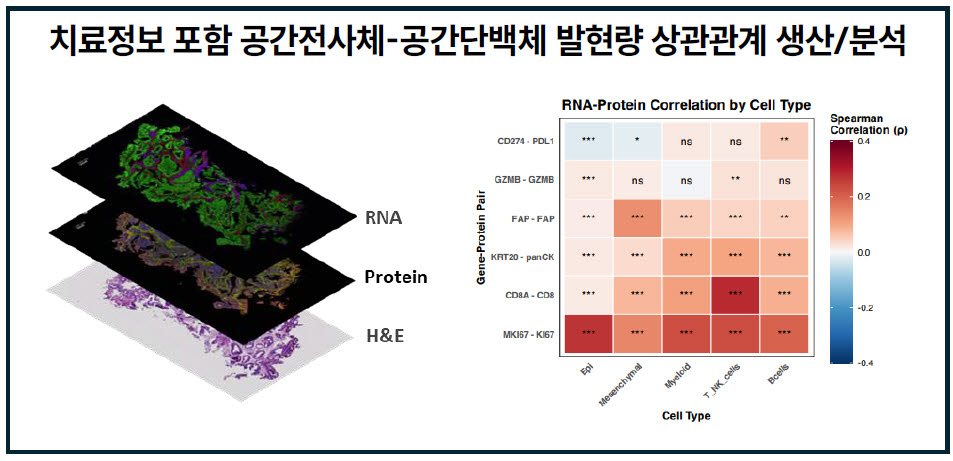
IntelliRVL is not a generic AI model grafted onto biological data. It is built around a specific kind of data integration: single-cell RNA sequencing and spatial omics are combined with patient clinical records and treatment response data. The goal is to find drug targets that are not just biologically plausible but also tied to real patient outcomes.
This matters because many AI target-discovery platforms operate in a data vacuum. They find proteins that look like good targets based on expression patterns or network topology. But a target that is overexpressed in a tumor doesn’t necessarily mean blocking it will help patients. The connection to treatment response is what separates academic curiosity from a licensable asset.
GINnus is now adding the second half of that equation. By using antibody discovery technology to generate binders against its predicted targets, the company will measure binding affinity, map mechanism of action at the cellular level, and generate data that can either confirm or contradict the AI’s predictions.
Why Western pharma should notice
Drug discovery partnerships between big pharma and AI-native biotech have followed a predictable pattern over the past five years. The AI company finds targets using proprietary algorithms. The pharma partner provides disease expertise and later-stage development capability. The deal usually involves upfront payments, milestone payments, and royalties.
The problem has been credibility. Pharma partners have repeatedly expressed frustration that many AI-discovered targets fail basic biological validation. This has slowed deal flow, compressed valuations, and created a trust deficit that benefits neither side.
GINnus is addressing that trust gap directly. By building internal validation capability — from target identification through antibody generation and mechanistic characterization — the company is signaling that it can deliver de-risked assets, not just predictions. For a global pharma partner evaluating a portfolio of AI-discovery companies, that signal is expensive and hard to fake.
The company’s own statement made this explicit. It said it plans to use the validation data to expand joint-development and technology-transfer negotiations with domestic and international pharma and biotech firms. That is not a research statement. It is a commercial strategy.
Who wins, who loses
If GINnus succeeds in building this end-to-end pipeline, the winner is the model itself: AI-native discovery paired with internal biological validation. Companies that rely solely on computational target identification without wet-lab proof will face increasing pressure to justify their pipelines.
The loser, at least in the near term, is the middle ground. Companies that can do some validation but not at scale — or that can validate targets but cannot connect them to patient-level clinical data — will find themselves squeezed between pure AI platforms and fully integrated CROs.
For Korean biotech broadly, this is a potentially meaningful moment. South Korea has invested heavily in AI infrastructure and data ecosystems. But the country has not yet produced a globally credible AI drug-discovery pipeline. GINnus is attempting to fill that gap. Success would encourage similar moves from other Korean players. Failure would reinforce the perception that Korean AI biology remains a domestic story.
What happens next
The immediate question is whether the validation data will be positive enough to attract pharma interest. The company has not disclosed which targets are being tested or what preliminary results look like. What is clear is the timeline: GINnus plans to iterate the platform using the experimental data, then actively pursue partnership negotiations.
A second question is whether this validation capability can scale. Generating antibodies against dozens of predicted targets is feasible for a small company. Doing it for hundreds — which is what a truly competitive AI drug-discovery platform would need — requires significant capital and operational discipline.
The third question, and the one that matters most globally, is whether this model transfers. If GINnus can show that its approach — combining single-cell and spatial omics with clinical outcome data, then validating with internal antibody generation — produces higher-confidence targets than existing AI platforms, other markets will pay attention. The data infrastructure exists in multiple countries. The question is execution.
Why this matters outside Korea
Cancer drug discovery is one of the few areas where global health outcomes depend on computational speed. Every year, thousands of promising targets enter the pipeline and fail at later stages due to poor early validation. The cost of that failure is measured not just in capital but in patients who do not receive effective treatments.
Korean companies have historically been suppliers in the drug discovery value chain — contract research, manufacturing, clinical trials. GINnus is attempting something different: to own the earliest and most valuable part of the chain, the target discovery itself, and to prove it with biological data rather than computational claims alone.
If the validation program delivers, the implication is not just commercial. It is structural. The next generation of cancer drug discovery may not originate in Cambridge, Boston, or Basel. It may originate in Seoul — or at least in platforms built there that global pharma will license because the data convinced them to.
That is not a guaranteed outcome. But the direction GINnus is moving in is the right one, and the race to prove it is only beginning.