Hyundai Steel Breaks Ground on US Plant That Could Reshape Auto and Rocket Steel Supply
A $5.8 billion steel plant in Louisiana is the latest move by Korean industrial giants to circumvent US tariffs while embedding themselves deep inside America's automotive and aerospace supply chains.
The Steel Plant That Isn’t Just About Cars
Hyundai Steel and POSCO broke ground in September 2026 on what sounds like a conventional industrial project — a steel mill in Donaldsonville, Louisiana — but the implications run far beyond automotive supply chains. The $5.8 billion Hyundai-Posco Louisiana Steel (HPLS) facility represents the most consequential second-order effect yet of the US-China trade war: Korean steelmakers are not just adapting to American tariffs, they are restructuring the North American industrial map around them.
The numbers are specific enough to matter. The plant sits on roughly 2.23 million pyeong of land in Ascension Parish, with an annual production capacity of 2.7 million tons of hot-rolled, cold-rolled, and coated steel sheets. Ownership is split 50 percent to Hyundai Steel, 20 percent to POSCO, and 15 percent each to Hyundai Motor and Kia. Mass production is targeted for 2029.
What makes HPLS different from previous foreign-owned steel investments in America is its process technology and its intended customer base. The facility uses direct-reduced iron fed into electric arc furnaces rather than the traditional blast furnace route. Hyundai Steel estimates this cuts carbon emissions by approximately 70 percent compared to conventional steelmaking. That figure matters because it positions the plant not as a legacy polluter, but as a compliance asset for customers facing their own Scope 3 emissions targets — including automakers under tightening environmental regulations and aerospace contractors navigating defense procurement standards.
The Tariff Bypass Is the Easy Part
The immediate economic rationale is straightforward. The US government has imposed a 50 percent tariff on imported steel and aluminum. Korean steel exports to the US fell 8 percent year-on-year in the prior calendar year, landing at 2.54 million tons. The tariff made American-bound Korean steel expensive enough to shift demand toward domestic or allied-nation sources.
Building in Louisiana removes that friction entirely. But the strategic logic goes further than tariff avoidance. The United States produces 82 million tons of crude steel annually, ranking third globally behind China and India, yet it still imports more than 20 million tons every year. Domestic supply has not kept pace with demand. America is also the world’s second-largest car producer, manufacturing 10.24 million vehicles last year, and federal policy is actively incentivizing further expansion of that output on American soil.
HPLS is located within a radius that touches six major assembly plants: Hyundai’s Alabama facility, Kia’s Georgia plant, Hyundai Motor Group’s Meta-Plant America, General Motors’ Texas operations, Volkswagen’s Tennessee plant, and Honda’s Alabama factory. That proximity translates into just-in-time delivery capability that cross-border shipping simply cannot match at scale. Local supply also insulates these automakers from the political risk of future tariff changes, a risk that has proven volatile since 2018.
The Aerospace Signal Is the Real Story
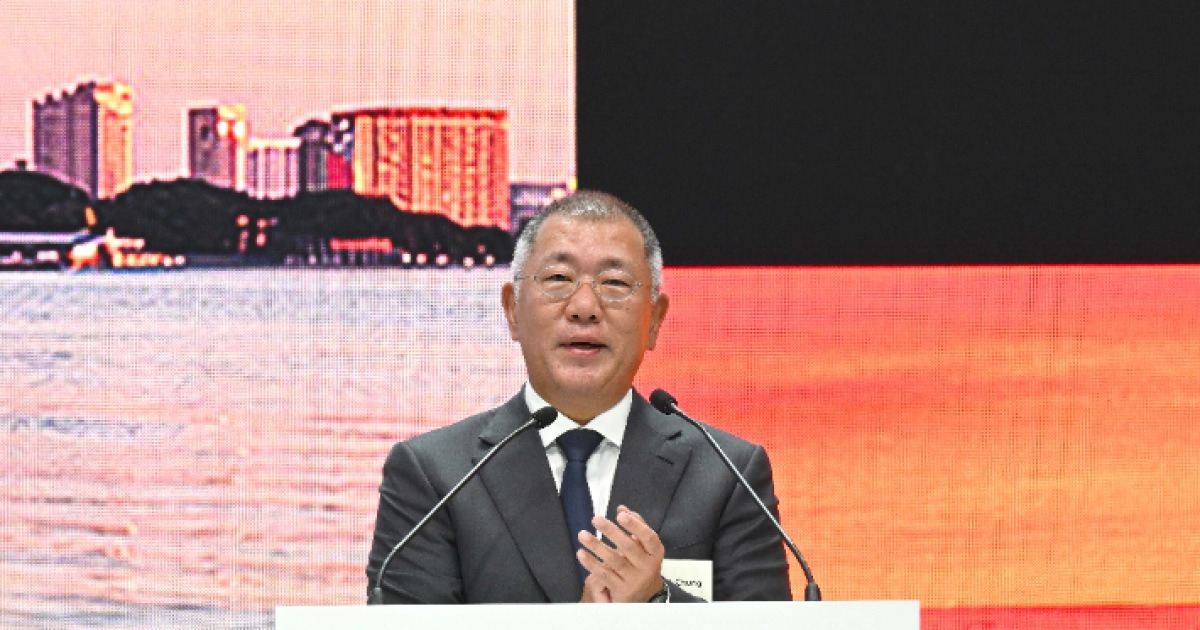
The most revealing moment came not from the executives on stage but from Jaeyong Lee, Hyundai Motor Group’s chairman, answering an impromptu question from reporters. When asked whether steel from HPLS could be used in Hyundai’s Atlas humanoid robot, he said it should be. Then he added: “I hope we can supply steel to SpaceX and other rockets in the future.”
That remark, casually delivered at a groundbreaking ceremony, carries more weight than most policy speeches. It signals that Hyundai Steel is explicitly positioning HPLS as a dual-use industrial asset — serving both the automotive sector and the aerospace and defense supply chain. The United States is the world’s leading space launch nation, and SpaceX alone has an expanding production pipeline that consumes enormous quantities of high-grade steel for rocket structures, engine components, and support infrastructure.
Chinese steel currently dominates global commodity markets, but high-specification steel used in aerospace applications requires certifications, traceability, and domestic sourcing preferences that US defense contractors increasingly demand. A Korean-owned plant on American soil producing certified low-carbon steel under US jurisdiction would satisfy those requirements in a way that imports from China or even Europe cannot. This is not speculation — it is the logical extension of the same industrial policy that drove CHIPS Act subsidies for semiconductors and now extends to critical materials.
Why This Matters for Global Steel Flows
The HPLS project is one component of Hyundai Motor Group’s broader $26 billion investment plan in the United States through 2028. That total includes battery plants, semiconductor packaging facilities, and manufacturing expansion. The Louisiana steel mill is the heaviest industrial anchor in that portfolio and the first dedicated steelmaking facility owned by a Korean company inside the US.
For POSCO, the partnership is equally strategic. POSCO’s president In-hwa Jang noted that combining Hyundai Steel’s electric arc furnace capabilities with POSCO’s hydrogen-based reduction technology and automotive steel expertise would create a globally competitive operation. That technology exchange is itself a signal: Korean steelmakers are integrating their strengths precisely where the market is moving, not where it has been.
The employment impact is estimated at roughly 5,400 jobs across construction and operations, concentrated in a region near Baton Rouge and New Orleans that has historically relied on petrochemical and maritime industries. For Louisiana, this is a diversification play that local politicians have embraced enthusiastically.
What Happens Next
HPLS begins construction in the fourth quarter of 2026, with full production expected by 2029. Between now and then, three variables will determine whether this investment delivers on its strategic promise.
First, US trade policy may shift before the plant reaches operation. A change in administration could alter tariff structures or expand them, either strengthening or weakening HPLS’s competitive position. Second, the global steel market remains oversupplied, particularly from Chinese producers who continue to export at depressed prices. If demand softens, the plant’s economics become tighter regardless of its location advantage. Third, and most interestingly, whether HPLS actually enters the aerospace supply chain will depend on certification timelines and customer relationships that are not yet public.
What is already clear is that Korean industrial groups are no longer peripheral players in American heavy industry. They are building the kind of foundational infrastructure — steel, batteries, semiconductors — that defines economic sovereignty. The Trump administration’s tariff regime created the conditions for this shift, but the structural driver is deeper: the reconfiguration of global supply chains away from Chinese dominance and toward allied-nation production. Hyundai Steel’s Louisiana plant is one of the earliest physical manifestations of that transformation, and its significance will only grow as the facility moves from groundbreaking to operation.