What the Myanmar Genocide Ruling Unlocks for Rwanda, Gaza, and Global
The ICJ's historic first-ever genocide conviction against a state — Myanmar — rewrites the rules of international accountability and will echo through cases involving Rwanda, Gaza, and beyond.
A Line Crossed
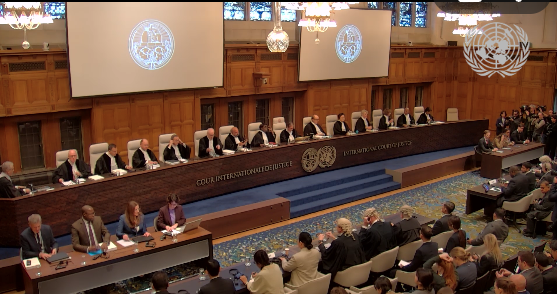
On November 19, 2026, the International Court of Justice drew a line that did not exist before it. In a 191-page judgment, the Court found — for the first time in its history — that a state had committed genocide. That state is the Republic of the Union of Myanmar. The victims were the Rohingya. The finding is not symbolic. It changes what international law allows courts around the world to say, and under what standard.
The case was brought by The Gambia, a small West African nation with no territorial stake and no direct relationship to Myanmar other than membership in the Organisation of Islamic Cooperation. The structure of the Convention on the Prevention and Punishment of the Crime of Genocide lets any state party invoke the ICJ over another state’s compliance, regardless of connection to the harm. That architectural choice, once theoretical, now has a face: Nay Phone Mar, a Rohingya man who testified via video link about his brother being shot; U Khin Maung, whose mother was raped in a burning hut; the 1,834 documented acts of rape identified by the UN Fact-Finding Mission, each one a shard of evidence the judges said “fully convinced” them.
Nine judges voted in favor. Six dissented. All fifteen wrote separately. The dissenters argued primarily about the standard of proof and whether the intent element — dolus specialis — could survive the “only reasonable inference” test. But the majority stood firm. The evidence, they concluded, excluded every alternative explanation: counter-insurgency, forced displacement, collective punishment. What remained was genocidal intent.
What the Court Actually Found
The judgment rests on three categories of act listed in Article 2 of the Genocide Convention: killing, causing serious bodily or mental harm, and imposing measures intended to prevent births within the group.
On killing, the Court cited testimony and documentation placing the death toll at a minimum of 10,000 Rohingya. Killings included men and boys executed in groups, people burned alive inside their homes, children targeted indiscriminately. Security forces opened fire on crowds fleeing toward Bangladesh.
On harm, the record documented thousands of survivors with gunshot wounds, knife injuries, and burn scars. The Court also catalogued sexual violence as a weapon: mass rape, gang rape, beatings, mutilation. The psychological dimension carried equal weight. The Court recognized that witnessing these acts inflicted severe mental harm on family members and entire communities.
The most novel category was preventing births. The Court found that restrictions on marriage and childbirth imposed on the 500,000 Rohingya in Maungdaw Township, combined with the denial of birth registration for Rohingya children and the commission of 1,834 rapes during the 2017 operations, demonstrated intent to destroy the group’s reproductive capacity. Government officials had publicly warned about “uncontrolled Rohingya population growth.” The Court treated those statements as contextual confirmation of purpose.
All told, 815,000 Rohingya in Northern Rakhine State constituted a substantial part of the group. The Court made clear that genocide does not require intent to kill every member. It requires intent to destroy the group in substantial part — measured not only by deaths but by the total impact on the group’s ability to function as a distinct community.
The Legal Earthquake
This is where the consequences begin to multiply.
The most immediate effect is precedential. For decades, states accused of atrocities have faced investigations, sanctions, and diplomatic pressure — but never an ICJ judgment declaring that genocide occurred. The word has been floating above the jurisprudence like a charged cloud. Today, it landed.
That landing reverberates through every national court operating under universal jurisdiction. Belgium, Germany, France, Spain, and Argentina already host cases stretching across continents. Before today, a defendant could argue — credibly — that while horrific crimes had been committed, a formal finding of genocide required layers of political negotiation and evidentiary caution that domestic courts should not replicate. That shield is gone. National prosecutors can now cite an authoritative, fully reasoned ICJ judgment establishing genocide and ask their own judges to apply that same legal standard to parallel conduct.
The mechanism works both ways. If Myanmar can be found guilty, so can any other state that meets the threshold. The logic of the ruling creates an obligation for other states parties to the Genocide Convention to ensure that neither genocide nor complicity in genocide occurs within their jurisdictions — a duty the Court has previously interpreted broadly in the Bosnia case (2007) and now applies with renewed force.
The Cascading Cases
Two situations stand out immediately.
In Rwanda, the 1994 genocide has been adjudicated at the International Criminal Tribunal for Rwanda and through domestic trials, but the Rwandan government itself has never faced a state-level genocide determination — because the legal architecture at the time did not permit it. An ICC prosecutor is currently investigating claims that Tutsi-led forces committed atrocities in 1994 and again in eastern DRC after 1996. The ICJ’s Myanmar ruling strengthens the analytical framework for evaluating genocidal intent in conflicts where the perpetrators claim self-defense or counter-insurgency as justification. Defense arguments built on those justifications will now meet a judicially tested standard that explicitly rejects them when the scale and method point elsewhere.
In Gaza, the stakes are both moral and legal. Israel faces accusations of genocidal intent in its military campaign following the October 7 attacks. Pro-Palestinian states have already floated ICJ proceedings, modeled directly on The Gambia’s approach against Myanmar. Until today, skeptics could point to Myanmar as the first example and note that such cases remain untested outside one factual matrix. That argument no longer holds. The standards the ICJ applied — the assessment of context, the evaluation of official rhetoric, the rejection of alternate inferences — provide a template. Whether Gaza fits that template is for future proceedings to decide. But the blueprint exists now.
Who Wins, Who Loses, What Comes Next
The winners include survivors. Not financial compensation yet — the Court deferred specific remedies to later proceedings — but recognition. A formally inscribed historical record. A judgment that says what Rohingya communities have said since 2017: this was genocide.
The losers include states that have long operated with impunity behind procedural defenses. Myanmar’s military faces new obligations under international law. Its leaders may become targetable by universal jurisdiction courts across Europe and Latin America. Asset freezes, travel bans, and arrest warrants that were legally risky before are no longer speculative gambles.
The broader cost is uncertainty. The judgment opens the door to a wave of litigation. States will test its boundaries. New cases will arrive from Ukraine, from Ethiopia, from Sudan. Courts will struggle to manage the volume. Diplomatic channels will face pressure to respond or risk appearing indifferent to genocide findings.
There is also a practical question about enforcement. The ICJ has no police force. Myanmar has already signaled it will not comply. The UN Security Council, where China and Russia hold veto power, may refuse to act. But legal recognition carries its own gravity. It shifts the terrain on which diplomacy operates. It empowers domestic prosecutors. It changes what investors, airlines, and corporations must consider before engaging with a state branded as a genocide-perpetrator by the world’s highest court.
The Precedent Is Now Real
The Myanmar judgment is the ICJ’s heaviest contribution to international criminal law since the Bosnia decision nearly two decades ago. It takes an abstract legal concept — genocidal intent — and grounds it in witness testimony, satellite imagery, and documentary evidence. It tells future courts exactly how to reason through competing inferences. And it establishes, irrevocably, that states can be held legally responsible for genocide just as individuals have been for decades.
The road ahead includes reparations proceedings, possible security council referrals, and a flood of derivative cases in national courts. Some will succeed. Some will fail. But none will start from scratch. The foundation is laid.
For the Rohingya, the judgment does not bring back the dead or return the displaced. It does not guarantee justice in any immediate sense. But it marks a turning point in what international law can do when politically inconvenient truths finally demand formal acknowledgment. The question now is not whether genocide can be judged. It is which next state will stand in the dock.