India's Crackdown on 'Cockroach' Protests Exposes Democracy's Fraying
New Delhi's security sweep against the youth-led Cockroach movement is about more than voter lists—it reveals how aggressively Modi's government is narrowing space for dissent ahead of crucial state elections.
The Cockroach Movement Won’t Be Silenced—But the Government Isn’t Trying
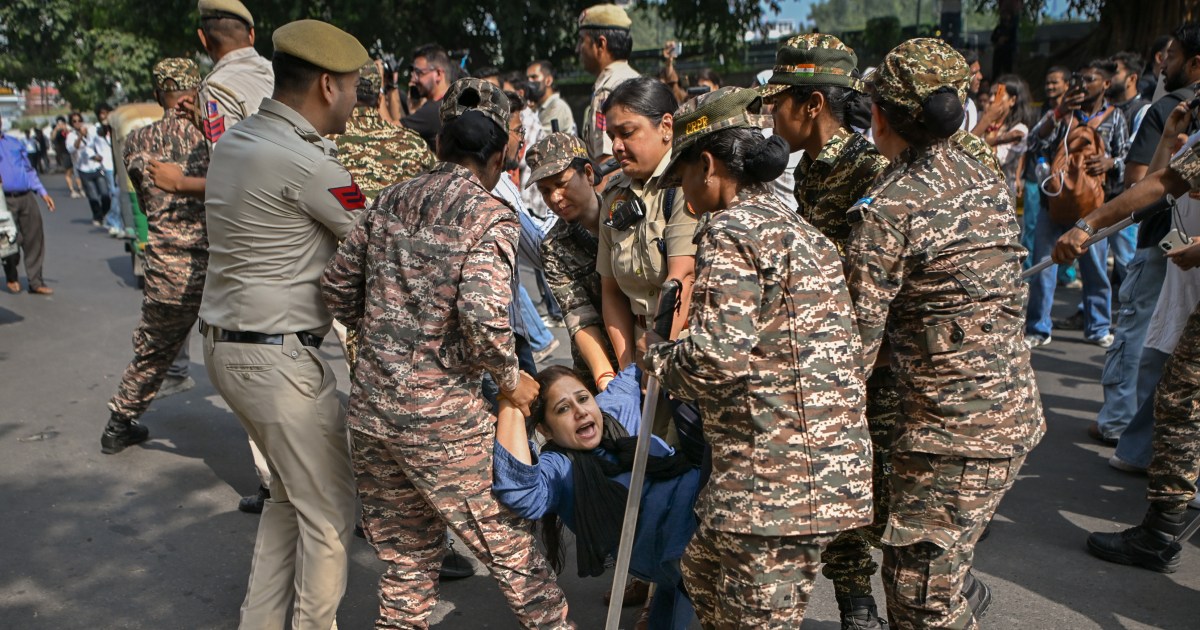
India’s authorities didn’t just break up the latest protest by the Cockroach movement on Saturday. They made sure it could never start.
Police intercepted movement leaders at the airport as they landed from Mumbai. Barricades went up around Jantar Mantar, the capital’s traditional protest ground. Checkpoints on every approach road turned buses and cars into search targets. Anti-riot vehicles with tear gas launchers were positioned along key routes. Mobile internet was restricted. Loudspeakers announced that gatherings of five or more people were banned in parts of the city.
This was not a disruption. It was a pre-emptive neutralization.
The government’s response to Sambit Patra, a spokesperson for Modi’s Bharatiya Janata Party, captured the mood inside the administration: “Their flop show has been completely demolished.” The word “anarchic” was applied to demonstrators before a single placard was raised.
The crackdown came days after police briefly detained Congress leader Rahul Gandhi, part of a broader pattern of squeezing opposition voices ahead of state elections next year. Uttar Pradesh—India’s most populous state, governed by the BJP—and Gujarat, Modi’s home state, are both up for polls. The message from New Delhi is clear: the government will not tolerate a repeat of the July scandal that forced the resignation of the education minister over exam paper leaks.
Why the Voter List Dispute Matters More Than It Sounds
At the center of the protests is the Election Commission’s Special Intensive Revision, which has removed more than 130 million names from voter rolls so far. The government says the exercise is routine—eliminating duplicates and ineligible entries. Opposition leaders say it is something else entirely.
They argue that the removals have disproportionately affected communities that vote against the BJP, while supporters of Modi’s party have been left on the lists or added. The commission denies the allegation. Independent verification is difficult in a system where the same body administering the revision is also the institution answering the complaints.
What makes this dispute politically explosive is timing. India’s national elections are not due until 2029. But state elections in Uttar Pradesh and Gujarat in 2026 will determine whether the BJP retains its grip on the two states that together account for roughly a third of the country’s parliamentary seats. If the opposition can turn the voter list controversy into a mobilizing issue—something the Cockroach movement has shown it can do—then 130 million disputed names is not an administrative statistic. It is a political weapon.
The Cockroach Movement: From Exam Leaks to Democratic Crisis
The Cockroach movement emerged online in May 2026, named for the protesters’ claim that they are impossible to eradicate. Their initial grievance was specific and visceral: leaked exam papers that undermined the credibility of entrance tests for millions of students. The protests were sustained, coordinated, and relentless. Within weeks, they forced the resignation of the education minister—a rare setback for a prime minister who has dominated Indian politics for more than twelve years.
What happened next was instructive. Rather than dissolving, the movement pivoted. The voter list dispute offered a new, broader grievance. The same organizational energy that mobilized students for exam reform was redirected toward challenging what the movement frames as electoral manipulation. Leadership figures like Abhijeet Dipke, Saurav Das, and Ashutosh Ranka became the faces of a campaign that now stretches beyond youth issues into the architecture of democracy itself.
Saturday’s detention of these leaders at the airport suggests the government understands the risk. A movement that can convert exam integrity into an electoral challenge is far more dangerous than one focused on a single policy failure.
Who Wins, Who Loses
The government wins the immediate battle. The protest was contained. Leaders were arrested before they could reach the capital. Media access was restricted. The narrative of a “flop show” is already being broadcast through official channels.
But the costs are real and cumulative. Each escalation raises the question that Tanya Negi, a college student who traveled from Mumbai, put plainly: “Why is Modi afraid of India’s young people?” The answer, if it is not fear, must be something worse—awareness that the movement is gaining traction.
For the opposition, Saturday’s crackdown offers a potent symbol even as it demonstrates the government’s capacity to suppress. John Brittas, an opposition lawmaker, was detained after telling reporters the city was under siege. Arresting sitting members of parliament sends a signal that even institutional opposition is not immune.
For India’s young voters—the demographic most affected by both the exam scandals and the voter list revisions—the crackdown is likely to backfire. Detaining leaders at airports and banning gatherings of five or more people in the heart of the capital does not look like the response of a confident democracy. It looks like the response of a government that knows it is losing narrative control.
The Global Implications Are Hard to Ignore
India’s strategic partnership with the United States and other Western democracies has long rested on a shared premise: that India’s democratic institutions can contain authoritarian tendencies and that its electoral process remains broadly credible. That premise is increasingly difficult to defend.
The crackdown on the Cockroach movement is not an isolated incident. It is part of a pattern that includes the detention of opposition leaders, restrictions on journalists, and the use of anti-riot vehicles and internet bans to manage peaceful assemblies. Each episode erodes the credibility of the argument that India’s democracy is fundamentally resilient and that concerns about democratic backsliding are exaggerated.
The United States and its allies have incentives to look away. India is the counterweight to China in Asia, and the strategic logic of partnering with New Delhi is powerful. But that logic does not require accepting the erosion of democratic norms. It requires being honest about what is happening.
If India’s election commission can remove 130 million voters without independent scrutiny, if the government can detain protest leaders at airports and then deny permissions retrospectively because applications were submitted “late,” if opposition lawmakers can be arrested for speaking to foreign press—the space for credible democratic contestation narrows. The question is not whether this matters only within India. It is whether the world’s largest democracy can still serve as an example worth supporting.
What Happens Next
The Cockroach movement has shown it can adapt. The exam leak protests began as a student grievance and became a national crisis. The voter list dispute is already expanding into a broader challenge to electoral legitimacy. Detaining leaders in one city does not eliminate the network that organized them online.
The BJP’s position in Uttar Pradesh and Gujarat next year will depend partly on whether it can convince voters that the voter list revisions are legitimate and partly on whether it can prevent the opposition from turning those revisions into a mass mobilization. The government’s approach so far—crackdown rather than engagement—suggests it fears the latter more than it admits.
For the opposition, the challenge is to convert detention and dispersal into legitimacy. Being arrested outside Jantar Mantar does not win votes. But being arrested while organizing a peaceful protest about electoral fairness might. The movement’s survival depends on whether it can sustain momentum across multiple states and issues, not just in Delhi.
For India’s young people, the test is whether frustration translates into organization. The Cockroach movement proved that a grievance rooted in education can become a force that reshapes national politics. The voter list dispute offers a new front. Whether it becomes a second wave depends on whether the movement can survive the crackdown and reach beyond its core base.
The government’s message on Saturday was that dissent would not be tolerated. The movement’s response so far has been to keep appearing. In a democracy, that tension is not a sign of breakdown. It is the engine of politics. When the engine is suppressed rather than engaged, the question is not whether the movement will return. It is what form it takes next time.