Iran Strikes Bahrain and Blocks the Hormuz: A Global Energy Crisis
Iran's coordinated assault on US bases in Bahrain and tanker attacks near the Strait of Hormuz mark a dangerous escalation. Here's what the strikes mean for global energy markets, shipping routes, and US strategy in the Middle East.
A Strike That Crossed a Line
Iran didn’t just send drones and missiles across the water this weekend. It aimed them directly at the headquarters of America’s entire Middle East command.
The Iranian military struck four US bases in Bahrain — including facilities at Sheikh Isa and Juffair — in two waves of attack Saturday night, according to Iranian state media. Bahrain’s government confirmed the strikes, describing them as a “heinous Iranian aggression,” while US Central Command remained circumspect, neither confirming nor denying specific damage claims from Iran’s Revolutionary Guards Corps, which said it hit Patriot defense batteries and a radar system.
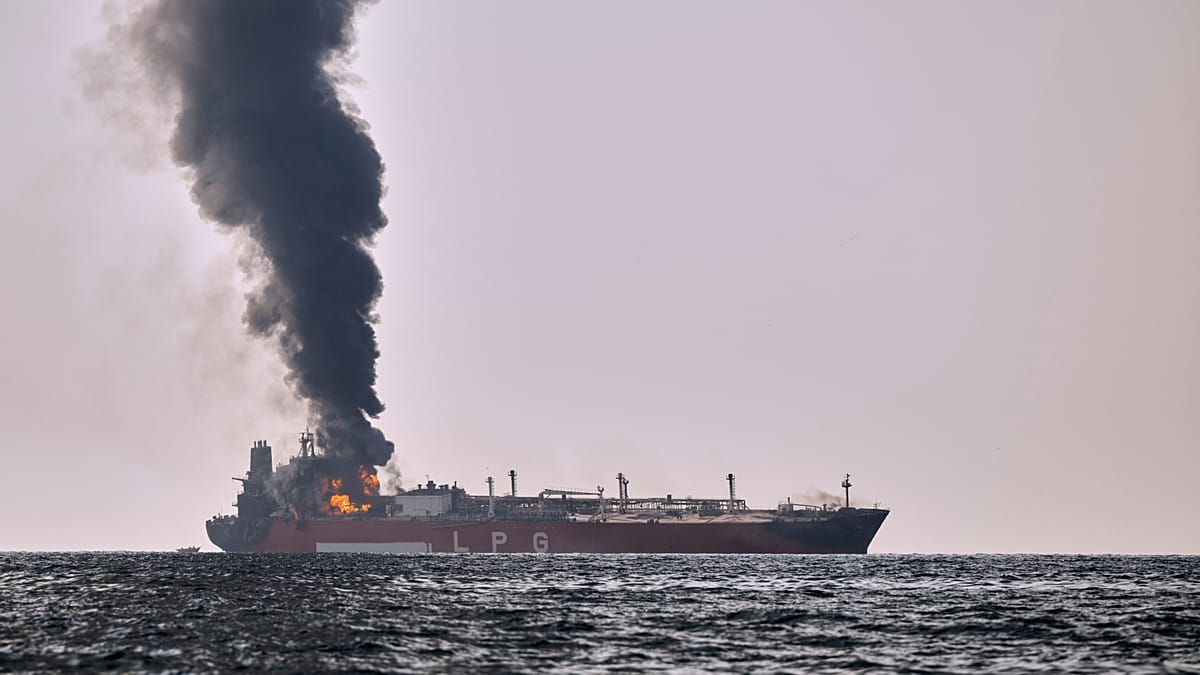
What made this different from the week-long tit-for-tat exchanges was coordination. Simultaneously, at least three oil tankers were attacked in or near the Strait of Hormuz. Two were hit by projectiles early Saturday as they exited the Persian Gulf, the UK Maritime Trade Operations centre reported. Iran’s navy claimed a tanker struck a naval mine east of the strait and caught fire. No casualties were reported, but the message was unambiguous: Iran can threaten both American military installations and international commerce with equal impunity.
Bahrain’s smaller geographic size — the island nation sits barely 30 kilometers from Iran across the water — makes it uniquely vulnerable to this kind of saturation attack. The base network housing the Fifth Fleet was previously considered shielded by distance and defense systems. That calculus has shifted overnight.
The Tanker Convoy That Changes Everything
While the missiles flew, Iran was assembling something far more consequential: a convoy of more than 14 oil tankers positioned off Kharg Island, Iran’s primary oil export terminal, preparing to attempt a breakout past the US naval blockade that has effectively choked Iranian oil exports for months.
Kazem Gharibabadi, Iran’s deputy foreign minister, told state media that Washington had been warned the convoy would sail soon to China. When asked what would happen if the US engaged the ships, he offered a warning that carried the weight of someone who has prepared to say it openly: any interception would trigger a “fierce military response” and “widespread attacks on energy infrastructures across the Gulf region.”
This is not rhetorical posturing divorced from capability. Iran has demonstrated repeatedly over recent weeks that it can strike targets well beyond its own borders — from US bases in Bahrain to commercial shipping in an internationally vital waterway. The IRGC’s statement about operations being “not limited to a specific geographical area” should be read as a threat against Saudi Arabia’s eastern oil fields, the UAE’s industrial zones, Qatar’s LNG terminals, and Kuwaiti ports. All are within range of Iranian ballistic missiles and drones. None are positioned like Bahrain’s Fifth Fleet headquarters to absorb direct hits without consequence.
The Institute for the Study of War captured the strategic bind succinctly: the United States faces either letting the blockade collapse or escalating into a war that carries steep political costs and strains relations with Gulf allies who depend on American protection.
Insurance Spikes, Supply Shocks, and Prices You Will Feel
The Strait of Hormuz handles approximately 20 percent of the world’s petroleum consumption. It is the single most concentrated chokepoint in global energy logistics — no alternative route comes close. Three tankers attacked in a single week represents a dramatic intensification from the sporadic incidents that characterized the preceding months.
Marine insurance premiums for vessels transiting the Gulf are already elevated above normal levels due to the ongoing escalation. Additional attacks on commercial shipping will push those rates higher still, and carriers will factor the cost into freight charges — meaning the premium does not appear exclusively in oil prices but in the price of everything shipped through the strait: refined fuels, chemicals, containerized goods, liquefied natural gas.
Oil markets react to uncertainty faster than they react to actual supply disruptions. Even if Iran’s convoy carries only a fraction of its nominal capacity and Washington allows passage rather than firing, the precedent matters. If a US blockade can be broken by a determined adversary with missiles pointed at your fleet, every insurer re-evaluates the risk profile of the entire northern Persian Gulf corridor.
Prices may not surge dramatically on this news alone. But sustained escalation — additional base strikes, further tanker attacks, the convoy breakout attempting to run the blockade — would change the trajectory quickly. The question is not whether the market prices in risk. It is whether the baseline assumption that Hormuz remains open continues to hold.
How Washington Answers
President Donald Trump told Fox News on Saturday that he intends to reach a “permanent” deal with Iran preventing nuclear weapons acquisition, adding he has no interest in regime change. Iranian Foreign Minister Abbas Araghchi responded with his own conditions: end the blockade, lift sanctions, acknowledge “past mistakes,” and reopening the strait would be “not difficult.”
Between these positions lies the narrow window that Qatar has been working to keep open. Deputies from both sides met Friday evening in Doha for approximately two hours, according to Gharibabadi. Diplomacy continues despite the missiles.
But the military reality complicates negotiation. Every US strike inside Iran strengthens hardliners in Tehran who argue that diplomacy cannot stop American bombs. Every Iranian strike on US positions in Bahrain strengthens hawks in Washington who argue that the US appears weak when it does not respond proportionally. Gharibabadi’s warning that the convoy would face a “fierce military response” if intercepted places the ball in Washington’s court with extremely high stakes.
CENTCOM denied an Iranian claim that a surface-to-air missile damaged an F-16 on Friday evening, signaling that the US is tracking and countering Iranian claims even as the underlying conflict intensifies. The Pentagon has conducted regular retaliatory strikes against Iranian military facilities over recent weeks. That pattern is unsustainable as a long-term strategy — retaliation invites further retaliation, and escalation spirals do not resolve themselves.
What Comes Next
Three scenarios dominate the near term.
In the first, Washington allows the tanker convoy to pass, avoiding immediate conflict but allowing the blockade’s credibility to erode. Iran gains a propaganda victory, maritime insurance costs climb, and the US signal that its threats carry operational consequences weakens across the region. Gulf allies watch quietly and begin asking whether American security guarantees are enforceable under sustained pressure.
In the second, the US intercepts the convoy, triggering the military exchange Iran has threatened. Strait operations halt temporarily or permanently depending on the intensity of the response. Oil prices spike sharply. Regional allies are pulled toward direct involvement. This outcome serves no stakeholder’s interests except those profiting from disruption.
In the third — the hardest to achieve but the only one that avoids losses all around — the Qatar-mediated talks produce enough agreement to decompress tensions, reopen the strait under mutually accepted terms, and establish a mechanism for managing future disputes without missiles. Neither side gets everything they want. That is usually how lasting agreements begin.
The strikes on Bahrain demonstrate that Iran believes it can raise the cost of American presence without triggering a full-scale war it cannot win conventionally. The tanker attacks prove it can challenge the economic lever that has constrained its oil exports most effectively. Both moves pressure Washington simultaneously on military and economic fronts.
How America responds determines whether this weekend’s escalation becomes a contained incident or the opening chapter of something far more costly.