Iran's Threat to Bahrain Isn't Empty Rhetoric
Iran's IRGC has explicitly warned Bahrain's ruling family their survival is at risk. This is the most direct challenge yet to the Al Khalifa monarchy—and a stress test for America's Persian Gulf strategy.
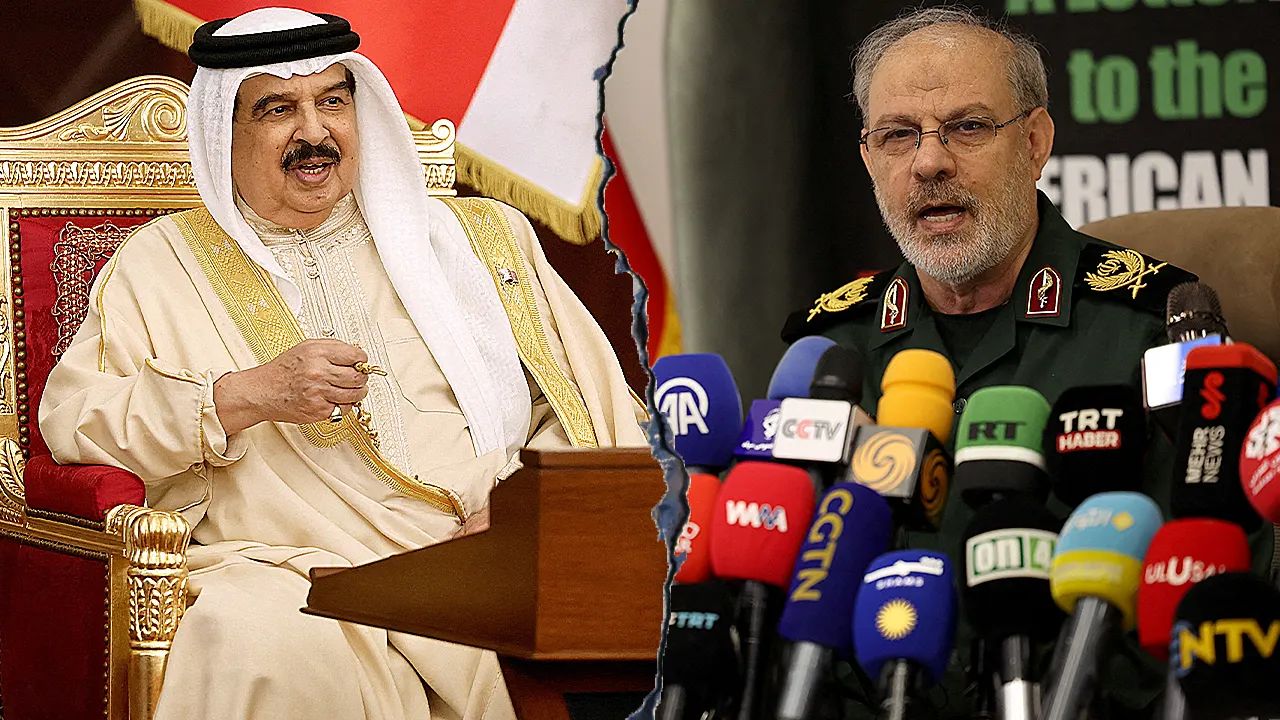
Iran Has Stopped Pretending
Iran is no longer whispering threats about Bahrain through proxies or operating quietly in the background. The Islamic Revolutionary Guard Corps just put on paper exactly what it has been attempting for decades: regime change on Bahrain’s shores.
IRGC Brig. Gen. Hossein Mohebbi wrote directly to Bahrain’s ruling Al Khalifa family on X, calling their cooperation with the United States, reliance on American protection, and challenges to Shiite religious authority three fundamental mistakes. If they persist, Mohebbi warned, their survival will be in doubt under whatever new regional order emerges from the current conflict.
“A word to the wise is enough,” he wrote.
This is not standard posturing. It is an existential deadline delivered by a military command that believes it has been delivering one for years. What makes this message distinct from previous Iranian rhetoric is its specificity and public venue. Mohebbi did not reference events indirectly through media surrogates. He named the Al Khalifa family directly, identified their errors with enumerated precision, and framed consequence as inevitable rather than conditional. That shift from implication to declaration signals that Tehran has concluded diplomatic cover is no longer necessary—and that it sees the current regional moment as favorable to overt pressure campaigns against Gulf monarchies.
The Crackdown That Preceded the Warning
Two days before Mohebbi’s threat, Bahrain’s criminal court sentenced dozens of Shiite clerics to life in prison on terrorism charges. Prosecutors said they had uncovered communications between the defendants and Iranian authorities, including the IRGC, accusing them of plotting to undermine the government.
The timeline matters. Tehran escalated its public threats immediately after Bahrain moved decisively against Iranian influence operations inside the country. The message is unmistakable: punish your friends and we punish you.
It also explains why Behnam Ben Taleblu, a senior fellow at the Foundation for Defense of Democracies, identified sectarian, political, strategic and American-force-related gripes as the layers behind Iran’s animosity toward Bahrain. The target is not just a neighbor. It is a small island monarchy hosting the United States Navy’s Fifth Fleet—a symbolic and practical anchor of American power in waters Iran has long considered its own sphere.
The sentencing of these clerics represents the most aggressive domestic containment operation Bahrain has conducted in recent memory. By targeting individuals with alleged IRGC ties, Manama is attempting to sever the informational and logistical lifelines that connect local Shiite communities to Tehran’s revolutionary apparatus. But the crackdown produces a predictable second-order effect: it validates Iran’s narrative that the Al Khalifa regime oppresses its own Shiite majority, reinforcing the sectarian framing that radical elements on both sides depend upon for recruitment and legitimacy.
Why Bahrain Matters More Than You Think
Most Western coverage treats the Fifth Fleet’s presence in Bahrain as background noise. It is not. The fleet commands operations across the Persian Gulf, the Strait of Hormuz and surrounding waters—the chokepoint through which roughly a fifth of global oil shipments pass every day. Lose access to Manama, and Washington loses its most forward naval hub in the region almost overnight.
But the deeper implication is geographic. Bahrain sits directly off Saudi Arabia’s eastern coast. A destabilized Bahrain creates a vulnerable southern flank for Riyadh, which already hosts thousands of American troops and faces recurring Houthi and Iranian drone strikes from Yemen. If Iran can make Bahrain ungovernable or uncooperative, it gains leverage against Saudi Arabia’s most exposed territory.
That connection is why this story deserves attention far beyond the Persian Gulf. The Fifth Fleet is not just an American installation. It is a keystone in the broader Gulf security architecture that includes Saudi defense, UAE power projection and Qatari logistics. Pull one stone out and the whole wall shifts.
For Saudi Arabia specifically, Bahrain is not merely a neighbor—it is a geographic liability that complicates eastern province defense planning. The Eastern Province houses critical energy infrastructure and a significant Shiite population that Tehran has historically sought to mobilize. Any instability spilling across the narrow strait separating Bahrain from Saudi soil would force Riyadh to divert security resources from other theaters and potentially reconsider the posture of forces deployed along its southern border.
How Iran Plans to Win Without Winning
Tehran does not need to invade Bahrain. It needs to make hosting American forces politically unsustainable for the Al Khalifa regime. Drone attacks on radar installations, missile strikes near bases, public threats against the royal family—these are components of a single campaign designed to create unbearable pressure on a small state that lacks strategic depth.
Taleblu put it plainly. Iran is looking for places close to Bahrain’s territory where it can land blows against the United States on the cheap. It wants to generate pain broadly across the region while targeting sites that have already proven vulnerable.
The recent drone intercepts over the Bahrain Financial Harbour, near the Israeli embassy, and the repeated claims of strikes on Fifth Fleet infrastructure demonstrate exactly how thin the defensive perimeter has become. CENTCOM confirmed interceptions but did not report casualties. That silence is notable. In warfare, no reported casualties often means the threat was real but the damage was limited. The psychological toll is measured differently.
Iran’s strategy here operates on a calculus of attrition rather than decisive victory. Each intercepted drone, each claimed strike, each public threat increments the cost of hosting American forces without triggering the kind of response that would escalate beyond Tehran’s comfort zone. The campaign exploits Bahrain’s vulnerability as a micro-state: it cannot project power outward, it depends entirely on external security guarantees, and its domestic cohesion rests on a fragile sectarian bargain that Tehran has spent years eroding.
The Economic Dimension Most Analyses Miss
Beyond the military and sectarian dimensions lies an economic pressure point that receives insufficient attention. Bahrain’s economy is already constrained by limited natural resources, a bloated public sector, and mounting debt. A sustained security deterioration would trigger capital flight, depress tourism and financial services—the two sectors most exposed to regional instability—and increase dependence on Saudi subsidies that Riyadh itself is stretching thin.
Iran understands this dynamic. Economic precarity amplifies political fragility. When ordinary citizens feel the cost of their government’s alignment choices in declining living standards and employment prospects, the durability of even authoritarian arrangements becomes uncertain. Tehran has cultivated economic leverage through trade routes, informal cross-border networks, and the broader shadow economy that connects Bahrain to Iran regardless of official sanctions.
What Comes Next for the US Presence
The central question now is whether Washington can afford to maintain bases so close to an adversary’s territory under sustained fire. Taleblu identified Bahrain as the test case for America’s future footprint across the entire CENTCOM area of operations in the Persian Gulf. If the Fifth Fleet must relocate or operate from dispersed, hardened positions, the calculus of deterrence changes fundamentally.
Iran has signaled it intends to keep raising the cost of that presence. The question is whether the United States can absorb those costs indefinitely—or whether this escalation forces a broader withdrawal that benefits Tehran more than any invasion ever could.
Relocation is not a simple bureaucratic decision. Moving the Fifth Fleet would require constructing equivalent infrastructure in Qatar, Kuwait, or dispersed naval vessels—an undertaking measured in years and billions of dollars. More critically, it would signal to America’s Gulf allies that security commitments are conditional on casualty tolerance, potentially accelerating regional hedging strategies toward China and Russia.
For Bahrain’s monarchy, the immediate calculation is simpler. Host the Americans and invite daily threats. Resist Iranian pressure and risk internal collapse from a network of clerics and militants Tehran has cultivated for decades. The Al Khalifa family is trapped between two powers that do not share its interests.
The warning from Mohebbi was never meant solely for Manama. It was sent to Riyadh, Abu Dhabi and Dubai as well. If Bahrain cannot survive the pressure, the lesson for the rest of the Gulf is equally clear: accommodation may be the only path to longevity. But accommodation carries its own risks—alienating the United States while gaining nothing measurable from Tehran, which has demonstrated repeatedly that concessions are interpreted as weakness rather than good faith.
The Al Khalifa family’s dilemma reflects a broader strategic困境 facing every Gulf monarchy: the American security umbrella is retreating even as Iranian ambition expands. Bahrain is simply the place where that tension has become impossible to ignore.