Crew Dragon returns home as new crew settles at the ISS
SpaceX Crew-12 undocks after a 237-day mission as replacements lock in for a six-month tour. The steady cadence of commercial crew rotations is reshaping how the International Space Station operates — and what it signals about the future of orbital presence.
The rhythm is the story
The undocking happened at 8:05 a.m. Eastern Time. The Crew Dragon capsule Freedom — carrying Jessica Meir, Jack Hathaway, Sophie Adenot, and Andrey Fedyaev — backed away from the Harmony module’s space-facing port, executed a controlled loop over the station, and dropped into the Pacific approach corridor. By Thursday morning they’ll splash down off Southern California, ending a 237-day mission that logged 3,792 orbits and roughly 101 million miles.
The landing itself is routine. What’s worth noticing is what it makes possible: Crew-13 commander Jessica Watkins, pilot Luke Delaney, Canadian astronaut Joshua Kutryk, and cosmonaut Sergey Teteryatnikov — launched on October 1 — remain aboard for a six-month tour. They share the station with the longer-duration Soyuz MS-29 crew: Pyotr Dubrov, Anna Kikina, and Anil Menon, who arrived in July and are planned to stay eight months.
That’s a seven-astronaut station. The math of who sleeps where, who eats when, and which experiments get attention is no longer managed by a handful of Russian cosmonauts and NASA veterans doing everything themselves. It’s managed by a rotating cast arriving on commercial spacecraft, each replacement a scheduled handoff.
The handoff that wasn’t special — and why that matters
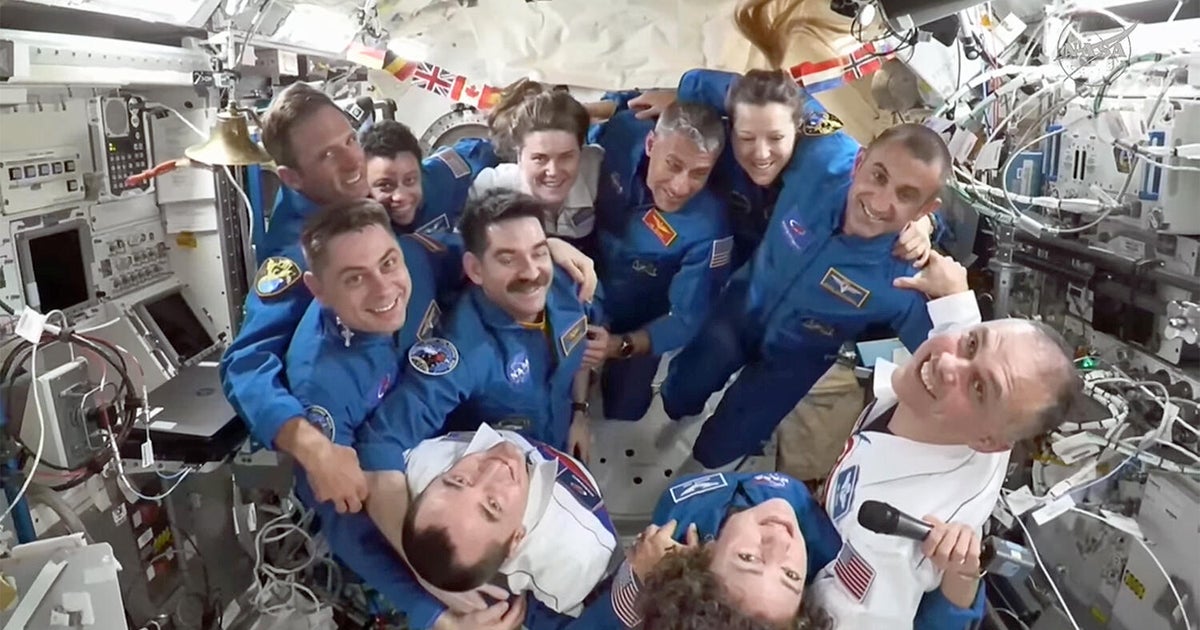
Meir turned command over to Dubrov on Sunday. There was a symbolic key, a speech about Sputnik’s anniversary, and what she called a “huggle” — the crew huddling into a circle in microgravity, arms around each other’s shoulders. It was filmed, posted, and moved on from within hours.
That’s the quiet signal. A change-of-command ceremony that draws global headlines is one thing. A change-of-command ceremony that is so thoroughly routinized it barely registers is another. The ISS has been continuously crewed since November 2000. Commercial crew rotation since 2020 has added a new cadence on top of that: not just maintaining presence, but cycling through it like a shift change at a factory that never closes.
SpaceX now flies crews on a schedule that NASA treats as operational infrastructure. Crew-12 was one flight in a sequence that includes Crew-13, Crew-14, and beyond. Each launch removes a variable that used to be a crisis — the retirement of the Shuttle left a gap that Soyuz filled alone; now multiple SpaceX flights per year mean redundancy, overlap, and a buffer against delays.
Who wins when the rotation speeds up
NASA wins first. The agency no longer needs to solve the problem of how to get people to low Earth orbit and back. It buys seats. It defines requirements. It conducts missions. The billing cycle is a launch manifest.
SpaceX wins too, obviously. The company has turned crew transport into a repeating revenue stream with proven reliability. Eight-month missions mean the capsule sits at the station longer, which means fewer launches per year than if everyone rotated every three months — but each flight carries more cargo, more research, and more political weight. The Dragon is still the only commercial spacecraft certified for human transport by NASA, which gives it a singular position even as competitors like Boeing’s Starliner and future vehicles aim to enter the market.
Europe and Japan and Canada win in a smaller but real way. Adenot’s three consecutive spacewalks during this mission — including two alongside Menon — are not background detail. They’re evidence that the ISS has become a laboratory where international crews operate at a pace that would have been impossible a decade ago. No single nation could sustain that frequency alone. The rotation model makes it feasible.
Who loses, and what’s at stake
Russia loses the most in relative terms. The Soyuz MS-29 crew — Dubrov, Kikina, Menon — remains on station, but the balance of power has shifted. The ISS was once a Russian-dominated platform with Western guests. It is now a jointly operated station where the default assumption is that someone will arrive on a SpaceX rocket and leave on a SpaceX capsule, regardless of which country they represent. That’s not a slight against Roscosmos. It’s just arithmetic.
The deeper question is what happens when the station reaches end of life. NASA has publicly discussed 2030 as a target for deorbit. The commercial crew program was always partly about ensuring continuity — that when the ISS goes, American presence in orbit doesn’t. But “doesn’t go away” is a different claim than “continues robustly.”
A station transition from government-run to commercially operated is the stated goal. Whether anyone actually builds and maintains a replacement that large, that well-integrated, and that internationally governed is another question entirely. The rotation cadence proves the model works. It doesn’t prove there’s a destination for it.
The six-month tour as a new normal
Crew-13’s planned six-month stay is shorter than the Soyuz crew’s eight months. That asymmetry is intentional — NASA and its partners are testing different mission lengths to find the optimal balance between crew fatigue, logistics, and science output. Three months was the Shuttle standard. Six months is becoming the Crew Dragon standard. Eight months is what Soyuz has been doing for years.
Each increment adds data. Each data point informs the next launch. The station is both a laboratory and a proving ground, and the proof is in the departure and arrival boards — schedules that were once sources of anxiety are now sources of confidence.
The undocking was clean. The splashdown will be, too. The real story is that no one is treating it as one.