The Nuclear Clock That China and Europe Just Built Changes Everything
China and Europe just published the first working nuclear clock in Nature. It isn't the most precise clock yet — but its immunity to external interference makes it the best candidate for deep-space navigation, relativity tests, and next-generation timing.
The quietest clock you’ve never heard of
On October 8, two independent research teams — one Chinese, one European — published in Nature that they had each built a nuclear clock for the first time. The headline numbers are not yet world-beating: neither device outperforms the best optical atomic clocks in raw stability. But the significance runs much deeper than a single precision table.
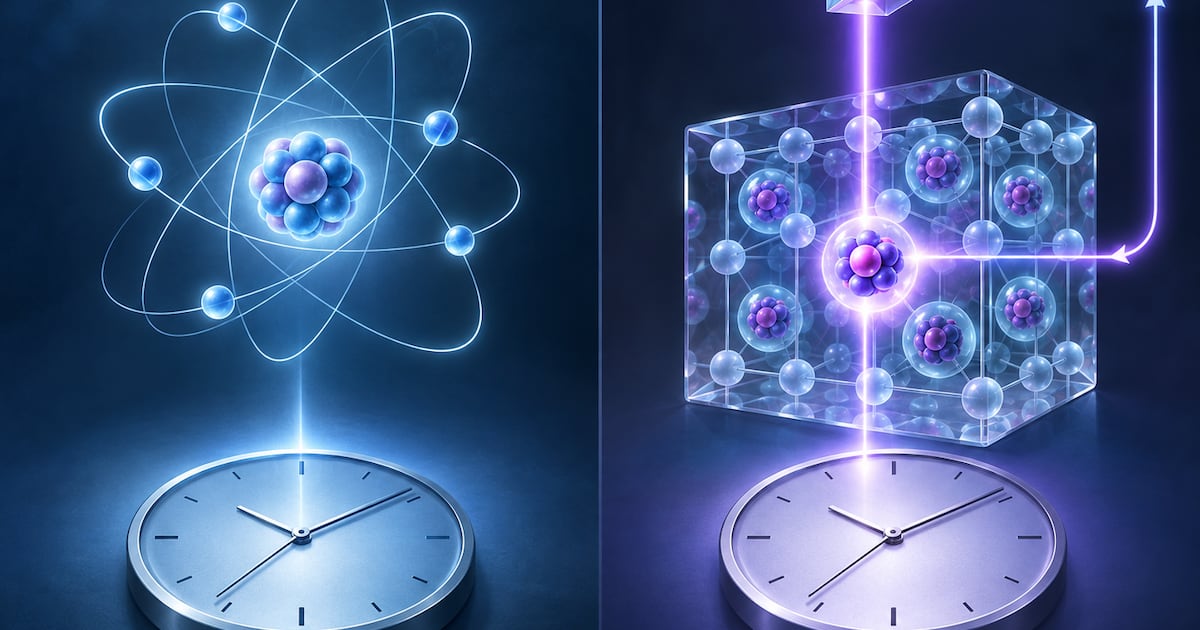
A nuclear clock uses the energy transitions inside an atom’s nucleus, not its electron cloud, as the timing reference. Nuclei are roughly 100,000 times smaller than electrons and sit far more deeply shielded from the electromagnetic environment. That makes them intrinsically resistant to the thermal radiation, stray electric fields, and magnetic noise that limit even the best optical clocks today. If you can build a reliable nuclear oscillator, you are no longer at the mercy of your lab’s cleanliness.
That shift — from precision that depends on environmental control to precision that is built into the atom itself — is what makes this milestone worth taking seriously.
What the two papers actually show
Both teams worked with the same isotope: thorium-229. Most nuclear transitions require mega-electronvolt energies, which is why people have chased particle accelerators rather than lasers for nuclear clocks. Thorium-229 is the famous exception. Its first excited state sits only about 8.4 electronvolts above the ground state — low enough that a vacuum-ultraviolet laser at roughly 148 nanometres can drive the transition directly.
The Chinese team embedded thorium-229 ions in a calcium fluoride crystal and used the nuclear absorption signal to lock a laser. As measurement time increased, the frequency instability dropped to the 10⁻¹⁵ level. The European team pursued the same architecture independently and reported roughly one day of continuous nuclear-clock operation — a practical demonstration that the system does not collapse after a few hours.
Neither result yet beats the fractional uncertainty of state-of-the-art optical lattice clocks, which reach the 10⁻¹⁸ range. But the two teams proved something harder than raw numbers: that you can trap a nuclear transition, read it with a laser, and use it as a feedback reference without the signal degrading overnight.
Nature’s framing — calling it a metrology milestone — is accurate. The real implication lives in what comes next.
Why nuclear clocks matter beyond the lab
Optical atomic clocks are already astonishing. The best of them would gain or lose less than a second over the age of the universe. Yet they remain vulnerable. A thermal gradient in the vacuum chamber, a fluctuating stray field, even the cosmic microwave background radiation — all of these impose limits that scale with how tightly you must isolate the clock. Engineers spend enormous effort shielding, cooling, and isolating.
A nuclear clock flips that hierarchy. Because the nucleus is small and deeply buried, external perturbations couple to it far more weakly. The dominant error sources are fundamentally different: laser phase noise and technical drift, not environmental electromagnetic contamination. That distinction is what makes nuclear clocks attractive for applications where you cannot control the environment.
Consider three concrete cases.
Deep-space navigation. Current spacecraft rely on ground-based radio tracking and onboard atomic clocks that drift under radiation and temperature extremes. A nuclear oscillator would provide timing stability that degrades far more slowly in the space environment. Over multi-year missions to the outer planets, that difference compounds into positional accuracy measured in kilometres rather than hundreds of kilometres. For a Mars landing or an orbital rendezvous at Jupiter, that gap is operational.
Relativistic geodesy. General relativity predicts that time runs faster at higher gravitational potential. An optical clock can already detect the time-dilation difference between two points separated by a vertical distance of a few centimetres. A nuclear clock with comparable or better intrinsic stability would sharpen that measurement dramatically, turning clock networks into instruments that map Earth’s gravitational potential with centimetre-scale resolution. That capability feeds into sea-level monitoring, tectonic strain studies, and resource exploration.
Autonomous systems. Self-driving vehicles, distributed sensor networks, and underwater navigation all depend on precise timing without reliable GPS. A compact nuclear oscillator — once miniaturized — would provide a timing reference that remains stable across temperature swings and electromagnetic interference that disable conventional clocks. You do not need a laboratory to benefit; you need a device that works when conditions go wrong.
What is still missing
The honest read is that we are early. Both teams demonstrated proof of principle, not production hardware. Several gaps remain before nuclear clocks displace optical clocks in any application.
Laser technology at 148 nanometres is difficult. Vacuum-ultraviolet sources are inefficient, fragile, and expensive compared with the near-infrared lasers that power today’s optical clocks. Until compact, stable VUV lasers exist — or a different nuclear isotope with a transition at a more convenient wavelength is discovered — the nuclear clock stays laboratory-bound.
Miniaturization is another barrier. The Chinese and European devices are bench-scale experiments. A nuclear oscillator that fits on a satellite or a vehicle requires engineering work that has not yet been attempted.
And finally, there is the question of whether the nuclear clock will ever surpass the best optical clocks in absolute performance. Optical lattice clocks continue to improve. If their environmental sensitivity can be controlled further through better shielding and new trap geometries, the nuclear clock’s advantage may shift from raw numbers to durability — a different kind of superiority that matters for field use but is less dramatic in a paper.
The geopolitical context
This result deserves attention for another reason. Two independent groups, in different parts of the world, published the same breakthrough within days of each other. The Chinese team’s work and the European team’s work converged on the same isotope, the same architecture, and the same kind of laser-feedback design. That convergence signals a maturing field, not a single-lab race.
China’s rapid advance in precision measurement has been steady. This nuclear-clock result builds on earlier work in trapped-ion systems, quantum logic spectroscopy, and solid-state rare-earth doping. The European team’s parallel success suggests the technique is reproducible and that the physics community has moved past the point where a single group controls the answer.
For Western readers, the useful framing is not competition but replication. When two independent teams publish the same first, the result is robust. That robustness is what turns a lab curiosity into an engineering foundation.
What happens next
Expect incremental papers for the next two to three years: longer coherence times, improved laser sources, perhaps a different isotope candidate. The trajectory is clearer than the timeline. If the 148-nanometre laser problem yields — and it will — nuclear clocks move from demonstration devices to engineering hardware. The first applications will be in specialized environments: satellite timing packages, relativistic geodesy networks, and tests of fundamental physics that require stability beyond what optical clocks can sustain over long integration times.
The Chosun Ilbo piece that triggered this analysis captured the essential fact cleanly: the nuclear clock is real now, it is not yet the most precise clock available, and its value lies in what it makes possible rather than what it currently outperforms. That distinction matters. The most important clocks are not always the ones with the smallest error bars on a bench. They are the ones that keep working when everything else fails.
This is one of those clocks.