Japan Found a Rare-Earth Lifeline 5,569 Meters Below the Sea
Japan extracted mud containing 53.9 percent medium-heavy rare earths from the Pacific floor near Minamitorishima in a world-first deep-sea trial. The result is a potential crack in China's export-control leverage — but commercial production is years away.
The Seafloor Just Got Interesting
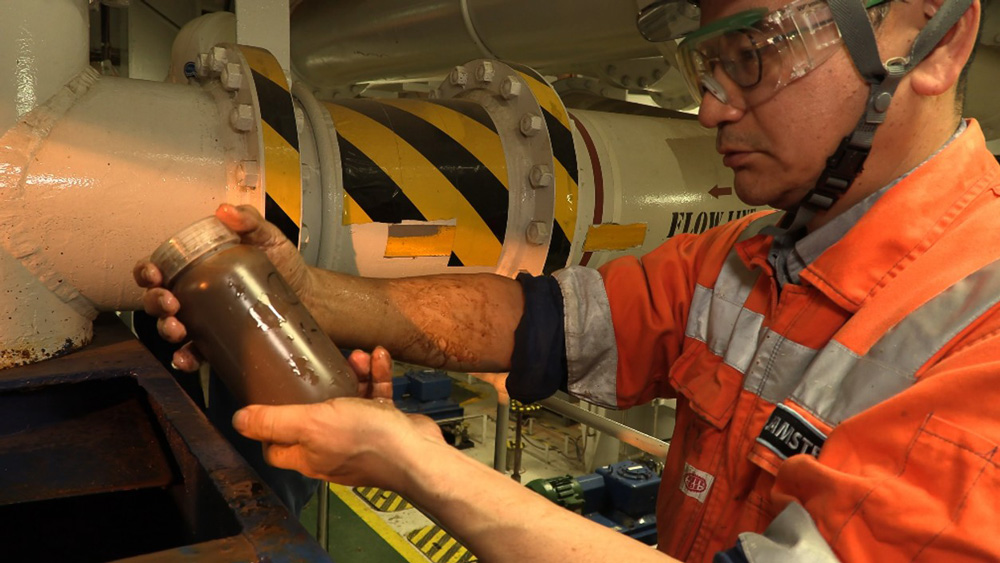
On February 1, 2025, at 00:30 JST, mud from 5,569 meters below the Pacific surface arrived on deck of the drill ship Chikyu. Three days of continuous pumping from three separate layers had produced roughly 50 tons of sediment. Analysis published July 24 by JAMSTEC and the Cabinet Office revealed that 53.9 percent of the rare-earth content in that mud was medium-heavy: yttrium at 29.9 percent, gadolinium at 4.9 percent, dysprosium at 4.6 percent.
That number — 53.9 — is the headline. Medium-heavy rare earths are the ones China restricts most aggressively. Light rare earths like neodymium are abundant and relatively commoditized. The medium and heavy fractions are what make high-performance permanent magnets, semiconductor deposition equipment, and nuclear control rods possible. And they are scarcer, harder to separate, and far more concentrated in Chinese output.
Japan called the operation a world-first: continuous suction of seabed mud from nearly 6 kilometers depth to the ship above. It achieved that under 7-meter waves and 20-meter-per-second winds, extending a pipe roughly the length of nine Tokyo Skytrees end to end. The crew exceeded the planned 7-day window, taking 12 days just to lower and retrieve the equipment.
Why This Number Matters More Than the Volume
Fifty tons of mud sounds modest. It is. But the value of this discovery is not in its scale — it is in its grade and its geography.
China controls roughly 60 percent of global rare-earth mining and an estimated 85 to 90 percent of processing capacity. In October 2023, Beijing restricted exports of gallium and germanium. In December 2023, it tightened controls on antimony. In October 2025, it extended export controls to certain rare-earth processing technologies. Each move signals the same strategy: rare earths are not merely commodities, they are instruments of industrial policy.
Medium-heavy rare earths are where that leverage is sharpest. Dysprosium is essential for EV motors that operate at high temperatures without losing magnetic strength. Yttrium is used in LED manufacturing and semiconductor tooling. Gadolinium absorbs neutrons in reactor control rods — a detail that gives it strategic weight beyond the civilian economy. Japan imports nearly all of these from China.
Finding them in the seabed beneath Japan’s own exclusive economic zone changes the calculus, even at early stages.
The Quiet Race Inside Japan’s EEZ
Japan has one of the largest EEZs in the world. Most public discussion treats it as a fishing zone. The Chikyu trial reframes it as a resource frontier.
Minamitorishima lies at Japan’s easternmost edge, far from the main islands but centrally positioned in the western Pacific. The mud sampled there contains a composition that directly targets Japan’s import gap. Tokyo University’s Yasuhiro Kato, who has tracked the site since 2011, warned that China is accelerating ocean-resource surveys in adjacent international waters. If Japan does not move, the zone surrounding its EEZ could become contested in ways that echo territorial disputes on land.
That is the geopolitical subtext. The practical subtext is harder: nothing in this trial proves commercial viability.
What Stands Between This Mud and a Mine
Several concrete obstacles remain, each substantial enough to delay or derail a project.
Depth is the first. Equipment must operate stably at 6,000-meter depth for extended periods. Corrosion, pressure, and particulate abrasion are not laboratory problems.
Throughput is the second. The trial collected 50 tons over three days. The next test, scheduled for February 2027, plans roughly 350 tons per day for about a month. Scaling from a science experiment to an industrial operation is not linear. Pumping systems, mooring, and vessel logistics that work at small scale behave differently at volume.
Processing is the third. Separating medium-heavy rare earths from seabed mud at low cost remains unsolved. The mud must be transported to shore, dehydrated into a mud cake, and then subjected to separation and refining. Building a dehydration facility near the site, managing tailings, and meeting environmental standards are all open questions.
Environmental assessment is the fourth. JAMSTEC reported no significant levels of harmful or radioactive substances in this sample — a positive sign. But plume dispersion, benthic ecosystem impact, and long-term monitoring requirements are not settled. Any commercial project will face rigorous review.
Economics are the fifth. Rare-earth prices cycle. When prices are low, stockpiling becomes rational. When prices spike, alternatives emerge. Tokyo University’s Takeshi Okabe suggested diversifying through Australian ore refined in Malaysia or Vietnamese separation capacity, or simply stockpiling ten years’ supply during cheap periods. Those are valid strategies, but they do not make deep-sea mining cheaper.
The Timeline Is Real, Even If the Outcome Isn’t Certain
The schedule is specific. The February 2027 trial will run for approximately one month, targeting 350 tons per day. Crew rotations by aircraft and helicopter will be tested. Mud will be shipped to Minamitorishima for dehydration, then moved to the main islands for separation, refining, and smelting — a full chain demonstration. A comprehensive evaluation covering economics will be completed by March 2028.
That March 2028 deadline is the date policymakers and industry watchers should mark. If the evaluation comes back positive, Japan could begin planning licensed mining operations within a few years. If it comes back negative, the data will still be useful: it proves the resource exists, it refines the engineering challenges, and it strengthens Japan’s negotiating position in discussions about critical minerals with allies.
Who Wins and Who Loses
If Japan commercializes deep-sea medium-heavy rare earths, the immediate winner is any manufacturer in Japan, the US, or Europe that currently sources dysprosium or yttrium from Chinese processors. Supply-chain risk drops. Export-control leverage weakens. Pricing power shifts slightly away from Beijing.
China loses leverage, not volume. Its mines and refineries will still operate. But the threat of restriction loses credibility when alternative supply is demonstrable, even if scaled later.
The ocean ecosystem is the uncertain party. Plume studies, biodiversity surveys, and impact assessments will determine how much extraction is permissible. Japan’s strict environmental standards may slow development but also legitimize it in markets that require sustainability credentials.
The Real Takeaway
Japan’s seabed trial did not produce barrels of rare earths. It produced a number — 53.9 percent medium-heavy — and a proof of concept at a depth that no one has systematically exploited before. The resource is real. The engineering is hard. The economics are unproven. The geopolitics are already shifting.
What changes most is the signal. For years, Japan’s rare-earth dependence was treated as a structural constraint with no domestic option. The Chikyu results reframe it as a solvable problem, one that happens to sit 5,569 meters below the surface.