Japan's Rice Price Reversal Signals a Glut That Could Haunt Next Year's Harvest
New rice in Japan is now cheaper than old rice — a rare inversion driven by a 2025 harvest surplus that could trigger a policy whiplash and affect food inflation strategies across Asia.
The Inversion No One Expected
Japan is experiencing something that should not be happening in a country where rice is cultural infrastructure, not just a commodity.
Newly harvested 2026 rice — what Japanese retailers call shinmai — is now selling for less than the previous year’s crop. Supermarket prices for a 5-kilogram bag have fallen to 3,112 yen as of late August 2026, down from 4,416 yen in January. That is the lowest level in nearly two years, arriving at a time when almost everything else on Japanese shoppers’ lists has gotten more expensive.
The cause is blunt: there is too much 2025 harvest rice sitting in warehouses and store shelves, and the market has no choice but to move it.
This inversion runs counter to everything the seasonal rice market teaches. Shinmai has historically commanded a premium — sometimes 10 to 20 percent above old-crop prices — because Japanese consumers treat the first harvest of the year as a seasonal event, akin to cherry blossom viewing or first caught bonito. The fact that new rice now trades at a discount signals distress far beyond normal seasonal fluctuation.
Who Pays the Price
Farmers are the first layer of casualties. When new rice undercuts old rice, the price signal sent back to producers is chaotic. Farmers who planted in 2025 did so expecting normal autumn prices. Instead, the market is flooding with their own output, depressing the benchmark price for the 2026 crop before it even reaches consumers at full strength.
The JMA (Japan Marketing Association) rice benchmark for 2025-harvest standard-grade rice has slipped below the government’s administered reference price of approximately 20,000 yen per 60-kilogram crate — a level that usually acts as a floor. When market prices fall beneath the administered benchmark, the subsidy mechanism designed to protect farmer income kicks in, but those payments come with political friction. The Agriculture, Forestry and Fisheries Ministry has repeatedly warned that deficit payments are not sustainable at current volumes, and the 210,000-ton buyback announced this week pushes the budgetary exposure further still.
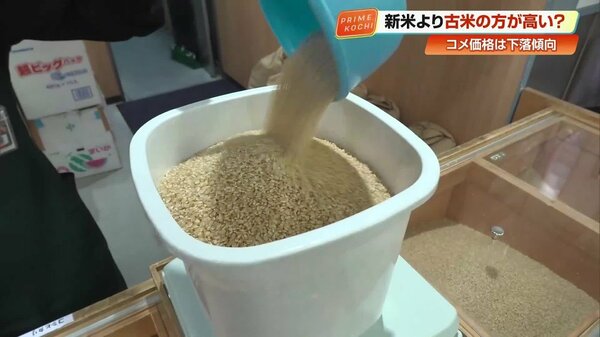
Retailers are not immune either. Direct-sales shops in Kochi City, such as Tosa no Sato, have been forced into an unusual workaround: pricing old rice and new rice identically so that neither category becomes stranded inventory. Store manager Hashimoto told FNN that customers now choose by preference rather than price, but the operational reality is painful — the shop must carry two harvest years simultaneously, tying up capital in stock that should have moved months ago.
The anxiety is not confined to Kochi. Shop managers across Japan share the same concern: if 2025’s surplus forces retailers to also discount or delay 2026’s new harvest, the 2027 crop will inherit a double burden. That is the cascade risk Hashimoto explicitly flagged — a one-year surplus becoming a two-year problem.
The ripple extends into processing and distribution. Mills that normally rotate through old-crop inventory before taking on new harvest are now running overlapping campaigns, straining storage capacity and logistical throughput. Distributors report that warehouse space reserved for winter distribution of the 2025 crop is being consumed by unsold stock, leaving less room for incoming 2026 shipments — a spatial squeeze that could force some regional handlers to decline contracts altogether.
The Government’s Emergency Response
Agriculture Minister Suzuki announced that the government will repurchase up to 210,000 tons of 2025-harvest rice from its strategic reserves by the end of September 2026. This is a meaningful intervention. Japan’s rice stockpile system was designed precisely for this scenario — a bumper or stalled-consumption year creates surplus that the state absorbs to stabilize prices.
But the move also reveals how thin the margin is. The government had to accumulate that reserve in the first place because demand fell or supply rose beyond projections. Buying it back now is not a routine market operation; it is damage control for a price collapse that arrived faster than most analysts predicted.
The buyback figure deserves scrutiny. Japan’s annual rice consumption sits at roughly 7.8 million tons and has been shrinking by 2 to 3 percent year over year. A 210,000-ton government purchase represents approximately 2.7 percent of total annual consumption — a sizable single intervention, but one that leaves the question of residual surplus open. If the market still carries unsold 2025 stock after the September deadline, the downward pressure does not simply evaporate. It may intensify as retailers accelerate clearance before winter holidays and gift-giving seasons.
There is also a second-order cost to the intervention. Government repurchase programs typically purchase at administered reference prices, which are above market rate. That means the state is buying high to remove low-priced inventory from circulation — a transfer of cost from the market onto taxpayers. The Ministry of Finance has not disclosed the budget allocation for this round of purchases, but estimates from industry observers place the outlay between 50 and 70 billion yen depending on the exact tonnage and grade mix.
What This Means Beyond Japan
The rice price inversion in Japan is a small story in isolation. It is not small when you connect the dots.
Japan is the world’s fourth-largest rice consumer and one of the few major economies where household rice consumption has been structurally declining for decades. When the government still needs to buy 210,000 tons off the market, it means even that long-term demand erosion has produced a supply shock on the other side. That paradox — falling demand coexisting with surplus — points to volatile weather patterns disrupting planting cycles more than consistent overproduction.
The 2025 harvest benefited from unusually favorable growing conditions in key producing regions including Niigata, Akita, and Fukushima — areas that collectively account for roughly 40 percent of Japan’s commercial rice output. Bumper yields in those prefectures, combined with flat domestic consumption, created the surplus. But favorable weather was not uniform: parts of Kyushu experienced heat stress during pollination, reducing yields in some sub-regions. The net result was a regional mismatch — enough total tonnage to glut the market, but uneven quality distribution that complicates pricing.
For the broader Asian rice market, the signal matters. Japan’s rice sector is heavily protected by tariffs and quotas. Domestic prices normally run well above regional benchmarks. A sudden domestic price drop does not immediately flood exports — Japan does not compete on rice price globally — but it does change the calculus for regional traders monitoring Japanese consumption trends as a leading indicator for the rest of import-dependent Asia.
Vietnam and Thailand, the world’s top exporters, watch Japanese import quota utilization closely. If Japan’s government is buying surplus domestically rather than importing, that reduces outbound demand from the region and adds downward pressure on Bangkok and Ho Chi Minh City pricing. Exporters facing softer Japanese demand may redirect volume to other markets, indirectly affecting prices in Africa and the Middle East.
Food inflation strategy is the second ripple. Japan’s central bank has watched consumer prices closely, and staple food inflation is a politically sensitive gauge. Rice prices falling while other groceries rise creates a distortion that complicates monetary policy communication. The Bank of Japan cannot point to a broad food inflation trend when the country’s signature carbohydrate is actually deflating. This asymmetry makes it harder for policymakers to frame inflation dynamics in straightforward terms — a problem that matters when the BOJ is still calibrating its exit from ultra-loose monetary policy.
The Next Twelve Months
The immediate question is whether the 210,000-ton buyback is large enough to clear the glut without further damaging producer prices. If the government removes only a fraction of the surplus, retailers will continue discounting old stock through winter, which keeps downward pressure on new-crop pricing well into 2027.
The second question is whether 2026 plantings respond. If farmers cut area in response to depressed 2025 prices, the surplus could correct on its own — but that creates a different risk: a 2027 shortage that sends prices spiking, repeating the whiplash cycle that Japanese rice policy has fought for thirty years.
There is a third, quieter variable: the aging farming population. Japan’s average rice farmer is over 67 years old. Many operate on marginal land where profit margins are already thin. A multi-year price depression does not simply reduce income — it accelerates retirement and land abandonment. The Japan Agricultural Cooperatives (JA) has reported that approximately 8,000 hectares of rice paddy were taken out of production in 2025 alone, part of a longer trend. If the current price environment persists, that rate of abandonment could climb, reducing future supply capacity in ways that are difficult to reverse even if prices recover.
The fourth question is whether the government’s buyback program crowds out private-sector distribution. When the state enters a market as a buyer of last resort, it changes the incentives for private traders. Some distributors may wait to see how the government purchase programme unfolds before committing to their own procurement, creating a lags and uncertainty that slows the normal rotation of inventory. The result is not a clean removal of surplus but a prolonged period of market hesitation.
The third question, and the one most consumers will feel, is whether grocery prices rebound. The current dip to 3,112 yen per 5 kg may look like relief at the checkout, but it is built on distressed inventory, not structural abundance. Once the old stock is cleared — by sale, by government purchase, or by both — the next harvest’s price will set the tone for 2027 dining tables.
The Close
Japan’s rice market is in an uncomfortable holding pattern: new rice cheaper than old rice, farmers unsure what price to plan for, and a government trying to absorb a surplus that should not exist in the first place. The 210,000-ton buyback is a bridge, not a resolution. It buys time. But the underlying dynamics — shrinking consumption, aging producers, volatile weather, and a protected market that cannot easily export its way out of a domestic glut — remain unresolved.
If the 2026 harvest turns out average to below-average, as some agronomists are already forecasting based on summer heat projections, the current surplus could be burned through faster than expected and prices could rebound sharply heading into next autumn. That would reward patience for farmers who held back plantings and penalize those who expanded. If the 2026 harvest is also strong, the government will face the same problem again in 2027 with a depleted policy toolkit and a budget already strained by this year’s intervention.
The inversion of new and old rice prices is not just a seasonal anomaly. It is a stress test for a system that has managed scarcity and surplus for decades, and the results are still unwritten.