Japan's Translation Industry Is Hollowing Out — and the World Is Watching
Profit in Japan's translation sector has collapsed 70% in three years as AI eats into work once thought immune. The casualties include bankruptcies — a signal for knowledge-work economies everywhere.
The number that should unsettle everyone who thinks AI will spare knowledge workers
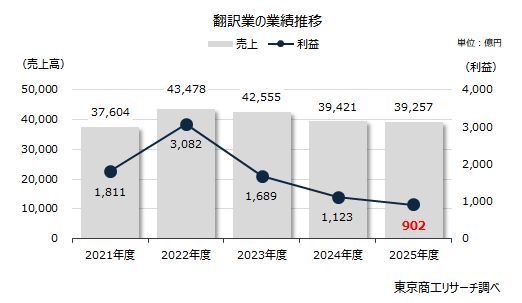
Japan’s translation industry lost 70 percent of its profits over three fiscal years. That is not a soft landing. It is a collapse with a timetable.
The data comes from Tokyo Shoko Research, which tracked 100 translation companies over five years. In the fiscal year ending March 2025, those 100 firms posted combined revenue of 39.26 billion yen and net profit of just 920 million yen. Three years earlier, in fiscal 2022, the same cohort had earned 3.08 billion yen in profit. Revenue fell 9.7 percent over the same stretch. Half the companies reported declining sales. Nearly half reported shrinking margins.
This is not a niche story. Translation was one of the last bastions people assumed would resist automation. Languages are messy, context-dependent, culturally layered — or so the argument went. The assumption turned out to be wrong fast.
How the erosion happened
The timeline matters. Profit peaked in fiscal 2022. That is exactly when generative AI translation tools crossed a visible quality threshold. Cheap and later free machine translation became viable for straightforward documents. Contracts, websites, internal communications, marketing copy — categories that once guaranteed steady work for translation houses — began moving through automated pipelines with minimal human intervention.
What changed is not just raw accuracy. It is access. A company no longer needs to hire a translator for a 50-page product manual. It pastes the text into a tool and gets something usable in seconds. The marginal cost of translation dropped toward zero for a vast swath of commercial content. Pricing collapsed. And when pricing collapses, profit margins evaporate — especially for firms whose cost structure was built around per-word or per-page billing.
Tokyo Shoko Research noted that among the 100 companies studied, 50 reported lower revenue in fiscal 2025 and 47 reported lower profit. Only 32 saw revenue grow. The distribution is telling: AI did not crush every firm equally, but it hollowed out the middle.
The bankruptcy signal
Bankruptcies in the sector had stayed below five per year for some time. The pandemic briefly pushed them to six in 2020, then government support measures held them at zero through 2021 and 2022. By August 2026, three filing insolvencies were already confirmed — the first uptick in years.
One company, a capital-region translation service, cited AI as the final blow. According to Tokyo Shoko Research, the firm was already struggling before AI arrived. But the technology made recovery impossible. “AI translation was the nail in the coffin,” a source told researchers.
Closure and dissolution numbers tell the same story. The sector has seen 50 or more firms shut down annually since 2024, after breaking 30 for the first time in 2019. These are not staggeringly large employers, but they are not negligible either — and they represent accumulated expertise, client relationships, and institutional knowledge being liquidated.
Where human translators still matter — and why that may not be enough
The report acknowledges a silver lining that some firms are clinging to: specialized terminology, legal nuance, cultural subtlety. Complex contracts and domain-specific documents still require human judgment, and many companies retain a final human review step even when AI does the heavy lifting.
That defense has a shelf life. AI models are already absorbing legal and technical corpora at scale. The gap between machine output and human output in specialized domains is narrowing every quarter. What is defensible today may not be defensible in 18 months.
Firms that survived the initial shock tended to be the 32 that reported revenue growth. They are likely the ones that pivoted fastest — toward high-value localization, multimedia subtitling, regulatory compliance work, or services that bundle translation with cultural adaptation rather than mere language conversion. Those are real niches. But they are also smaller markets with higher barriers to entry.
Why this matters beyond Japan
Japan’s translation industry is not a special case. It is an early read on a global pattern. The country’s demographic and linguistic isolation — fewer English speakers relative to GDP, a domestic market large enough to sustain local-language services, deep traditions in precision documentation — should have made it the hardest place for AI translation to disrupt. It was not.
If a protected, linguistically distinct, regulation-heavy market can lose 70 percent of sector profits in three years, then the displacement risk in more open economies is likely steeper and faster.
nThe global knowledge-work narrative has focused on coding, customer support, and content creation. Translation belongs to the same family — skilled, language-based, medium-complexity cognitive labor. The mechanism is identical: AI reduces the cost of a serviceable output, price follows, firms that cannot differentiate on quality or specialization compress, and the market restructures around a smaller number of higher-value players.
What happens next
Three scenarios are plausible.
First, consolidation. The surviving firms acquire failing ones at discount valuations, absorb their client lists, and raise prices by offering guaranteed human-reviewed output. This is already happening in other sectors. It reduces competition and raises costs for clients, which in turn may slow adoption — a self-correcting feedback loop.
Second, commoditization. AI translation becomes the default for everything except the most sensitive documents. Human translators concentrate on a narrow set of high-stakes work — court proceedings, treaty negotiations, literary publishing. The profession shrinks dramatically in headcount but potentially rises in per-unit value for those who remain.
Third, hybrid dependency. Firms reposition as AI-editing and AI-training services rather than pure translation shops. Translators become prompt engineers, quality auditors, and domain-specific fine-tuners. This is the most productive outcome for the economy overall, but it requires retraining at scale and carries its own displacement risk as AI tools improve at auditing their own output.
None of these paths are comfortable for the firms and workers caught in the transition.
The uncomfortable question
The translation industry was assumed safe precisely because language is hard. That assumption was wrong. Not because language is simple — it is not. But because AI does not need to master language the way humans do. It needs only to produce output that is good enough for enough purposes at a price that undercuts human labor by orders of magnitude.
“Good enough” is a moving target. And every quarter it moves closer to “indistinguishable” for a wider range of use cases.
Japan’s experience should not be watched with detached interest. It is a leading indicator. The 70 percent profit collapse, the rising bankruptcy count, the shuttered firms — these are not localized events. They are early data points in a structural shift that will touch every knowledge-worker economy on earth.