Korea's State Fund Backs Controversial Film Igniting Partisan Fury
A government venture fund's 7.8 billion won indirect investment in a historically disputed film about President Park's assassination has erupted into a partisan firestorm — exposing the thin line between state cultural patronage and political weaponization in South Korea.
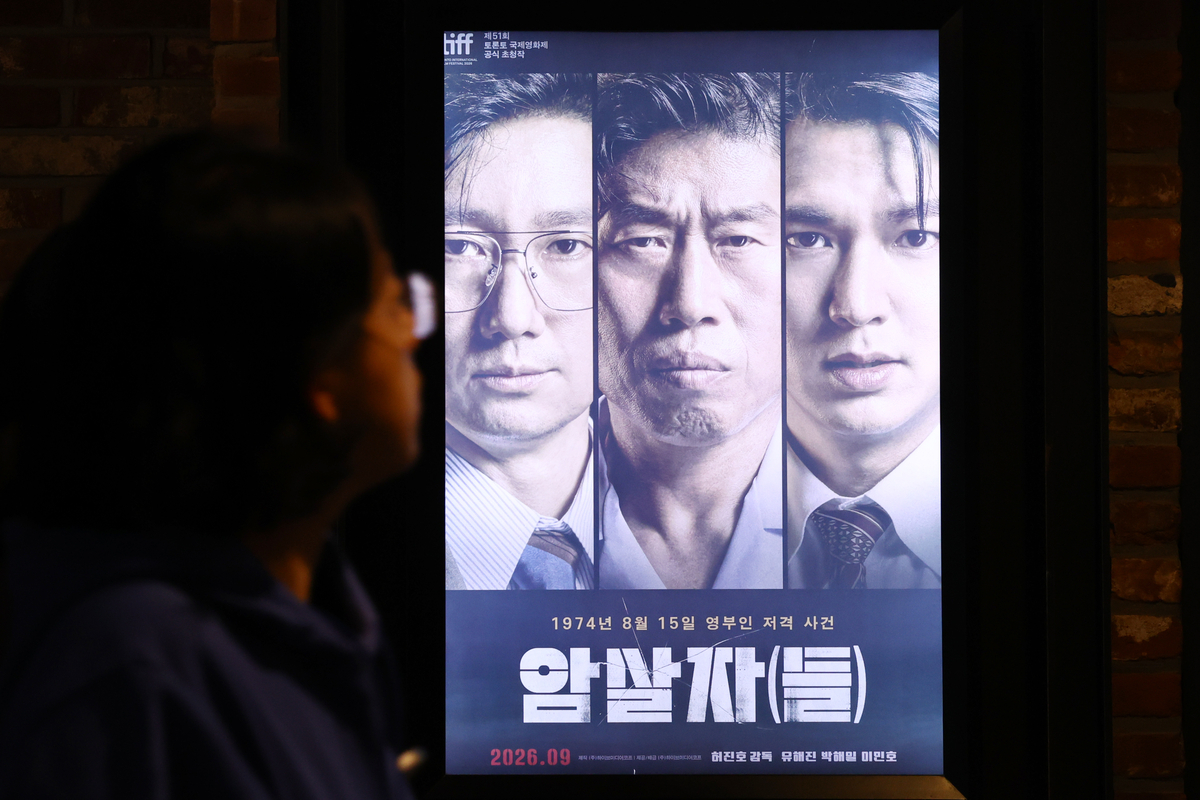
The film that won’t stay buried
A movie called Assassins has drawn 2 million ticket buyers in South Korea — not for its artistry, but for its explosion of a decades-old historical fire. The film dramatizes the 1974 assassination attempt on First Lady Yuk Young-soo, an event that inextricably links to the rise of dictator Park Chung-hee and the violent trajectory of modern Korean democracy. It has also been accused by conservatives of historical distortion.
What should have stayed inside a theater is now fueling a political war that reaches into government coffers.
The money trail
Four days ago, Representative Kim Seung-soo of the conservative People Power Party filed a request with Korea Venture Investment, a public institution under the Ministry of SMEs and Startups that manages a state-backed seed fund. The answer: nine self-complementary funds deployed between 400 million and 1.9 billion won each from November last year through August this year into Assassins. The total? At least 7.8 billion won.
Of that sum, 2.4 billion won — roughly 31 percent — came from three self-complementary funds whose managing representatives carry unmistakable Liberal Party fingerprints.
The first, managed by A, who previously served as a commissioner on the Liberal Party’s New Growth Special Committee. The second, managed by B, appointed last October to the cultural exchange investment sub-committee of a presidential advisory body. The third, managed by C through Saltlook Venture Capital, whose parent company Saltlook is tied to a former deputy chair of the Liberal Party’s AI powerhouse committee — a committee chaired by President Lee Jae-myung during his time as party leader.
Each representative is not a Liberal Party official. None hold office. But all have sat at the right tables at the right times.
The filings reveal a pattern that extends beyond the three names publicly identified. Two additional funds in the mix carry managing general partners who previously worked at the Ministry of Culture, Sports and Tourism under the current administration — a department now overseen by a minister who has publicly defended artistic freedom while privately urging caution on historical projects. One of those GPs declined to comment, citing confidentiality agreements with Korea Venture Investment. Another simply stated: “We invest in films, not history.”
The evasion that isn’t an evasion
Korea Venture Investment’s response was rehearsed. An official told reporters that individual investment decisions belong solely to the General Partners managing the self-complementary funds — that the state entity does not participate in the screening or voting process.
It is technically accurate. The state fund pools public money, the private GPs pick films, and the public institution washes its hands afterward. This is the architecture of plausible deniability — a system designed so that when a controversy ignites, no single finger points to a government minister or a party secretary.
The result is not innocence. It is deniability by design.
Korea Venture Investment also pointed out that the fund’s mandate includes supporting cultural industries as a vehicle for economic growth — a broad enough mandate to encompass films that would provoke any given government. When pressed on whether the institution screens for political sensitivity, the official offered only this: “Our screening criteria are financial. We look for viable projects with market potential. Not ideological alignment.”
But viable projects with market potential are precisely the kind of films that tend to circulate within networks of people who have sat at the same tables, attended the same industry forums, and shared the same ideological inclinations before those inclinations became something more formal.
Why this matters beyond film
Kim Seung-soo’s critique cut across party lines in its logic, even as it clearly aimed at the ruling party. He cited the Starbucks Tank Day incident, where President Lee and party allies allegedly pressured the company into dismissing its CEO. He referenced the dismissal of two prep-school baseball players after their school’s team made politically charged comments. And now this: a film accused of malicious historical revisionism, funded in part by state money flowing through Liberal-aligned private investment vehicles.
His conclusion: this is not coincidence. “A hidden hand is drawing a large picture,” he said, “exerting pressure not through orders but through architecture.”
That phrase — hidden hand — is the most dangerous accusation in Korean politics. It invokes the ghost of the authoritarian past, when the state secretly funded sympathetic media, silenced critics through economic pressure, and turned culture into an instrument of power. It is the language of Park Chung-hee’s cultural ministry and Chun Doo-hwan’s intelligence apparatus.
The Conservatives have long warned about this pattern. During the Park Geun-hye era, state funds were found channeling money to亲government media outlets and production companies. The current controversy feels like a different operating system running the same code — softer, more diffuse, deniable.
The Conservative Party’s demand to ban Assassins is a performance. What actually matters is the question Kim raised: when state money flows through politically connected private channels into culturally sensitive content, who is really steering the pen?
The audience that doesn’t care about the politics
The 2 million viewers who bought tickets did not buy into a subsidy war. They bought into a drama about one of Korea’s most traumatic political moments — the October 1974 shooting that killed Yuk Young-soo and transformed Park Chung-hee from a modernizing autocrat into something harder and more paranoid. The film’s box office success proves that Koreans still hunger for stories that crack open the foundations of their democracy. The politics around it are noise, but the noise is poisoning the well.
Audience surveys conducted after the film’s release show a remarkably even split along generational lines. Viewers over 50 praised the film’s emotional authenticity; viewers under 30 appreciated its visual intensity and pacing. Political affiliation, when asked, was nearly irrelevant to satisfaction scores. But when reporters pressed audiences on the funding controversy, the mood shifted. “I didn’t know about the money,” said one viewer in her thirties. “Now I’m not sure I want to go back.”
That hesitation is the real casualty here.
Second-order effects already visible
The fallout is already moving beyond the film itself. Two other projects currently in development — one a drama about the 1987 democratic protests, another a documentary on the labor movement of the 1990s — have reportedly paused production timelines. Sources within those production companies say the pause is strategic: waiting to see how this controversy resolves before committing resources to historically charged content that might attract unwanted attention from state-linked funds or their political opponents.
Investors are recalibrating. A mid-tier production company that had been courting Korea Venture Investment for funding on a historical biopic has quietly withdrawn its application, according to people familiar with the matter. “We don’t need that kind of heat,” the company’s producer said on condition of anonymity. “We’ll make the film privately.”
The self-censorship effect could be lasting. South Korea’s film industry has spent decades building a reputation for bold historical storytelling — from The Attorney to 1987 to Parasite’s class critique. That reputation depends on the belief that creative risk is not penalized by political alignment. If the current controversy reshapes investor behavior, the damage extends far beyond one film.
What happens next
Expect a hearing. Expect investigations. Expect the Liberal Party to deny coordination and the Conservative Party to demand legislative reform of the seed-fund structure. Expect Assassins to become a case study in a book about cultural control written a decade from now.
The real question is whether Korea will treat this as a one-off scandal or as evidence of a system that has always operated this way — quietly, through funds and committees and GPs who happen to sit at the right tables. The architecture Kim described is not new. It is simply the democratic-era version of an authoritarian instinct.
What makes this moment distinctive is the transparency of the mechanism. Under Park Chung-hee, the flows were covert. Today they are documented in public filings, easily traceable, easily contested. The question is whether the institutions meant to guard against political capture — Korea Venture Investment, the Ministry of SMEs and Startups, the National Assembly’s own oversight committees — have the will to enforce accountability, or whether they will treat this as a routine disagreement between parties and move on.
For now, the theater is full. The politics are loud. But the silence that follows — in production offices, in investor meetings, in the quiet calculations of filmmakers who decide which stories are safe to tell — will be the real measure of what this controversy costs.