Japan Just Solved the Wet-Electronics Problem for Implantable Sensors
RIKEN's 200nm transparent conductive film stays stable in body fluids where most electronics fail. The materials science breakthrough could unlock a new class of implantable biosensors and brain-interface devices.
The Wet Problem No One Could Solve
Transparent conductive films exist in several forms. Metal oxides like indium tin oxide (ITO) are brittle and crack under mechanical stress. Silver nanowire meshes offer flexibility but corrode rapidly when exposed to water or saline solutions—essentially every environment inside or on the human body. That contradiction has been a bottleneck for bioelectronics for over a decade: you need transparency for optical monitoring and neural imaging, conductivity for signal acquisition, and stability in fluid for any real-world biomedical application. Getting all three simultaneously has proven extraordinarily difficult.
A research group at Japan’s RIKEN Institute appears to have resolved it.
What RIKEN Actually Built
The team, led by researcher Sun Lulu and senior scientist Takuo Sumiyasu at RIKEN’s Open Innovation Laboratory, published results in August 2026 describing a dual-phase percolation network film—BIPIN—that measures roughly 200 nanometers thick. The structure is elegantly simple in concept: a metal nanowire network provides the conductive pathways, while a polymer phase infiltrates the spaces between wires and wraps around them, forming a protective sheath.
The critical material choice is a fluorine-containing ionomer. Fluorinated polymers are among the most water-repellent synthetic materials known. By placing this polymer between the metal nanowires and the substrate, RIKEN blocked the ingress of water and chloride ions—the primary agents of corrosion and resistance drift in wet electrochemical environments.
The numbers are specific and aggressive. Water contact angle: 94.6 degrees, indicating genuine hydrophobicity. Sheet resistance: approximately 20 ohms per square. Visible-light optical transmission: over 90 percent. After 600 minutes of immersion in rainwater, seawater, or phosphate-buffered saline, the increase in electrical resistance was just 15.8 ± 5.1 percent. For context, most silver nanowire films report resistance increases exceeding 100 percent under comparable conditions before failure.
Why the Numbers Matter More Than They Appear
A 15.8 percent resistance shift over 600 minutes may sound modest, but in the context of implantable or wearable biosensors, it represents the difference between a device that functions for days and one that degrades within hours. Most existing transparent electrodes operate acceptably in dry laboratory conditions. The moment they encounter bodily fluids—sweat, interstitial fluid, cerebrospinal fluid—they begin an irreversible degradation spiral. Corrosion products accumulate at the electrode-tissue interface, increasing impedance and introducing noise that renders recorded signals unusable.
RIKEN’s film inverts that trajectory. The polymer encapsulation prevents the electrolyte from reaching the metal nanowires in the first place. The fluorinated ionomer acts as both a physical barrier and an ionic shield, repelling chloride ions that would otherwise initiate galvanic corrosion.
The Biological Validation Is Where It Gets Interesting
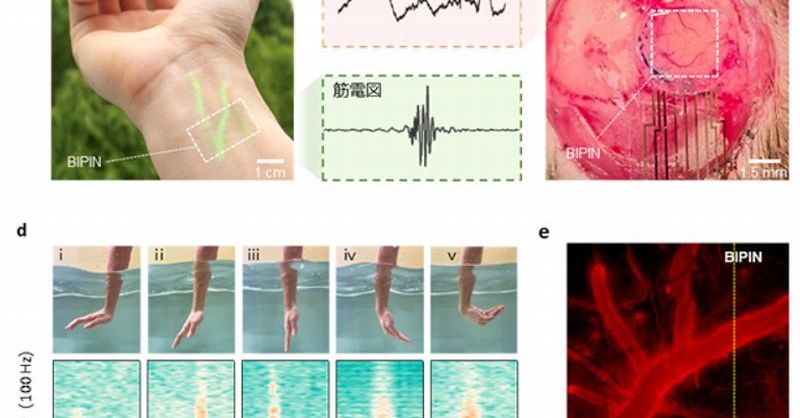
The paper doesn’t stop at material characterization. The team fabricated skin electrodes directly on human wrist skin and recorded electromyography signals while simultaneously performing near-infrared vascular imaging. They then built a nine-channel transparent brain surface electrode—each channel 300 by 300 micrometers, the entire array only 5.5 micrometers thick—and placed it on the cerebral cortex of live mice.
Cortical EEG signals were recorded stably for ten consecutive days. Signal quality did not degrade measurably over that period. Two-photon excitation microscopy confirmed that blood vessel imaging remained possible through the electrode itself, meaning the device can record neural activity and monitor underlying vasculature simultaneously without optical obstruction.
Cell viability on the BIPIN surface was 92.77 ± 1.78 percent relative to standard culture medium. Skin-electrode interface impedance at 100 hertz was lower than commercial Ag/AgCl electrodes and lower than silver nanowire-PDMS or PVA gel alternatives tested in the same configuration.
The Competitive Landscape Nobody Is Watching
This is a Japanese materials science publication, not a Wired feature. That means very few English-language medtech analysts have seen it. The implication is worth tracking.
The global implantable biosensor market is projected to exceed $15 billion by 2028, driven by closed-loop neurostimulation systems, continuous glucose monitors, and neural interface prosthetics. Every category demands transparent or semi-transparent electrodes for concurrent optical monitoring. Current solutions rely on opaque metal traces or opaque ITO patterns that blind the imaging channel. RIKEN’s film eliminates that trade-off entirely.
The more significant competitive question is timing. RIKEN is a public research institute, not a commercial manufacturer. The BIPIN film has not been licensed, packaged, or scaled. Japanese materials labs have a long track record of publishing breakthrough polymers and nanocomposites that take five to ten years to reach commercial production lines. The question is whether any medtech company with distribution relationships in Japan moves to license this before Chinese or Korean competitors reverse-engineer the formulation.
What Changes If This Scales
The first wave of impact lands on wearable health monitors. Current EMG and ECG patches use adhesive hydrogel electrodes that dry out, lose adhesion with sweat, and require daily replacement. A transparent, water-stable conductive film printed directly onto flexible substrates could enable skin-mounted sensors that maintain signal fidelity through exercise, bathing, and sleep—removing the single biggest source of data dropout in ambulatory monitoring.
The second wave is implantable. Neural recording arrays like Blackrock Microsystems’ Utah arrays or InteraCTION’s Michigan probes are opaque metal devices. Retinal prosthetics and cortical implants similarly sacrifice optical access for electrical recording. A 200nm transparent electrode that functions stably in cerebrospinal fluid for ten days or longer opens the possibility of hybrid optical-electrical implantable devices—recording neuronal spikes while simultaneously performing optical calcium imaging or optogenetic stimulation through the same aperture.
The third wave is less obvious but potentially larger: point-of-care diagnostics. Transparent electrochemical sensors for detecting biomarkers in blood or saliva would benefit from the same water-stable conductive platform. The low interface impedance measured against Ag/AgCl references suggests the film could serve as a working electrode in label-free biosensing applications without the background noise that typically plagues aqueous electrochemical measurements.
What Remains Unclear
The paper does not address long-term biodegradation or immune response beyond the 10-day in vivo recording. Twenty-week or annual implantation studies would be necessary before clinicians consider this for permanent implants. The scalability of the BIPIN fabrication process is also unspecified—spin-coating a 200nm dual-phase film on a lab-scale substrate is qualitatively different from roll-to-roll deposition on flexible plastic. And the cost of the fluorinated ionomer at production scale has not been disclosed.
None of these gaps negate the materials advance. They define the roadmap.
The Real Story
Japan’s materials science ecosystem produces world-class chemistry at research institutes like RIKEN, Kobe Steel, and Showa Denko. The pattern is familiar: brilliant discovery, cautious or absent commercialization, competitive capture by foreign firms. The BIPIN film follows that arc precisely. But the medtech addressable market is large enough, and the technical bottleneck real enough, that even a partial translation from lab to product could shift the electrode design baseline for an entire category of implantable and wearable devices.
The transparent conductive film has existed in various forms for twenty years. The version that survives immersion in seawater for six hundred minutes without meaningful resistance drift has not. RIKEN built it. Whether anyone builds a business on top of it remains an open question.
For now, the signal is clear: the wet electronics problem is no longer a theoretical constraint. It’s a solved one.