Kim Jong Un Is Betting Trump Will Blink First
North Korea's missile barrage after dismissing Trump's diplomatic overture reveals a calculated strategy: price leverage before the US midterms, then negotiate from strength. The calculus is reshaping regional defense spending and testing the limits of extended deterrence.
The Timing Wasn’t An Accident
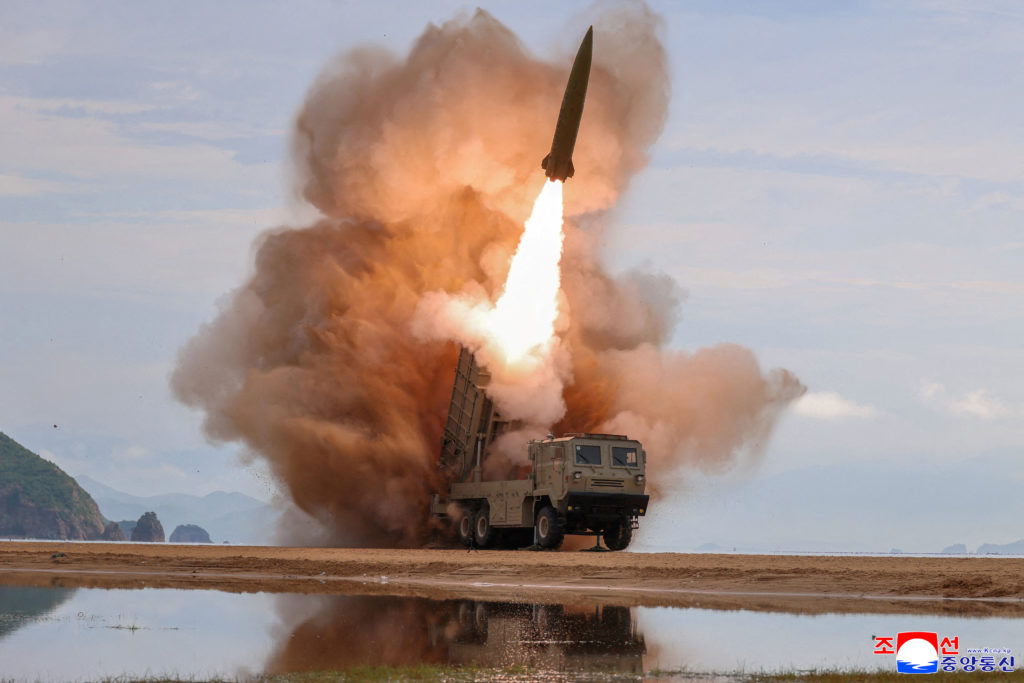
North Korea fired roughly ten short-range ballistic missiles into its eastern waters on Thursday afternoon, just one day after Pyongyang publicly dismissed a diplomatic overture from Donald Trump. The sequence matters more than the missile count — and intelligence analysts are already parsing what the timing reveals about Kim Jong Un’s read on American politics.
Trump had ordered the Pentagon to substantially reduce the Ulchi Freedom Shield exercises with South Korea — cutting the 11-day drill roughly in half — citing what he called a good relationship with Kim Jong Un and Seoul’s refusal to support him on Iran. The decision drew immediate criticism from South Korea’s presidential national security council, which warned that reduced readiness would embolden North Korea’s provocations. Trump dismissed the concern, telling reporters the cuts were a strategic gamble that could unlock a breakthrough with Pyongyang.
Kim Yo Jong, the leader’s powerful sister and likely the channel through which any communication flows, responded with a statement that was notably restrained compared to Pyongyang’s usual inflammatory rhetoric. She said the drills retained their provocative nature regardless of size. She also denied Trump’s claim that Kim had agreed to talks — a flat contradiction that suggests either Trump overstated the state of negotiations or Kim is deliberately keeping him guessing. But she left the door open, noting that personal relations between her brother and Trump remained excellent. That qualification — personal, not diplomatic — is the critical distinction.
That restraint is the signal. Kim isn’t closing the door. He’s pricing it.
The ten missiles themselves were not especially sophisticated — mostly MR-500 and Hwasan-21 variants, consistent with Pyongyang’s recent testing cadence — but their trajectory tells the story: fired into international waters, no risk to South Korean territory, designed to demonstrate capability without crossing into outright aggression. This is calibrated escalation at its most precise.
Leverage Isn’t Free
In 2018 and 2019, Kim held historic summits with Trump in Singapore and Hanoi but walked away with no substantive agreement. The talks collapsed over the core question that still defines the standoff: how much sanctions relief should North Korea receive for dismantling its nuclear program, and how much dismantling comes first? The Hanoi summit ended without a joint statement — an unusual public failure that signaled how far apart the two sides remained on the sequencing of concessions.
Experts now assess that Kim holds significantly more leverage than during those earlier rounds, and the gap has widened materially since 2019. His nuclear and missile programs have matured beyond the point of easy reversal. North Korea unveiled a new facility for producing nuclear weapons fuel at Yongbyon this year — imagery analyzed by satellite intelligence firms showed construction activity consistent with uranium enrichment infrastructure. The country conducted engine tests for the Hwasong-17 and Hwasong-18 missiles, variants capable of reaching the US mainland with heavy warheads. And Pyongyang has deepened its military cooperation with Russia in ways that are reshaping the strategic picture: Moscow is reportedly using North Korean artillery shells — an estimated 10 million rounds delivered since the invasion of Ukraine began — in its war against Ukraine, while North Korean workers and potentially combat troops have appeared in Russian territory.
The Russia connection changes everything. Kim is no longer an isolated pariah state conducting tests on the margins of international attention. He is a supplier in an active hot war, embedded in a military-industrial relationship with a permanent UN Security Council member. That relationship provides him with a diplomatic shield that didn’t exist in 2018 — Russia has every incentive to ensure that sanctions pressure on Pyongyang doesn’t escalate to the point of destabilizing the regime, which would cut off a valuable military supplier.
Kim’s strategy has shifted from seeking recognition through summits to extracting concessions through calibrated escalation. The missile barrage following Trump’s drill cuts fits that pattern precisely: test how far the US will go to de-escalate before demanding anything in return. Each controlled provocation raises the cost of inaction for Washington while preserving plausible deniability about intent.
The Midterm Clock
Trump’s decision to scale back Ulchi Freedom Shield came with a clear political logic — build goodwill with Kim, project deal-making strength at home, and set up a potential summit before the 2026 midterms. A Kim-Trump meeting, even a limited one, would be the kind of photograph that dominates cable news and provides cover for critics who argue that engagement works where containment failed. The timing is deliberate: if a summit can be staged in the spring or early summer of 2026, it lands squarely in the window where it matters most politically.
But North Korea appears to be reading the same calendar.
By rejecting the scaled-back drills as insufficient while keeping personal channels warm, Kim is sending a message to Washington: the next move belongs to you, and it better come with real concessions. The calculation assumes Trump will make that next move. It also assumes that a Kim-Trump meeting would provide the political payoff Trump needs heading into midterm season. If Pyongyang is right about American domestic politics — if the data from intelligence estimates and open-source analysis supports the view that Trump feels genuine pressure to deliver a foreign policy success — the leverage tilts further in Pyongyang’s favor before any negotiations even begin.
This is a bet on American electoral mechanics, and it’s one Kim has every reason to believe he can afford. The alternative — escalating to a crisis level that forces Trump’s hand — carries risks Pyongyang is carefully avoiding. The missiles were fired into the sea, not toward population centers. The rhetoric stayed below the threshold that would trigger automatic military responses. Kim is applying pressure, not crossing lines.
Allies Are Watching the Math Change
The drill reductions have already triggered anxiety among South Korea and Japan that runs deeper than any single exercise. Seoul’s presidential national security council issued a statement urging North Korea to halt its launches — standard but pointed, and notably more forceful in tone than previous statements. Japan’s prime minister’s office confirmed it detected the suspected missile launches and coordinated with Washington and Seoul on monitoring. Both allies are now reassessing whether the US security guarantee holds up when Washington prioritizes bilateral diplomacy with Pyongyang over collective deterrence.
That reassessment is likely to show up in defense budgets within quarters, not years. South Korea has been steadily increasing its military spending independently of the US alliance — Defense Minister Han Min-koo has signaled intentions to reach 5% of GDP by 2027, up from roughly 3% — and is pursuing capabilities that reduce dependence on American strategic assets. Japan is pursuing similar autonomy, accelerating its acquisition of counterstrike capabilities and debating constitutional reinterpretations that would enable collective self-defense in ways previously unthinkable. If Pyongyang’s latest move convinces Tokyo and Seoul that Washington’s commitment is conditional on a leader’s temperament rather than institutional obligation, the region’s defense spending trajectory shifts sharply upward — and the US defense industrial base faces mounting pressure to fill gaps it never planned for.
The second-order effect extends beyond spending. The credibility of extended deterrence — the promise that the US would risk its own cities to defend allies — is now being stress-tested in real time. Every reduction in forward-deployed capabilities, every signal that Washington prefers diplomacy to deterrence, erodes the psychological foundation of the alliance architecture that has underpinned regional stability since the Korean War. Japanese and South Korean policymakers are asking questions that their governments have deliberately avoided for decades: Can we rely on the American nuclear umbrella if the president who guarantees it views it as negotiable?
No Talks Without a Price
Kim has publicly stated he will not return his nuclear program to the negotiating table on US terms. That is a line drawn in 2026 that was not visible in 2018, and it reflects a fundamental shift in Pyongyang’s posture. The expectation among analysts is that Kim will eventually secure international recognition as a nuclear state and extensive sanctions relief — but only in exchange for limited, reversible denuclearization steps, not the comprehensive dismantlement the US has historically demanded. The framework is no longer denuclearization first, then rewards. It is recognition first, then incremental steps.
The missile barrages, the refusal to engage on Trump’s timeline, and the continued denial that any conversation has been agreed to all point toward the same endgame: force the US into a position where it accepts Pyongyang’s terms rather than walk away empty-handed. Trump told reporters Wednesday he expects to meet Kim this year. He declined to confirm whether they are exchanging letters. The fact that he is still signaling availability is itself data — and Pyongyang is almost certainly collecting it.
This is a negotiation strategy built on asymmetry. Kim faces no electoral pressure. He faces no independent media demanding accountability for concessions. He faces no coalition partners who might split over a deal. Trump faces all of these things. The structure of the bargaining environment favors Pyongyang by design.
What Comes Next
The immediate horizon offers little clarity. North Korea is unlikely to return to talks without a significant American concession — perhaps a formal suspension of sanctions, a pullback of strategic assets from the region, or explicit language acknowledging North Korea’s nuclear status. Trump is unlikely to offer those without a visible diplomatic win to point to. Both sides are playing a longer game. Kim is stretching the negotiation timeline until the political cost of engagement falls on Washington, not Pyongyang. Trump is betting that continued personal outreach will eventually produce a deal that looks like a victory at home.
The missiles flying toward the sea on Thursday were not an attempt to start a war. They were an attempt to set the price. And the question now is whether Washington will pay — and at what point, the allies who have banked on American security guarantees decide the ledger no longer balances in their favor.