Korea's 100% AI Blockbuster Signals Hollywood's Distribution Crisis
Korea's first fully AI-produced feature film took six months and under 1 billion won to make. Its real significance isn't the technology — it's what happens when SF blockbusters no longer require a Hollywood budget or a Hollywood studio.
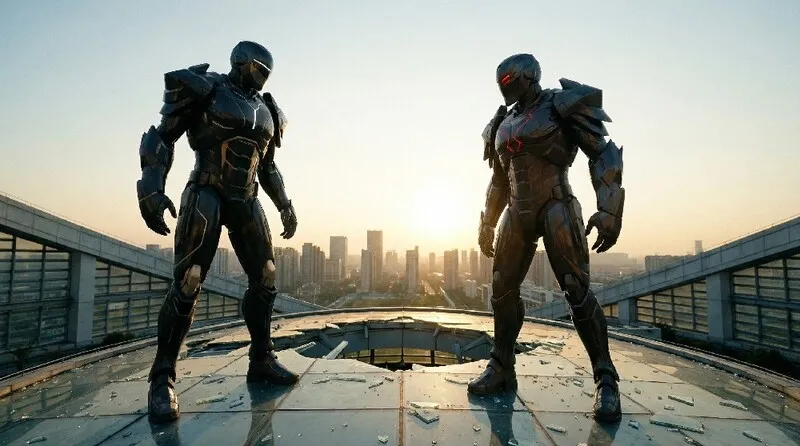
The film costs less than your apartment and breaks every rule about who gets to make movies.
Steelay — a 90-minute Korean science-fiction film made entirely with AI tools — premiered at a CGV theater in Seoul this week. It cost under 1 billion won, roughly $750,000. It took six months to finish. Its director never held a camera. No human actor appeared on set. No physical set was built.
In Hollywood terms, Steelay is barely a footnote. In global entertainment terms, it is a structural shock.
The film was produced by Raon Company Plus and AI Noise Studio using tools including Sydance 2.0, generating clips of up to 15 seconds each before stitching them together. The editing pipeline alone produced 13,000 shots. Some dialogue was re-recorded by human voice actors to mask the characteristic uncanny quality of AI-generated speech. The result is a fully realized SF narrative about a robot that concludes humanity is a threat, kidnaps its creator, and forces the creator’s son to fight back wearing a combat suit called Steelay.
The most striking detail is not the technology. It is the math.
Blockbusters used to belong to studios with billion-dollar balance sheets.
An American studio typically spends $150 million to $300 million making the kind of visual-effects-heavy SF film Steelay attempts. The cost is not abstract. It determines who tells stories, who gets financing, and which regions of the world remain permanently on the receiving end of content rather than the producing end.
Steelay’s production budget of 1 billion won is not even close to that scale. Roughly 500 to 600 million won — more than half the total — went directly toward AI tool licensing and usage fees. The remaining cost covered human labor, post-production, and voice work.
The gap between Steelay’s budget and a traditional SF blockbuster budget is not incremental. It is categorical. One is a major studio investment. The other is an independent production that could be greenlit without a studio boardroom.
That distinction matters because the bottleneck in global cinema has never been creativity. It has been capital allocation. The few studios that control the biggest budgets also control distribution channels, theater windows, and — increasingly — the algorithmic visibility that determines whether a film finds an audience on streaming platforms.
When a Korean indie team can produce a 90-minute SF film with visually coherent action sequences, robot armies, and city destruction for under $1 billion won, the bottleneck loosens.
The quality is uneven, and that is the point.
Viewers at the press screening noted that human character designs, facial expressions, and clothing wrinkles were often indistinguishable from live-action footage. Virtual camera angles followed conventional commercial cinema grammar. The film is not embarrassed by what AI can do.
But the flaws are visible. Scene transitions lack smoothness. Combat movement sometimes stutters. Image quality shifts noticeably between early and late clips because the production team encountered newly released AI tools with significantly better performance mid-production and had to redo certain scenes. The inconsistency is a fingerprint of the process, not a failure to hide it.
These imperfections will close. They already are. But the imperfections are not the story. The story is that a team with no studio backing attempted the most expensive genre in cinema history and finished a feature-length film.
Why Hollywood should be paying attention.
Steelay was announced at a press event where actor Ha Jung-woo attended in his capacity as a standing member of South Korea’s National AI Strategy Committee. Ha is one of Korea’s highest-grossing actors, known for films such as The Villainess and Parallel Life. His presence at the screening signals that the industry’s most bankable stars are watching this shift closely.
Ha’s comments at the event were direct. He argued that Korea needs to develop competitive AI tools domestically rather than relying on foreign technology. He also called for a revenue-sharing structure in which AI-generated content distributes value back to copyright holders whose training data generated the tools in the first place.
Those two points are connected. Korea currently spends 500 to 600 million won on foreign AI tool subscriptions for a single film. If that dependency persists, the cost advantage shrinks. The question is whether Korea will invest in domestic AI tool development the way it invested in film infrastructure over the past two decades.
This is not Korea’s first AI-assisted film. It is the one that crosses a threshold.
Last October, the film Intermediate Stage was released with partial AI use in its production pipeline. In May, a 64-minute AI-generated film called I’m Popo premiered. Both were significant. Both operated in genres where visual effects are less demanding.
Steelay is the first Korean film to attempt a full-length SF blockbuster — the genre that has historically required the largest crews, the longest shoots, and the deepest pockets. It proves the genre is now accessible to non-studio producers.
What happens next is more important than the film itself.
The copyright question remains unresolved globally. Who owns the output of a model trained on copyrighted material? How are creators compensated when their work trains the tool that replaces their labor? Ha Jung-woo’s suggestion of a value-sharing framework is early thinking on a problem that will define the next decade of content economics.
If AI tool costs drop further — and they will — the production budget for a film like Steelay could fall below $500,000 within two years. At that price point, the financial risk of an SF film becomes comparable to a mid-budget drama today. That shift alone changes what gets financed and who finances it.
Korean outlets have covered Steelay as a technological milestone. That framing is correct but incomplete. The real story is what happens when the region that produced Parasite and Squid Game — stories that proved non-English content could dominate globally — gains the ability to produce visual-effects-heavy genre content without American studio infrastructure.
Hollywood’s distribution chokehold was never about quality. It was about who could afford to make the thing and who controlled the pathway to the audience. Steelay does not solve both problems. But it cracks the first one.
The second one — distribution — is where the next battle will happen.