Korea's 30% Crash Shows Leveraged Retail Trading Can Upend Markets
South Korea's KOSPI lost a third of its value in two months as retail investors who borrowed billions to chase AI-semiconductor stocks were caught in a margin-call spiral. The fallout raises questions about market stability in economies where two firms dominate half the index.
The Math Behind the Meltdown
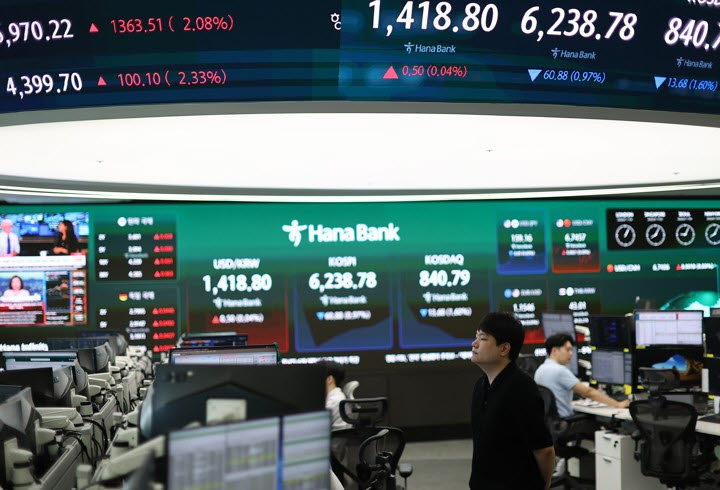
South Korea’s KOSPI shed 30 percent of its value from a peak on June 19 — not over a year, not over quarters, but in roughly eight weeks. The speed of the collapse matters as much as the magnitude. Markets that climb fast on borrowed money tend to come down faster still.
At the center of the storm are retail investors who piled into leveraged exchange-traded funds tied to Samsung Electronics and SK Hynix, the two semiconductor giants that together account for more than 53 percent of the entire KOSPI market capitalization. When credit-loan balances among individuals hit a record 29.8 trillion won (≈$21.4 billion) on June 24 — up nearly 75 percent from the start of the year — the market had already priced in a continuation of the AI-driven rally. Instead, it unraveled.
Citi estimated personal investor losses on leveraged ETFs alone at $38.7 billion, roughly 53.9 trillion won. That is a staggering sum for a demographic typically associated with modest savings accounts rather than institutional-grade speculation. The figures suggest a household-level panic that no single regulator anticipated.
Who Built the Trap
The regulatory framework made this outcome more likely, not accidental. South Korea’s financial authorities deliberately narrowed the gap between domestic and overseas ETF regulations, allowing single-stock leveraged and inverse products for Samsung and SK Hynix. The first of these instruments launched on May 27 — barely six weeks before the market turned.
Leveraged ETFs are designed to multiply daily returns, not long-term ones. A product tracking twice the daily movement of its underlying stock can diverge dramatically from a simple two-times holding over weeks or months, especially in volatile conditions. That structural risk is well known in institutional finance. It appears the government judged that retail access to such products was a reasonable trade-off for deepening domestic markets.
The timing was catastrophic. The KOSPI had already more than doubled from its October low the prior year. Samsung and SK Hynix were riding an AI semiconductor supercycle. Into that overheated environment flowed a wave of newly minted leveraged products and an unprecedented surge in margin borrowing. The convergence created a classic fragility: heavy positioning in a narrow set of stocks, financed with debt, amplified by derivatives that magnify both gains and losses.
The Human Cost Is Real and Measured
Market crashes are usually discussed in index points and percentage draws. This one has a psychological footprint that is unusual for a developed economy.
The VKOSPI — South Korea’s implied volatility index, often called the Korean VIX — surged to 97.99 in early July, the highest reading since records began in 2009. For context, readings above 40 signal significant stress; above 80 is rare even during financial crises. Daily KOSPI swings of 5 to 8 percent became routine in July, a pace that destabilizes even professional traders, let alone individuals who entered the market during the frenzy.
The collateral damage extended well beyond portfolio balances. Jeon Seok-jae, a financial YouTube channel with 3.7 million subscribers, told Reuters that many retail entrants suffered losses severe enough to destroy their interest in investing entirely. Park Jong-seok, a Seoul-based psychiatrist specializing in investment-related counseling, reported that his daily patient load rose from seven or eight per day last year to an average of eleven since June. In Busan, a man in his twenties was arrested on suspicion of brandishing a weapon over a dispute blaming a stock-loss YouTuber for his financial losses.
These are not peripheral details. They signal that the crash penetrated communities and mental health systems in a way that will take years to fully assess — and that public trust in the market as a vehicle for wealth creation has been sharply damaged.
The Korea Discount Complication
The crash arrives at a politically sensitive moment. The Lee Jae-myung administration has staked part of its economic credibility on eliminating what analysts call the Korea discount — the persistent undervaluation of Korean equities relative to peers — through corporate governance reform and capital market overhaul. A key milestone on that path is inclusion in the MSCI Developed Markets index, which would trigger passive inflows from global institutional funds.
Hur Jae-hwan, a researcher at Eugine Investment & Securities, told Reuters that the excessive volatility risked undermining exactly the kind of long-term foreign investment the government seeks. Governance improvements, he noted, need time to take root; a 30 percent drawdown in two months does not provide that runway.
The executive office and the Financial Services Commission have pushed back, saying risk factors were evaluated at each stage of the leveraged ETF rollout. Whether that assessment was sufficient is now subject to intense scrutiny. The broader question — whether emerging-market regulators can responsibly introduce complex derivatives to retail audiences during a speculative bubble — remains unresolved.
Who Wins, Who Loses
Samsung and SK Hynix remain the cornerstones of the Korean economy and the global semiconductor supply chain. Their fundamentals have not evaporated; the AI demand cycle is real. But the market structure that concentrated more than half the index in two names proved brittle under leverage stress.
Retail investors who entered with borrowed money absorbed the brunt of the damage. Many will exit the market entirely. An 80-year-old retired investor who told Reuters he lost 35 percent of his capital and vowed never to return to the KOSPI represents a demographic that regulatory reform explicitly aimed to protect and expand.
International institutional investors face a different calculation. Some may view the crash as a buying opportunity in fundamentally sound companies trading at depressed valuations. Others will reassess Korea’s risk profile and delay allocation until volatility subsides and regulatory clarity emerges. The MSCI developed-market bid hangs in that balance.
What Happens Next
The most likely near-term trajectory is a period of suppressed participation. Retail investors who have been burned do not return quickly, and the psychological scars — psychiatric caseloads rising, arrest incidents emerging — suggest this episode will be discussed in professional circles for years.
Regulators will face pressure to reconsider leveraged product accessibility for retail audiences, at minimum in concentrated markets where two names dominate an index. Whether they act before the next speculative cycle begins is an open question.
For global markets, the episode offers a reminder that semiconductor demand signals do not travel in isolation. Korea’s market structure — extremely concentrated, increasingly leveraged, and tightly coupled to a single sector — means that a sharp correction here can ripple through supply-chain expectations, earnings revisions, and investor sentiment well beyond East Asia. The crash is a domestic event with international implications, precisely because the KOSPI is not a diversified proxy but a concentrated bet on memory chip cycles.
The Korea discount was never going to be solved by a rally fueled by margin debt. It requires institutional stability, deeper participation, and a market structure that does not collapse when borrowed money runs out. The 30 percent drop has exposed how far the country still has to go.