Korea's 7,000-Line Breach Is a Canary for EMs Under Oil and Fed Squeeze
Korea's flagship index just lost a psychologically critical level for the first time in over a month, dragged down by surging US Treasury yields and oil above $100 a barrel. The real story is what this reveals about emerging-market fragility when commodity shocks meet tighter dollar policy.
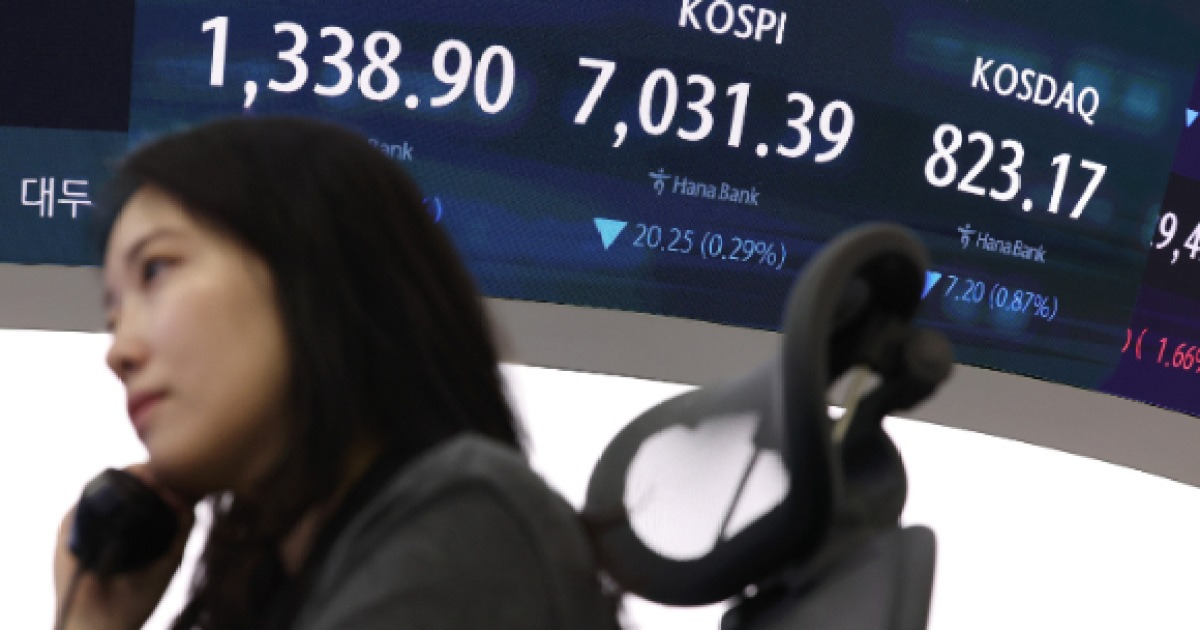
A Threshold Gone
The KOSPI opened below 7,000 on Wednesday morning — not because of domestic weakness, but because two external shocks collided on the same session. US 10-year Treasury yields climbed to 4.83%, Brent crude settled above $101 a barrel, and a quarterly futures-and-options expiry added mechanical selling pressure. The composite index fell 87.84 points, or 1.25%, to 6,963.80 by 9:43 AM local time.
The psychological weight of 7,000 should not be dismissed lightly. The index had climbed back above that level only the day before, ending a stretch of stagnation that dated to early August. Losing it within hours of reclaiming it suggests the market’s upward move lacked conviction from the start.
Who Is Selling — And Why It Matters
The flow data tells a clearer story than the headline number. Foreign investors sold 101 billion won worth of KOSPI shares in the early session, while domestic institutions added another 25.6 billion won in selling. Retail investors, typical safe havens during selloffs, bought 16.99 billion won — a sign they may already be reaching their limit.
The same pattern repeated on the KOSDAQ, where the index slid 1.45% to 818.36. Foreigners sold 13.83 billion won, institutions sold 4.43 billion won, and retail bought 18.52 billion won. When the people who can least afford to lose purchasing power are the only ones left bid, the floor is closer than it looks.
Samsung Electronics fell 1.02% to 266,750 won and SK Hynix dropped 0.48% to 1.847 million won. The semiconductor sector — Korea’s most important export engine and the sector most sensitive to global growth worries — is absorbing the heaviest blows. That alone warrants attention. Global AI-capacity buildout has kept semiconductor demand robust through most of 2026, but rising borrowing costs and a stronger dollar compress the financing conditions underpinning that spending.
Financials moved in the opposite direction. KB Financial, Samsung Life Insurance, and Shinhan Financial Group all gained, reflecting the yield curve dynamics that reward lenders when rates climb. But sector rotations of this kind rarely sustain an index without broader breadth.
Two Shocks, One Market
The first shock is geopolitical. On Tuesday, the US Central Command confirmed strikes on five Iranian油 tankers, sending energy markets into a spike that pushed Brent crude to its highest close since May 22. WTI approached $100 as well. For a country that imports nearly all of its crude, any sustained move above $100 a barrel is effectively a tax on the entire economy — higher transport costs, higher manufacturing input prices, and downward pressure on household consumption.
The second shock is monetary. US Treasury yields rose sharply after the Treasury Department’s latest refunding announcement came in below market expectations, with a buyback size of just $6 billion against wider forecasts. The 30-year yield touched 5.3%, deepening the yield curve’s steepening phase and reinforcing the dollar’s strength. A stronger dollar matters enormously for Korea: the won has traded in a range that leaves exporters competitive but importers exposed, and a further appreciation would squeeze margins across the board.
Kim Ji-young, a researcher at Kiwoom Securities, noted that the confluence of weak US market sentiment — driven by the oil and yield shocks — and the mechanical volatility from the quarterly expiry makes a pullback likely. Her assessment undersells the structural dimension. This is not merely a technical correction. It is a re-pricing of risk in an environment where the Fed has not signaled easing and OPEC+ has not agreed to additional supply.
What This Means Beyond Seoul
Korea is often treated as a bellwether for emerging Asia, but it is more accurately a stress test for how deeply dollar-denominated debt and commodity dependence can penetrate an advanced middle-income economy. The KOSPI’s breakdown below 7,000 is a signal that the market’s recent recovery — built on semiconductor optimism and relative rate stability — was premature.
For regional investors, the lesson is specific: the carry trade is unwinding. A year ago, borrowing in yen or dollars to fund Korean equities was a popular strategy. Higher US yields and a strengthening dollar are squeezing that position from both sides. The sell-off in foreign-held Korean shares is not new money leaving — it is leverage being reduced.
For policymakers in Seoul, the dilemma is sharper still. The Bank of Korea faces a choice between cutting rates to support growth and holding steady to defend the won. Every basis point of easing strengthens the outflow pressure; every basis point of tightening deepens the domestic slowdown. The market has been pricing in a cut by early 2027, but today’s data suggests that timeline may need to shift later.
The next few weeks will determine whether 7,000 becomes a level that holds or a ceiling that proves decisive. The oil market is pricing in continued Middle East instability through November, and the US Federal Reserve has offered no encouragement on the rate front. Until one of those variables changes, the KOSPI is likely to remain range-bound at best, and trending lower at worst.
What happened Wednesday was not a flash crash. It was a reminder that in a world where energy prices can jump 3% in a single session and bond yields can reset without warning, no index level is permanent — not even one that took a month to reclaim.