Korea's Air Defense Net Closes Over Eastern Europe
South Korea is pivoting its European defense strategy from single-platform sales to layered air-defense ecosystems. At Poland's MSPO expo, Korean firms are offering everything from long-range SAMs to laser anti-drone weapons — and the win could reshape NATO's eastern flank.
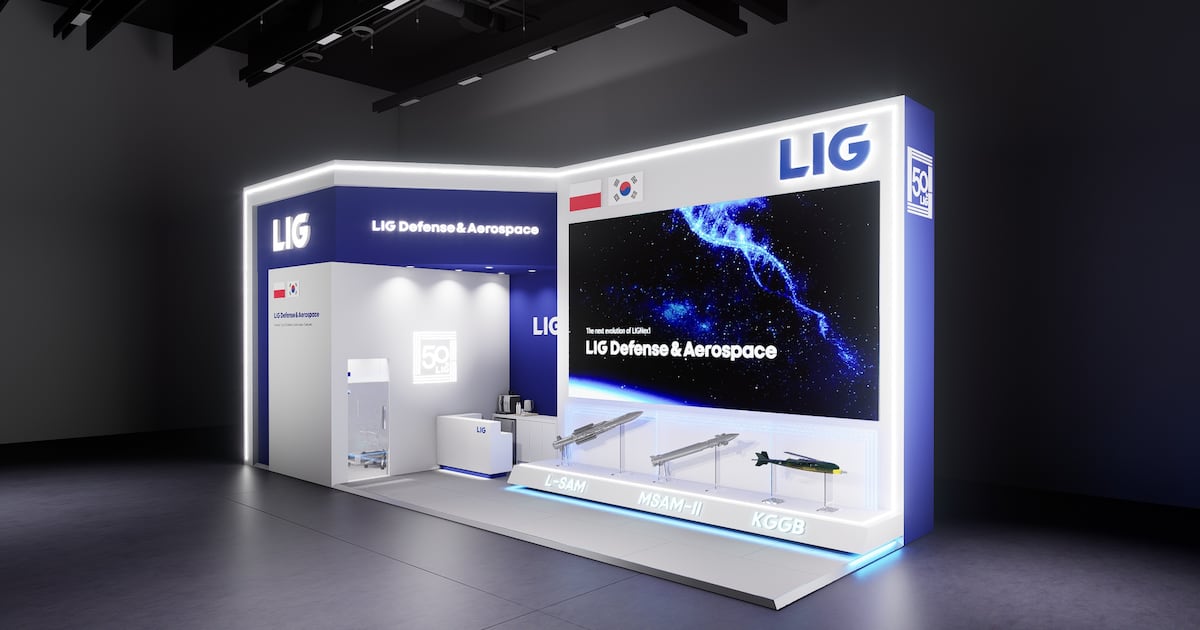
The real product isn’t a missile. It’s a net.
South Korea’s defense industry has spent years winning contracts one platform at a time. A tank here, a howitzer there, a fighter trainer over here. But at this week’s MSPO defense exhibition in Kielce, Poland, the Korean pitch has shifted. The offer on the table is no longer a single system — it’s an integrated, multi-layered air-defense architecture, and the implications reach far beyond the show floor.
LIG Defense & Aerospace (LIG D&A) is fronting the play with two of its flagship systems: the Cheongung-2 (Heavenly Palace II) medium-range surface-to-air missile and the L-SAM long-range system. Between them sits a short-range interceptor co-developed with Germany’s Rheinmetall, a partnership sealed at a strategic MOU in June at France’s Eurosatory show. The structure is deliberate — a three-tier net covering everything from long-range bombers to low-altitude drones and small UAVs.
The short-range piece will appear not on a Korean booth but on Rheinmetall’s own display at MSPO. That’s a signal. Korea is no longer trying to sell alone in Europe. It is stitching itself into the existing industrial fabric, letting a European prime contractor carry the short end of the system while Korea owns the mid and long tiers. The message to procurement officials is clear: you get Korean performance with European supply-chain familiarity.
Hanwha is running a parallel track. Its integrated pavilion covers H-SHORAD — a wheeled armored vehicle mounting a cannon and guided missiles for anti-air and anti-armor missions — and H-Shield, a sensor-and-soft-kill system designed to detect and neutralize drones and small aerial targets. On the hard-kill side sits Cheon-gwang, a laser-based anti-drone weapon that fires directed energy rather than projectiles. Korea is now competitive across the full spectrum: long-range SAMs, short-range interceptors, and laser defenses, a combination few non-European suppliers can match.
Hyundai Rotem’s contribution is equally strategic. It is displaying a mockup of the K2PL tank — the Polish variant of Korea’s main battle tank — outfitted with an active protection system and anti-drone jammers. The APS, now being indigenized to higher rates, is designed to counter both ATGMs and suicide drones. This is not a generic K2 on loan. It is a platform adapted for the specific threat profile of the Eastern European battlefield, where drone saturation is as much a concern as armored thrusts.
Why this matters for NATO’s eastern flank
The timing is consequential. Poland is the logistical and industrial anchor of NATO’s eastern flank, and it is spending more on defense than any other European country. But its air-defense needs are not solved. The country operates a mixed bag of American, Israeli, and European systems, and interoperability remains a chronic problem. A Korean multi-layer network offered as a single contract — even indirectly through a Rheinmetall partner — could simplify procurement and reduce the political friction that comes with juggling multiple original-equipment manufacturers.
The second-order implication is geographic. MSPO is not just a trade show. It is where buyers from across Central and Eastern Europe scout capability. Czech defense officials, for example, have signaled interest in Korean air-defense systems and plan to visit LIG D&A’s facilities in Seoul during the upcoming Seoul Dialogue. If Poland buys in, the next customers will not come from a cold call. They will come from neighbors watching a live demo.
Romania is another target that deserves attention. Hanwha Aero’s showcase of an unmanned-vehicle concept synced with the K9A1 howitzer — autonomous platforms conducting reconnaissance while the gun system engages — is explicitly tailored to Poland’s unmanned-program aspirations. But the broader prize is Romania, which is actively pursuing an unmanned ground-vehicle program. A successful Polish demonstration raises the probability that Bucharest looks east rather than west for its next platform family.
The Spain contract was the overture. Poland is the main act.
Hanwha Aerospace closed a roughly 1 trillion won ($700 million estimated) deal last month to export K9 howitzers to Spain’s Indra Sistemas. It is the first Korean self-propelled gun sale to Western Europe and follows the U.S. K9 win earlier this year. But Spain is a proof-of-contract story. Poland is a strategic foothold. Control the Polish market — or more precisely, control the air-defense architecture that Poland builds around itself — and Korea gains a staging point for the rest of the continent.
That is why the domestic-industry angle matters. A Korean source at MSPO noted that the growing participation of Polish firms — hundreds of local companies are expected this year — is not purely competitive pressure. It is an opportunity. Korean companies that already operate production or assembly lines in Poland can bundle local partners into their offers, creating a supply-chain knot that makes exclusion costly for European buyers operating under “Europe first” procurement pressures. The strategy is to become不可取代 not by being the cheapest, but by being embedded.
Who wins, who loses, and what breaks next
The winners are the Korean defense primes and their European partners. Rheinmetall gets a credible short-range complement to pair with its existing portfolio; Korea gets access to a distribution channel that already spans the EU. LIG D&A and Hanwha gain credibility in a market that previously favored American and Israeli systems. Poland gains a diversified, integrated air-defense option that reduces dependency on any single supplier.
The losers are the incumbents who assumed the Eastern European market was locked. Israel Aerospace Industries, Raytheon, and Skyrora all face a new competitor that is pricing aggressively, customizing platforms for local conditions, and bundling systems that compete companies struggle to replicate in a single package. The laser anti-drone angle is particularly interesting — Cheon-gwang offers a low-cost-per-shot alternative to interceptor missiles, a math that becomes compelling when you are defending against swarms.
What happens next is worth watching closely. If Korea secures a multi-layer air-defense contract with Poland, expect follow-on orders from Slovakia, Hungary, and the Baltics within 18 to 24 months. The Czech visit to LIG D&A is a canary. Romania’s unmanned-vehicle program is another. The K9A1 + unmanned sync concept will likely attract buyers beyond Poland who see the utility of semi-autonomous fire-support networks.
The deeper story is that Korea has graduated from being a reliable supplier of proven hardware to becoming an architect of integrated defense systems. That is a higher-margin, higher-barrier position — and one that European defense ministers, anxious about strategic autonomy from the United States, are increasingly willing to entertain.