Korea's Atomax Chip Is Quietly Chipping Away at Nvidia's Inference Monopoly
A Korean-made NPU is now handling 14 million daily inference requests from Japan through SK Telecom's services. The shift away from Nvidia GPUs for inference workloads marks a tangible early signal in the global push for AI chip sovereignty.
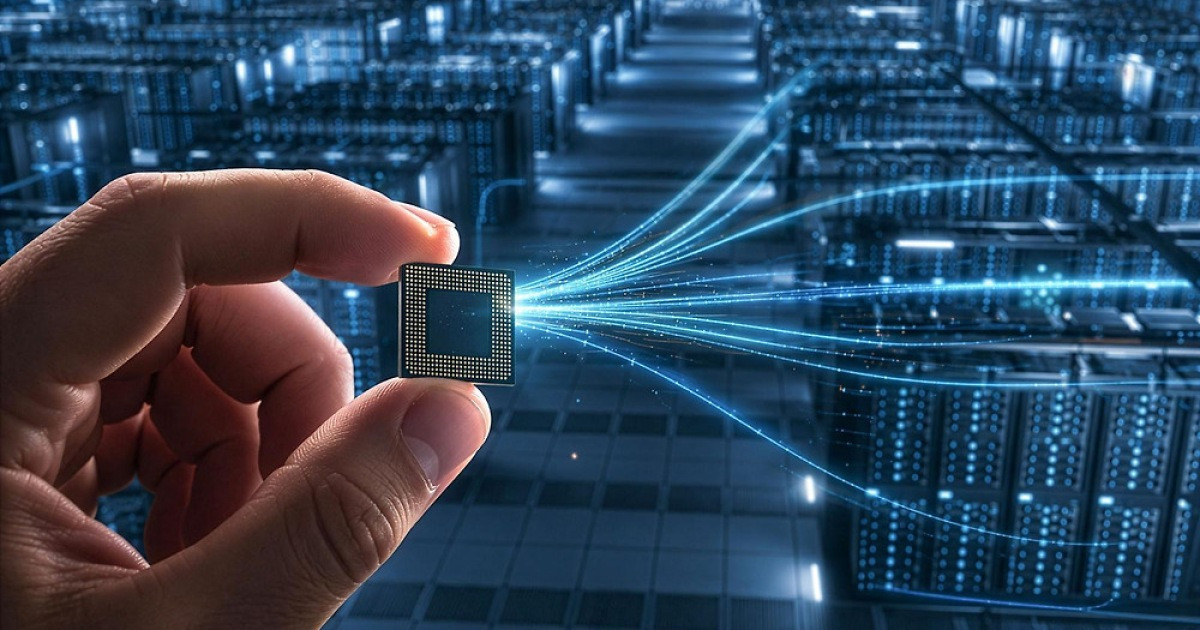
The inference battleground nobody was watching
Nvidia’s dominance gets measured in training clusters and megawatt data centers. But the quieter war is happening in inference — the day-to-day processing of user requests that actually runs your chatbot, your voice assistant, and your spam filter. And here, a Korean chip is already working.
Revellion’s Atomax NPU, designed for inference rather than training, is now handling roughly 14 million daily requests across SK Telecom’s AI services. That figure comes from SK Telecom and Revellion themselves, confirmed to Dong-a Ilbo. The workload includes call summaries for the Aidot AI agent, voice synthesis, an AI customer service desk, and ScamBanguard, a phishing-messaging detection tool. The chip processes over 4 billion tokens per day across those four services. Japan’s infrastructure — routed through SK Telecom’s network — accounts for a significant share of that volume.
This is not a research demo. It is a deployment that began in December 2023 and has since expanded. That matters more than the raw numbers.
Why inference chips are the unsung leverage
GPUs are generalists. They train models and they run inference, but they are expensive and power-hungry when all you need is to answer a user’s question. NPUs like Atomax are specialists. They do inference cheaper, faster, and with less energy per token. As AI moves from laboratory curiosity to production utility, the economics of inference become the bottleneck.
Anthropic’s CEO Dario Amodei recently raised alarms about AI safety and the concentration of compute power, while also pushing the U.S. government to tighten controls on advanced chip exports to China. The irony is blunt: the same export controls that aim to constrain rivals are accelerating every other country’s drive to build its own silicon. Korea is one of the most visible examples.
Atomax is already inside SK Telecom’s production stack. The chip’s verification cycle — the time from integration to live traffic — dropped from five or six months when Aidot first adopted it last year to two or three months by this summer. That kind of acceleration is the difference between a pilot project and a platform.
Japan’s requests, Korea’s chip
The headline figure — 14 million requests from Japan — deserves scrutiny. The source does not spell out whether Japan is receiving direct shipments of Atomax hardware or whether the requests traverse SK Telecom’s Korean infrastructure. What is clear is that Korean-made silicon is carrying Japanese inference load inside a domestic telecom operator’s network. That distinction matters less than the outcome: a Korean NPU is doing work that would have gone to an Nvidia GPU a year ago.
The broader signal is about supply-chain diversification. A 2024 analysis by the Center for a New American Security, cited by Dong-a Ilbo, found that Nvidia was supplying GPUs to 45% of 117 government-backed AI infrastructure projects worldwide as of late June. Countries touting AI sovereignty are nonetheless running on American hardware. Atomax breaks that pattern, even at this early stage.
What comes next
Revellion is already testing its follow-on chip, the Revell 100, at a data center in Magok, Seoul. The third-floor server room hits 77.5 decibels — loud enough that engineers must raise their voices. The unit has eight Revell 100 cards installed and is paired with HBM3E high-bandwidth memory. It is in trial before customer deployment. If the verification curve continues to steepen, that trial could tighten to weeks rather than months.
The architecture is not final. Yoo Hoejoon, who directs the AI Semiconductor Graduate Program at KAIST, called Atomax’s move from lab to commercial use a watershed moment for Korea’s domestic chip ecosystem. Kim Yongseok, a semiconductor professor at Gacheon University, pushed further: Korea has the design and prototyping capability, he said, but the follow-through — mass production and commercial scaling — remains the weak link. Public institutions and large corporations must act as anchor customers to build a reference portfolio that opens export markets.
That assessment is straightforward and unvarnished. The gap between a working NPU and a competitive one is execution at scale.
Who wins, who loses
SK Telecom wins immediate cost and latency relief on inference workloads, along with reduced exposure to export-control risk. Revellion wins credibility and a reference deployment that other operators can replicate. Korean infrastructure planners win a second source for a category that has been effectively monopolized.
Nvidia loses nothing today. Atomax is not competing for training workloads, and the chip’s reach is still limited to a handful of SK Telecom services. But every million-token shift away from Nvidia inference clusters is a precedent. The architecture of AI cost structures is being rewritten one specialist chip at a time.
Japanese clients routing inference through this Korean stack gain capacity and reduce single-supplier risk — with implications that extend beyond the bilateral relationship into the wider realignment of semiconductor supply chains.
The real takeaway
The Atomax deployment is small by global chip volume. It is also one of the few concrete, verifiable examples of a non-Nvidia inference chip running live production traffic at scale. The verification timeline is shortening. A next-generation chip is in trial. Anchor customers inside Korea are already buying.
If the trajectory holds, the next milestone is not whether Atomax can process tokens — it already does — but whether it can ship at the volume and price point that makes it a credible alternative to Nvidia’s inference offerings for operators outside the United States. That is the moment the story stops being about Korea and starts being about the first serious crack in a monopoly that has defined the AI era so far.