Korea's Solid-State Patent Blitz Shifts the EV Battery Race
Samsung SDI, LG Energy Solution and SK On have filed a wave of solid-state battery patents this month — and the filings reveal something crucial about where the real competition is heading. The battleground is no longer just chemistry; it is mass production.
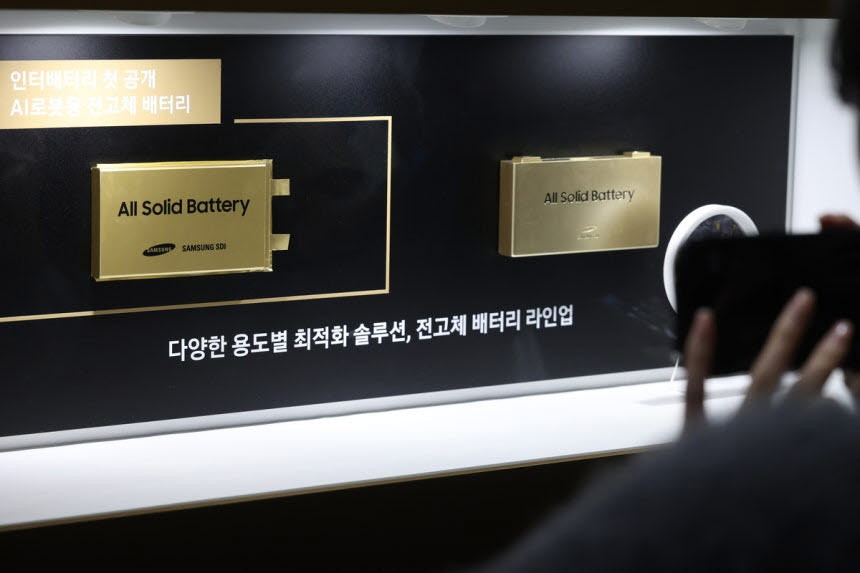
The filing pattern tells the story
South Korea’s three major battery makers — Samsung SDI, LG Energy Solution and SK On — have quietly been publishing a cluster of solid-state battery patents this month. On the surface this looks like routine corporate housekeeping. Look closer and the pattern shifts the entire picture.
The filings are not limited to materials science or electrochemistry improvements. They cover electrode stacking, compression techniques, manufacturing equipment and resistance-reduction methods — the gritty, unglamorous engineering steps required to move from a working prototype to a factory line. That shift in focus is the signal.
A senior industry source in Korea told reporters the commercial transition from liquid-electrolyte lithium-ion to solid-state is still years away for mass-market vehicles, with a timeline similar to when LFP (lithium iron phosphate) cells became the volume standard. But the panic beneath the patience is real. Manfred Hehr, head of R&D at Hyundai Motor Group, was blunt in a recent forum: falling behind in solid-state is not an option.
Why mass-production patents matter more than lab breakthroughs
Japan and China have been chasing the same goal for over a decade. Toyota has spent billions and filed thousands of solid-state patents, still aiming for vehicle launches next year or the year after. BYD plans to show its first solid-state-equipped car next year. CATL is pushing forward with pilot production lines. Korea is now answering with a filing spree that targets the step after the lab — the factory.
Patents that cover manufacturing process stability, electrode adhesion and cell architecture are harder to reverse-engineer than a novel cathode composition. They also create thicker defensive moats around production knowledge. If Samsung SDI, LG and SK On lock down the process IP first, the company that can scale fastest wins — regardless of which lab produced the highest energy-density cell in 2024.
This mirrors what happened in the semiconductor and AI races: early process advantages, not just theoretical ones, often determine who captures the market. The worry inside Korea is precisely this kind of first-mover lock-in. A gap opened today becomes a structural disadvantage tomorrow.
Who wins and who loses
Korea’s battery makers are the immediate beneficiaries. By accelerating patent filings across both materials and process, they are forcing competitors into a reactive stance. Toyota’s strategy of accumulating vast patent portfolios while moving slowly on production faces a new pressure point. If Samsung SDI brings a solid-state line online by late next year, as it aims to do, Toyota’s timeline gaps become visible to customers and investors.
China’s BYD and CATL are in a different bind. Their strength has been cost leadership and vertical integration on established chemistry platforms. Solid-state requires rethinking supply chains and fabrication entirely. The Korean filings signal that Korea intends to control the new production blueprint, not just participate in it.
Western OEMs are the likely beneficiaries of Korea’s acceleration. Volkswagen, GM and Ford have betting partnerships with these Korean firms. If solid-state supply is constrained in the near term, OEMs with prearranged Korean supply ties gain first access.
The loser in the near term is ambiguity. Companies without a clear Korean partnership or without their own process IP will be negotiating from behind. That includes startups and second-tier manufacturers hoping to enter the solid-state space later.
What happens next
The next 12 months will be defined by two measurable events. First, whether Samsung SDI reaches its target of completing mass-production readiness by late next year. Second, whether BYD delivers its first solid-state vehicle launch on schedule in 2026. The gap between those two milestones will set the tone for the rest of the decade.
Expect continued patent acceleration from all three Korean makers through 2026. The filings this month are not a one-off announcement; they are a public signal that the race has entered the production-validation phase. Expect licensing discussions, joint-venture rumors and supplier moves to follow as the technology transitions from paper to plant.
For the industry, the takeaway is straightforward. The dream battery is no longer a research question. It is a manufacturing race — and Korea just made its opening move.