Korea Bets Big on Indiana to Lock In HBM Dominance
SK Hynix's $4 billion packaging plant in Indiana is just the beginning. Sen. Todd Young says Seoul will invest across the entire semiconductor value chain in the US — a gamble that could lock in Korea's HBM leadership inside American supply chains.
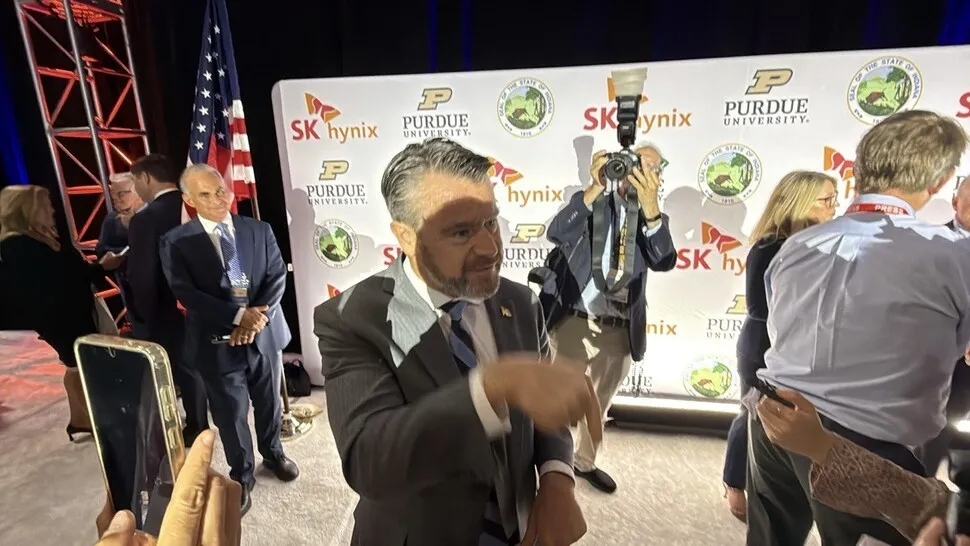
The packaging deal that isn’t just about packaging
Sen. Todd Young stood at a groundbreaking in West Lafayette, Indiana, and said something that should alarm anyone watching the global semiconductor supply chain.
He expects SK Hynix to invest far beyond its initial $4 billion advanced packaging facility — into everything from design to fabrication, across the entire chip lifecycle. He also hopes the SK Group expands into biotech and even shipbuilding. This was not a casual remark. It was a policy signal dressed as expectation.
Young, the Indiana Republican who chaired the Senate Commerce Committee during CHIPS Act passage, has become the single most important American voice on how Korea’s semiconductor industry settles into the United States. His message at the SK Hynix site carries more weight than most formal statements from Washington.
Why this matters for HBM
SK Hynix is the world’s leading producer of high-bandwidth memory, the chip that powers every major AI accelerator. Every Nvidia H100 and H200, every training run at OpenAI, Google DeepMind, and Microsoft depends on HBM stacks that SK Hynix designs and packages. Samsung is closing the gap, but SK Hynix still holds the edge — and it is betting that edge can be preserved inside American fabs.
The Indiana facility is a packaging plant, not a front-end fabrication line. Packaging is where HBM becomes functional: individual memory dies are stacked, connected with microbumps, and tested as a single unit. It is capital-intensive but traditionally done in East Asia, close to the fabricators in South Korea and Taiwan. Moving that step to the US is unusual and expensive. That is precisely why it matters.
Young said the CHIPS Act was never about American self-sufficiency. He called it a mistake to treat the goal as decoupling. Instead, he framed it as eliminating single points of failure in supply chains and deepening ties with allied producers. Korea is that producer. The Indiana plant is the physical proof of that logic.
Who wins, who loses
SK Hynix wins if this expansion materializes. A full-value-chain presence in the United States gives the company preferential access to domestic AI demand, shields it from export-control turbulence, and locks it into the US government’s definition of secure supply. The tax credits available under CHIPS Act provisions — especially if the December 2024 construction deadline is extended, as Congress is already debating — could shave billions off the effective cost.
Intel stands to lose from the political narrative. The Indiana site sits in the same region where Intel has spent years courting TSMC. Young’s expectation that SK Hynix will build out a broad ecosystem around its packaging operation shifts the economic gravity of the state away from Intel’s foundry ambitions and toward a Korean-led cluster. That is not a trivial redistribution of future investment.
Samsung faces a credibility test. The company has pledged $17 billion for a memory fab in Taylor, Texas. It has not announced an equivalent packaging footprint in the Midwest. If SK Hynix accelerates its Indiana operations while Samsung remains focused on front-end fabrication alone, the balance of HBM supply could tip further toward Seoul’s first-tier player.
The US government gains a supply chain that is harder to coerce. American AI companies currently rely on HBM that crosses multiple jurisdictional lines — design in Korea, fabrication in Korea or Taiwan, packaging in Korea or Singapore, assembly in Vietnam. Every transfer point is a potential chokepoint under export controls or geopolitical stress. A SK Hynix line operating entirely within US territory removes one layer of fragility, even if it raises costs.
The timeline that will decide this
The next six months will be defining.
The CHIPS Act investment tax credit currently requires construction to begin by December 31, 2024. Both parties in the Senate Finance Committee have signaled they want to extend that deadline. Young said he has not made up his own mind on whether extension is necessary, but he acknowledged it will be debated. An extension would give SK Hynix breathing room to structure larger commitments without penalty. No extension would compress its timeline and raise the cost of capital.
Meanwhile, the Biden administration has been pressuring memory makers to move front-end fabrication to the United States, not just packaging. Young’s remarks suggesting investment across “all areas” of the semiconductor ecosystem can be read as alignment with that pressure — or as a different strategy altogether. Packaging-first expansion may be the more realistic path for now. Front-end memory fabrication in the US faces steeper hurdles: a shortage of skilled process engineers, weaker local supplier networks, and higher operating costs.
What English-language readers miss
Most reporting on this story frames Young’s comments as encouragement for more Korean investment. That misses the sharper point. Young is effectively telling SK Hynix that packaging alone will not satisfy the long-term political bargain. The $4 billion facility is a down payment. The real deal — the one that survives administrations, tariff debates, and shifts in US-China policy — requires SK Hynix to embed itself structurally inside America’s industrial base.
That is both an opportunity and a risk for Korea. Embedding means access. It also means dependence on US policy stability, potential technology-transfer demands, and the possibility that American competitors learn SK Hynix’s packaging techniques while operating on American soil. Samsung learned from Taiwan’s TSMC model; there is no guarantee the reverse does not happen.
Young also suggested the SK Group look beyond semiconductors — into biotech and shipbuilding. That is a broader signal about how Washington wants Korea’s industrial power distributed across the American economy, not concentrated in one sector.
The bottom line
Korea is making a calculated bet: secure its HBM dominance by becoming indispensable to the US AI supply chain, rather than staying external to it. The Indiana packaging plant is the first visible move. Young’s comments confirm it will not be the last — if the timeline, subsidies, and political conditions hold.
The gamble is real. Front-end memory fabrication in the United States has not yet proven viable at scale. But packaging is a foothold, and footholds can become foundations. The question is whether SK Hynix can hold its technological lead while operating inside a jurisdiction that has every incentive to learn from it.