Korea's Blue Wave Shock Is a Warning for Global Chips
A Democratic sweep in US midterms spooked investors worried about AI regulation, sending Korea's KOSPI tumbling over 5%. Samsung and SK Hynix sold off sharply — a signal that the semiconductor supply chain has a new political risk factor.
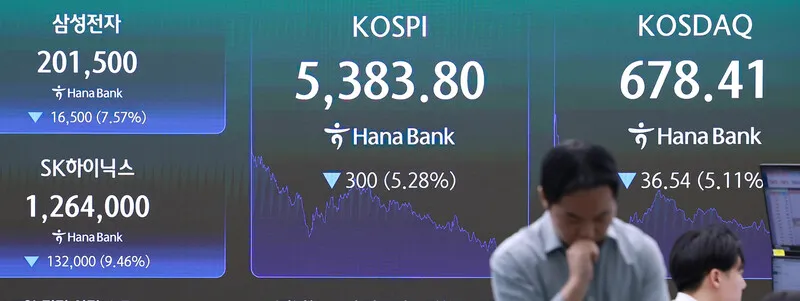
When the Blue Wave Hits Seoul, the World Listens
Korea’s stock market does not usually flinch at American politics. On November 5, it flinched hard.
The KOSPI closed at 5,383.80 — down 5.28% — its first breach of the 5,300 level since April. The KOSDAQ fell 5.11%. Sell-side circuit breakers triggered simultaneously across both markets, a mechanical response to panic that underscores how compressed the selling became. Foreign investors pulled out 3.4 trillion won in net selling, extending a streak to five consecutive trading days. Samsung Electronics shed 7.57% to 200,150 won. SK Hynix dropped 9.46% to 1.264 million won.
The trigger was not a trade war or a geopolitical escalation. It was a US midterm election result that sent a single, electric message through every portfolio exposed to artificial intelligence: regulation is coming.
What made this morning different from previous moments of transatlantic political noise was the specificity of the market’s read. Investors were not punishing Korea for democratic backsliding or trade friction. They were punishing it for being the most concentrated proxy in global markets for AI infrastructure bet. When Democrats took both chambers, the logic in institutional portfolios shifted from growth-at-any-speed to growth-with-guardsrails, and the first casualty was the Korean memory chip complex.
The Political Mechanism Behind the Drop
Democrats won control of both the Senate and the House. More specifically, they picked up ground in Texas and Ohio — states where local communities have been fighting new data center construction. The implication is direct. A Congress unwilling to face constituents over land use for AI infrastructure is a Congress that may slow the buildout that Samsung and SK Hynix depend on for their high-memory revenue.
The Philadelphia Semiconductor Index fell 3.13% overnight, but the Korean damage was nearly double that. Japan’s Nikkei dropped just 1.79%. Taiwan’s TAIEX fell 3.20%. Korea was penalized for having the wrong companies in the wrong basket at the wrong time.
Samsung and SK Hynix together account for roughly a third of the KOSPI’s market capitalization. When they sneeze, Korea catches pneumonia. This time, the sneeze was a regulatory chill emanating from Washington.
But the mechanism is more nuanced than a simple flight from regulation. The key insight comes from the geographic shift in Democratic gains. Texas and Ohio represent the actual physical footprint of the AI buildout — the land being cleared, the substations being wired, the water being diverted. Representatives from those districts sit on the committees that would shape permitting reform. Their electoral calculus pushes them toward friction, not acceleration. That is the signal the market decoded in real time.
For Samsung and SK Hynix, the concern is not existential. It is cyclical timing. Both companies have been pricing revenue models built on aggressive data center capex through 2026 and beyond. Any compression of that timeline hits their earnings forecasts immediately, because memory demand is derived demand — it follows the infrastructure, it does not lead it.
Why Memory Chips Are the Exposed Chord
The concern is not about AI in general. It is about the pace of data center investment, which drives demand for high-bandwidth memory — the product category where Samsung and SK Hynix hold dominant positions. Joo In, a researcher at Samsung Securities, put it plainly: new data center investment slowdown fears are weighing on domestic semiconductor earnings outlooks.
Memory chip cycles are already brutal. Prices rose dramatically through 2024 and 2025 on AI demand, but they are cyclical by nature. Any signal that the capex cycle could lengthen or compress hits memory names harder than logic or foundry names. AMD and Intel would fall on this news too, but their diversification provides a buffer that SK Hynix, whose memory revenue concentration approaches 90%, simply does not have.
There is also a second-order dynamic at play. Memory manufacturers invested heavily in new fabrication capacity during the upcycle, betting on sustained demand growth. If that demand softens, the industry faces a classic trough problem: fixed costs remain while utilization drops. Samsung’s new facility in Pyeongtaek and SK Hynix’s expansion in Icheon represent billions in depreciation that assumes a certain revenue trajectory. A regulatory slowdown does not change the technology, but it changes the payback period — and in memory, payback period is everything.
The contrast with Taiwan is instructive. TSMC manufactures the logic chips that run AI models, but its customers are diversified across smartphone, automotive, and industrial segments. Even if data center spending stutters, those other demand pillars absorb some of the shock. Samsung and SK Hynix do not enjoy that luxury. Their fate is inextricably tied to the infrastructure curve.
Who Wins, Who Loses
Foreign investors clearly won today. They sold 3.4 trillion won and are likely repositioning into US-listed semiconductor names or non-Korean exposure before any regulatory headlines materialize. Korean retail investors absorbed 2.2 trillion won in purchases, a counter-flow that reads as either conviction buying or a trap. Institutional investors picked up 800 billion won.
The losers are anyone with concentrated exposure to Korean semiconductors — whether through the KOSPI index, dedicated ETFs, or direct holdings. For the global supply chain, the lesson is that Korea’s chip sector now carries a political beta that did not exist two years ago. Every AI infrastructure debate in the US Congress sends a shockwave through Hwaseong and Giheung.
The retail buying deserves closer scrutiny. Korean household investors have been among the most active participants in the market this year, drawn by the rally in export-oriented giants. Their purchase of 2.2 trillion won against the foreign selling surge suggests a segment that either sees the regulatory risk as temporary or lacks the liquidity to exit quickly. Either interpretation carries risk. If the foreign selling persists — and five consecutive days of outflows suggest it may — retail investors could find themselves on the wrong side of a trend that institutional desks moved against hours after the election results were clear.
Meanwhile, Korean institutional investors adding 800 billion won raises a different question: are they providing stabilization or positioning for a rebound? The distinction matters for tomorrow’s flow. If institutions are buying to support the index, they will sell when the selling pressure lifts. If they are buying on conviction, they are placing a larger bet on the regulatory outcome than today’s price action suggests is prudent.
Second-Order Effects and Supply Chain Ripples
The implications extend beyond the KOSPI. Korea’s currency, the won, came under pressure as foreign capital exited, widening the trade deficit’s impact on exchange rates. A weaker won should theoretically help exporters, but in this case it is a symptom of capital flight, not competitive advantage. Import costs for raw materials and equipment rise, squeezing margins at a time when memory manufacturers need every margin they can defend.
Japanese and Taiwanese competitors may benefit from the relative weakness of Korean names, not because their fundamentals have improved but because portfolio rebalancing favors diversification away from concentrated political risk. fund managers who held Korea as a pure-play AI infrastructure bet are now reassessing the allocation, and the first move is almost always reduction before reconstruction.
There is also a psychological dimension that markets rarely price accurately in the moment. The Korean semiconductor sector enjoyed a years-long premium based on its indispensability to the AI buildout. This sell-off reminds the market that indispensability does not immunize against politics. The premium may not collapse entirely, but it will be revisited with greater caution on every subsequent legislative development.
What Happens Next
Three things to watch.
First, whether the Democratic congressional majority produces actual legislation targeting data center permitting or energy consumption. Campaign rhetoric and enacted law are different animals. If nothing passes, this sell-off will look like overreaction in three months. If something passes, the damage to Korean chips compounds. The relevant committees — Energy and Commerce in the House, Commerce, Science and Transportation in the Senate — will begin marking up bills in the coming weeks. Their language, not their intentions, will determine the trajectory.
Second, the memory price cycle. Even without regulatory headwinds, DRAM and NAND prices peaked in a tight supply environment. A demand-side surprise from Washington only accelerates whatever correction was already on the table. Industry trackers are already flagging a normalization in Q1 2025 pricing. The political shock does not create that cycle — it intersects with it, and intersections amplify outcomes.
Third, the flow of foreign capital. Five days of continuous foreign selling is not a one-day noise event. If the pattern extends into next week, the KOSPI may test the 5,200 range — a level that would represent a deeper structural rejection of the Korea-semiconductor premium. Watch the daily net flow numbers closely. A reversal within 48 hours would signal panic selling rather than strategic repositioning. Persistence would signal something more durable.
The Blue Wave did not just change American politics. It repriced the single most important sector of the Korean economy against a new regulatory risk. Global investors who treat Korea as a passive proxy for semiconductors will learn, painfully, that it is not.
The clearer close is this: Korea’s chip sector will survive the adjustment. Samsung and SK Hynix are too embedded in the global AI supply chain to be displaced by a single legislative cycle. But the era of treating Korean semiconductor stocks asapolitical growth instruments is over. The political beta is now priced in, however imperfectly, and every future election cycle will carry with它 it a premium or discount that did not exist before November 5th. Investors who ignore that shift will repeat the same mistake in the next downturn. Those who internalize it will navigate the new landscape with clearer eyes.