The Buyback Shield Holding Up Korea's Stock Market
Samsung, SK Hynix, and Celltrion are deploying tens of trillions in treasury stock buybacks — an implicit market backstop. When that shield expires, the KOSPI has no fallback.
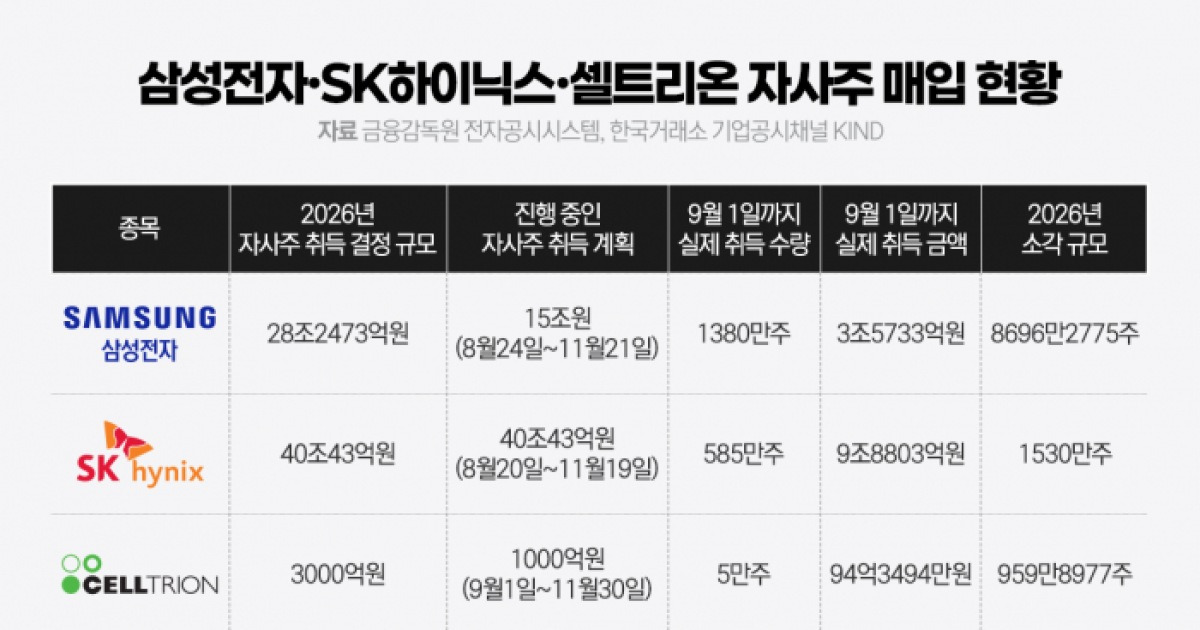
The Quiet Backstop of the KOSPI
When the market shudders from external shocks, Korean investors are increasingly counting on one unexpected safety net: their own blue-chip companies buying their own shares.
Samsung Electronics, SK Hynix, and Celltrion have together committed roughly 70 trillion won ($49 billion) in treasury stock buybacks this year. The money isn’t symbolic. Since late August, buyback-driven purchases by “other corporations” — a category dominated by these programs — have swallowed nearly 99 percent of all such buying power concentrated into just two names: SK Hynix and Samsung.
That concentration is the story. It is not a broad-based corporate defense of the market. It is a triage operation by three names to manage their own balance sheets, which has accidentally become a market stabilization mechanism.
What the Numbers Actually Show
Samsung has approved four separate buyback programs this year totaling about 28.2 trillion won. As of late August, it had executed roughly 13.2 trillion won worth of purchases and retired 87 million shares, mostly for employee compensation that gets recycled through buy-and-cancel cycles. The company still has more than 39 million shares left under its announced programs.
SK Hynix is the bigger spender. It approved 40.4 trillion won in buybacks this year, targeting 24.07 million ordinary shares to be repurchased by November 19 and then fully retired. Since buyback activity began in mid-August, other corporations have poured 9.74 trillion won into SK Hynix alone — nearly matching the 9.88 trillion won the company itself reports spending on actual repurchases during the same window. That means virtually every share change on the institutional side is accounted for by the buyback program.
Celltrion, the biotech heavyweight, has committed 3 trillion won in total buybacks. It repurchased about 1.08 million shares worth 229.5 billion won this year, has another 524,384 shares to acquire through November 30, and has retired roughly 9.6 million shares cumulatively.
Combined, the three companies still have about 58 million shares left to purchase under their current programs. At current prices, that represents roughly 10 to 12 trillion won in remaining commitment — money that is effectively parked and waiting to enter the market.
Why This Matters Beyond Korea
English-language coverage of Korean equities tends to focus on foreign fund flows or semiconductor cycle economics. It rarely examines the plumbing underneath. The buyback programs from Samsung and SK Hynix — two of Asia’s most heavily traded stocks — have become so large that they now dominate the supply-demand mechanics of the KOSPI itself.
When foreign investors sell Korean shares, as they have repeatedly done during periods of dollar strength or global risk-off moves, the buyback programs absorb a meaningful portion of that selling pressure. This creates the illusion of market resilience without actually resolving the underlying question: why are investors selling in the first place?
The phenomenon is specific to Korea’s corporate governance structure. Large conglomerates — chaebols and their ecosystem partners — have access to enormous cash reserves. When management decides to return capital through buybacks rather than dividends, and when those decisions are timed to coincide with market stress, the effect is similar to a central bank doing quantitative easing, just at corporate scale.
The Crack in the Shield
The more immediate risk is not structural but temporal. All three programs have expiration windows. SK Hynix’s must execute by November 19. Samsung’s remaining tranches carry their own deadlines. Celltrion’s runs through November 30.
When those programs conclude, a powerful institutional buyer vanishes overnight. NH Investment & Securities researcher Ryu Young-ho puts it bluntly: the buybacks provide downside support but are not an engine for sustained rallies. Once the buying stops, foreign capital flows and semiconductor fundamentals become the sole determinants of price direction.
Sejong University’s Kim Dae-jong makes the same point with less diplomatic padding. After the buybacks end, there is no fallback mechanism. Foreign investor sentiment, semiconductor cycle timing, and earnings revisions will dictate whether the KOSPI holds or retrenches.
Who Wins, Who Loses
Employees win — Samsung’s programs are partly designed for stock-based compensation, meaning workers participate in any valuation support these programs create. Shareholders who sold into the buyback demand at elevated prices also win, at least temporarily.
The market loses if it mistakes corporate buybacks for genuine demand. A rally built on a company purchasing its own shares is not the same as a rally built on expanding earnings or new capital inflows. The distinction matters because the former can vanish on a boardroom vote; the latter tends to compound.
Foreign investors who timed their exits around the buyback windows have likely saved themselves from deeper losses. But those who assumed the buybacks would continue indefinitely — or that they reflected confidence in future growth rather than capital management — may be exposed when the programs expire.
What Comes Next
The Korean market entered September with the KOSPI range-bound, and the buyback programs have been the primary reason it has not broken lower. That should not be confused with strength. It is a floor, not a ceiling.
Investors should watch three things: when SK Hynix completes its November 19 deadline and how much of its 40 trillion won commitment remains unexecuted, whether Samsung accelerates or pauses its remaining buyback tranches, and — critically — what happens to foreign fund flows in Korean equities once the buyback absorptive capacity begins to unwind.
The current setup rewards patience and punishes complacency. The buyback shield has held. But shields are meant to be temporary.