Korea's Export Surge Masks a Dangerous Chip Dependency
South Korea's October exports doubled, driven by a 222% semiconductor boom. But the numbers reveal a concentration risk that could destabilize the global AI economy.
The Numbers That Shouldn’t Be Possible
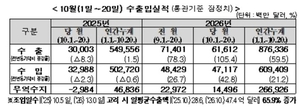
South Korea shipped $61.6 billion in goods in the first 20 days of October — more than double the same period last year. Semiconductors alone accounted for $27.5 billion, a 222.5% jump that erased any notion of a cyclical upswing and pointed toward something structurally different.
The daily average export rate hit $474 million, the highest ever recorded for any October period going back as far as the data stretches. The previous high-water mark was $34.3 billion set in October 2021. This year’s figure doesn’t just break that record; it vaults past it by nearly 80%.
What happened here is worth understanding before the headlines move on.
The AI Corridor in One Data Point
The single most revealing detail in this month’s customs data is not the headline export number. It is the share of semiconductors within total exports: 44.7%. That is a 16.2 percentage-point increase from the same period last year. Nearly half of everything South Korea sells to the world is now flowing through one narrow category of goods.
Those goods are high-bandwidth memory chips — the DRAM modules that serve as the short-term working memory for AI accelerators. Samsung Electronics and SK Hynix dominate this market. Together they supply the bulk of the HBM chips inside Nvidia’s GPU stacks, the chips powering OpenAI, Google, Microsoft, and Meta’s inference and training workloads.
This is the physical geometry of the global AI economy. When a California startup writes a prompt, the computation happens on silicon fabricated in a fab city in South Korea. The supply chain is shorter than anyone outside the industry realizes, and it passes through territory no policy paper acknowledges with adequate seriousness.
Who Wins. Who Is Exposed.
China remains the top destination for Korean exports, absorbing $154.4 billion worth in the year-to-date framing, followed closely by the United States at $154.9 billion. Vietnam and the European Union round out the top four at 74.6% and 78.2% growth respectively. Taiwan, despite its own semiconductor ambitions, showed a more modest 36.7% increase — a quiet signal that Korean chip exports are flowing outward rather than circular within the region.
The trade surplus for the period came in at $14.5 billion, with imports rising 42.8% to $47.1 billion. Energy imports alone jumped 53.5%. South Korea is selling memory chips at premium prices and buying back the raw energy those chips require to function — a metabolic loop that reveals the true cost structure of the AI boom.
Domestically, the win is clear. Samsung and SK Hynix are posting revenue that their Boards of Directors could not have forecast twelve months ago. Government tax receipts are lifting. The won has found a floor it hasn’t had in years. These are real, quantifiable benefits.
The exposure is less visible but more consequential.
The Concentration Trap
When a single sector — one whose end markets are dominated by three or four American companies — accounts for nearly half of national export growth, the economy ceases to be diversified and becomes instead a leveraged bet on a single technological trajectory.
If AI demand plateaus, if Nvidia’s roadmap shifts away from HBM-dependent architectures, if a rival memory technology displaces the current standard — South Korea’s export engine does not gently slow. It stalls. The 2022-2023 downturn, when chip prices collapsed and Korean exports contracted sharply, was a preview of exactly this dynamic. This year’s surge makes that vulnerability feel distant. It has not disappeared.
The geopolitical layer compounds the risk. South Korea’s two largest chipmakers are American allies operating in a country that shares a land border with a nuclear-armed state maintaining active military tensions. Any escalation in the Taiwan strait would disrupt shipping lanes that carry finished wafers from Korean fabs to assembly houses in Southeast Asia and final markets in North America and Europe. The supply chain has no redundant corridor.
What Happens Next
Three things are likely in the near term.
First, the customs data will continue to look strong through the rest of 2024 as hyperscaler capex cycles remain intact. Intel’s foundry ambitions are years from maturity. TSMC is constrained by its own capacity allocations. The HBM market has no credible second-source competitor at scale. Samsung and SK Hynix will ship what they can make.
Second, the Korean won will remain sensitive to moves by the Federal Reserve and to Chinese demand signals. The export surge is dollar-denominated. A strengthening dollar amplifies the headline percentage. A weakening one compresses it. The underlying volume may not change as dramatically as the nominal figures suggest.
Third, and most important, Washington and Brussels will continue treating South Korea as a strategic partner for chip production while doing almost nothing to diversify the actual physical flow of memory chips away from Korean fabs. Policy rhetoric about supply chain resilience does not match the capital expenditure being directed toward building redundant capacity. The concentration is a feature of the current equilibrium, not a bug waiting to be patched.
The Real Story Behind the Record
A 105.4% export increase reads like an economic victory lap. It is also a warning label. The global AI economy runs through a corridor that passes through two Korean cities and two corporate campuses. That corridor is efficient. It is also fragile.
The $27.5 billion in semiconductor exports for 20 days of October is not just a number. It is a map of where the world’s most valuable computing infrastructure physically lives, who controls it, and what happens when that control is tested by anything from a demand shock to a military contingency. No amount of trade surplus optimism should blind analysts to the fact that the entire architecture of modern AI compute depends on a supply chain no wider than a Korean shipping lane.
The question is not whether this concentration will matter. It is whether policymakers are preparing for the moment it does.