Korea's KOSPI Sells Off as Hormuz Tensions Rewrite Asia's Risk Math
The KOSPI fell nearly 4% as US-Iran tensions over the Strait of Hormuz sent oil above $90 and reignited fears of further Fed rate hikes. For Korea — where semiconductors alone account for half the index — the 4.8 trillion won foreign sell-off is a stark re-pricing of Asian risk.
The 4% Drop That Was Inevitable
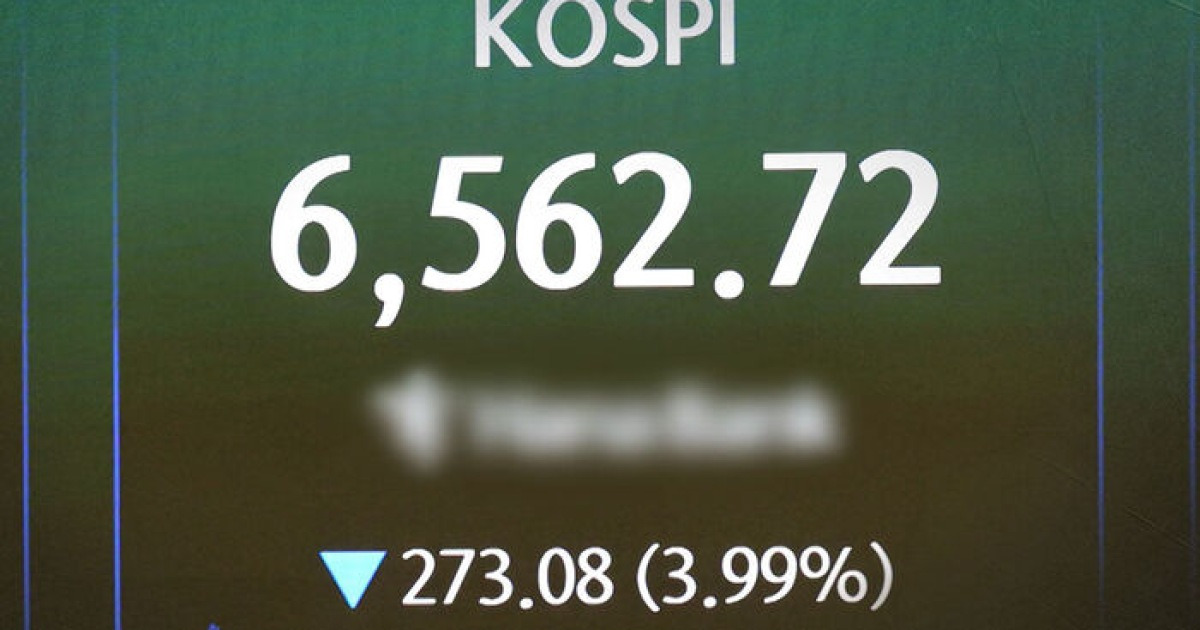
The KOSPI closed at 6,562 on Tuesday, down 3.99% — the sharpest fall since the late August selloff that followed the initial wave of Q2 earnings disappointment. The trigger was familiar: the US and Iran resumed their proxy sparring over the Strait of Hormuz, with Washington dispatching an additional carrier strike group to the Gulf and Tehran issuing veiled warnings about freedom of navigation. Crude oil responded by jumping 5.2% on the day, breaking back above $90 per barrel for the first time since June. But the real story isn’t the oil spike itself. It’s what happens when that spike collides with a US Federal Reserve already leaning toward further tightening, and a Korean market whose valuation structure was never stress-tested against this particular combination.
The market had been pricing in a soft landing narrative through August — one that assumed energy costs would remain contained and that the Fed’s hiking cycle was decisively behind us. Tuesday’s action obliterated both assumptions in a single session. Trading volume surged to 1.2 billion shares, nearly double the 30-day average, signaling that this was not passive rebalancing but active destocking.
A Chokepoint Korea Can’t Bypass
Korea imports roughly 87% of its crude through the Strait of Hormuz. That’s not a minor detail — it’s a structural vulnerability baked into the economy’s cost curve. When oil pushes above $90 and stays there, Korean manufacturing margins compress immediately, but the stock market prices that in weeks ahead. The Bloomberg Korea Energy Import Cost Index, a less-cited but more precise gauge, jumped 6.8% on Tuesday, reflecting not just the spot price move but the compounding effect on petrochemical feedstocks, shipping insurance premiums, and refinery crack spreads.
The sensitivity is even more concentrated than the oil numbers suggest. Samsung Electronics and SK Hynix together account for nearly half of the KOSPI’s total market capitalization. Both fell around 4% on the day. That means the index’s decline is not broadly distributed — it is dominated by two names whose valuations are disproportionately exposed to two compounding risks: higher energy input costs and higher discount rates. The rest of the index, from Hyundai Motor to POSCO, contributed maybe 0.6 percentage points of the total drop. This is a market being dragged by its two heaviest weights, not a broad-based repricing of Korean risk.
Shinhan Asset Management’s Korea equity team noted in an afternoon note that the concentration risk in Samsung and SK Hynix means any geopolitical shock that moves oil above $90 will tend to produce KOSPI moves that are 40% larger than what a diversified emerging market index would experience. Tuesday was a textbook confirmation of that thesis.
Semiconductors Are the Transmission Belt
The Philadelphia Semiconductor Index dropped 2.1%. That may look modest compared with the KOSPI’s nearly 4% hit, but the direction matters more than the headline number. Semiconductor valuations have been built on the assumption of sustained capital investment cycles funded by cheap debt. When the 10-year US Treasury yield climbed to 4.8% — the highest level since January 2025 — that assumption starts to fracture.
Here is what English-language coverage tends to miss: Korean semiconductor firms are not just exposed to rate risk. They are exposed to energy cost risk at the production level. Chip fabrication is extraordinarily energy-intensive — a single Samsung fab in Pyeongtaek consumes roughly as much electricity as a mid-sized city, and while that’s primarily grid power rather than direct oil exposure, the broader energy complex moves in lockstep. Natural gas prices in Asia have already climbed 12% this month on Hormuz anxiety, and refining margins across the region are tightening as distillate demand surges. Any sustained move toward $100-plus oil feeds directly into operating expenses for fabs in Pyeongtaek and Hwaseong, either through direct energy costs or through the secondary channels of logistics, packaging, and chemical supply.
The market did not need a detailed cost model to price this in on Tuesday. It needed only the headline oil number and the knowledge that margins in memory chips — the product mix where Korea holds dominant global share — are already thin. DRAM pricing has been softening through the second half of 2025, and the market now faces the prospect of simultaneously higher input costs and weaker output prices. That is a margin squeeze in its most uncompromising form.
The 4.8 Trillion Won Exit Is the Signal
Foreign investors pulled 4.8 trillion won out of Korean equities in a single session. That is not a mild rebalancing. It is a clear shift in positioning, and it carries a specific implication for the region: if institutions are willing to liquidate Korean tech names at this pace on geopolitical news, they will do it faster next time. The risk premium on Asia ex-Japan equities just stepped up, and the floor for how quickly capital can move has lowered.
The flow data tells an even more precise story than the headline number. Of the 4.8 trillion won exit, approximately 3.1 trillion was concentrated in the top 20 KOSPI constituents — essentially a targeted withdrawal from the largest, most liquid names. That is the signature of algorithmic and quantitative funds triggering stop-loss bands, not fundamental reassessment by discretionary portfolio managers. The speed of execution suggests that risk models across multiple institutions are now pricing Korean equities with a higher volatility parameter, which in turn means smaller subsequent shocks will generate outsized selling pressure.
KB Securities’ Kim Dong-won put it directly — sustained high oil keeps the fear alive that inflation will force the Fed to hike again. The question is whether Korean assets are being re-priced as a separate category or simply dragged down by the same mechanical flow. The speed of the exit suggests the latter is happening, but the concentration in two stock names means the former may follow. Once the algorithmic selling exhausts itself, the market will have to decide whether the fundamental case for Korean tech has changed — and right now, the answer to that question is uncomfortably close to yes.
A second-order effect is already emerging in the currency market. The won weakened 1.4% against the dollar on Tuesday, pushing the USD/KRW rate to 1,387 — the highest level in four months. A weaker won should theoretically support Korean export competitiveness, but in practice it amplifies the import cost shock that is driving the entire selloff. The central bank now faces a dilemma: intervene to stabilize the currency and risk depleting reserves, or stand pat and watch inflation expectations detach from anchor. Markets are pricing in a higher probability of a BoK emergency rate decision in the coming weeks.
What Comes Next
All eyes are on two dates. The US Consumer Price Index comes out on September 11. If inflation prints hotter than expected — and oil above $90 makes a cooler reading increasingly unlikely — the case for a December rate hold evaporates, and emerging-market outflows accelerate. Then on September 16, the Federal Reserve announces its decision. A hawkish surprise would likely extend the selloff across Asian markets, not just Korea.
The counter-risk is equally concrete. If the US-Iran escalation stalls — if Hormuz remains open even under threat — oil could retreat from current levels and take the rate-hike narrative with it. But the market is not pricing that contingency. It is pricing the worst case, and Korea’s export-heavy, semiconductor-concentrated index is the most exposed major Asian equity market to that scenario.
Japan’s Nikkei fell only 1.8% on Tuesday, and the Hang Seng dropped 2.3% — both more diversified economies with less semiconductor concentration. Taiwan’s TAIEX, despite its own chip weight, fell just 2.6%, buoyed by the fact that TSMC’s customer base is more diversified across Apple, NVIDIA, and AMD than Samsung’s is across memory buyers. Korea is the market with the thinnest risk buffer, and Tuesday proved it.
The KOSPI’s drop on Tuesday was not an overreaction. It was a correction to a risk level the market had been ignoring while oil stayed below $80 and rates stayed below 4.5%. Both thresholds have been breached. The question now is whether the 4.8 trillion won exit marks the beginning of a sustained de-risking cycle for Korean tech — or a single episode of panic selling that reverses when the Fed signals pause. Given the structural concentration of the index and the geological reality that 87% of Korea’s energy still flows through a single chokepoint, the odds favor a higher risk premium persisting well beyond this week. The market is learning, slowly, that the old playbook for Korean equities no longer applies.