Korea's Modular Data Center Play Could Reshape the AI Power Race
As power grid bottlenecks threaten to strangle AI expansion, Korea is betting on modular data centers. But the real story is how electricity access — not chip speed — is becoming the defining competitive advantage of the AI era.
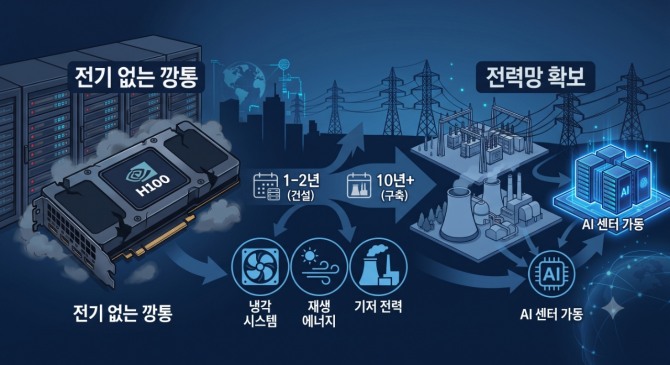
The GPU Was Never the Whole Story
Every AI headline tracks the latest Nvidia chip like it’s the finish line of a race. But zoom out past the press releases, and a more sobering bottleneck emerges — one that makes semiconductor capability feel almost secondary. It is no longer about who builds the fastest chip. It is about who can power the rooms where those chips live.
The numbers are staggering and largely unreported outside energy-trade circles. According to the International Energy Agency, global data center electricity consumption is projected to nearly double from roughly 485 terawatt-hours in 2025 to around 950 TWh by 2030. Artificial intelligence facilities, which demand far higher power density than legacy workloads, are driving a disproportionate share of that surge. A single modern AI data center can consume as much electricity as a small city.
Here is the catch that most coverage misses: a data center can be erected in 12 to 24 months. The transmission lines, substations, and generation capacity required to actually run it? Ten years or more. The infrastructure timeline and the silicon timeline are moving at fundamentally different speeds. Companies with unlimited capital can buy every GPU on the market. They cannot instantly conjure a high-voltage connection.
Texas Is Already a Cautionary Tale
The problem is no longer theoretical. In Texas, where the nation’s largest grid operates with relatively loose regulation, data center interconnection requests have surpassed 700 gigawatts. That figure is absurd — it exceeds the total peak demand currently served by the entire Texas grid. A significant portion represents what regulators are calling phantom demand: speculative applications filed to lock in future capacity before any actual construction begins.
The result is a classic tragedy of the commons playing out in real time. Incumbent generators and fossil fuel plants see their value propositions re-rated. Bitcoin mining operations, which already secured cheap grid access during the last crypto cycle, are now being courted by AI firms as ready-made power portfolios. Some miners are pivoting entirely to high-performance computing, selling their socket rights at enormous premiums to companies that cannot wait a decade for a new connection.
Vertiv, the power and cooling infrastructure company, signaled the shift clearly in September when it agreed to acquire microgrid specialist Utility Innovation Group for up to $2.6 billion. The logic is blunt: if you cannot get on the grid fast enough, build your own grid next door. Decentralized generation paired with battery storage is moving from niche solution to strategic imperative.
Korea’s Modular Answer
This is where Korea enters a conversation most English-language desks are barely having. LG U+ and GS E&C are advancing a modular data center model that deserves far more international attention. Rather than building monolithic facilities designed for decades of operation, Korea is pushing pre-fabricated, containerized, and rapidly deployable units that can be slotted into available power zones much faster than traditional construction allows.
The approach is not entirely new — modular construction has been used in industries from oil and gas to defense. But Korea is applying it to the AI data center question at a scale and with a speed that could produce an exportable playbook. The value proposition is straightforward: compress a ten-year infrastructure gap into a two-year deployment timeline by sidestepping the need for greenfield grid extensions.
What makes this strategically interesting is less the engineering than the timing. Korea lacks the vast landmass of the American Southwest or the cheap hydroelectric baseload of Scandinavia. It also does not control major energy exports. Modular data centers offer a way to punch above Korea’s natural resource weight by turning infrastructure flexibility into a competitive asset. If the model works domestically, it becomes a product Korea can sell to other countries facing the same power bottleneck — particularly in Southeast Asia and the Middle East, where AI investment is accelerating but grid capacity is not.
The Second-Order Arms Race
The deeper implication of all this is that the AI arms race is undergoing a quiet but fundamental shift in what counts as strategic infrastructure. For the past decade, the narrative was about compute density, model parameters, and training throughput. Chip design and fab capacity were the scarce resources everyone fought over.
Now the scarce resource is electrons. And unlike a GPU, which can be manufactured in a controlled fab environment, electricity requires territory, regulation, and decades-long permitting processes. The geography of AI power advantage will look very different from the geography of semiconductor advantage. Countries with abundant baseload generation — whether nuclear, natural gas, or hydro — gain disproportionate leverage. Countries without either face a structural dependency that no amount of chip investment can overcome.
This also changes the competitive dynamics between public and private actors. Governments that control energy policy now sit at the center of AI competitiveness in a way they did not during the silicon era. Permitting reform, grid modernization, and energy mix decisions are effectively industrial policy for the AI age. The question is no longer just which company has the best model. It is which jurisdiction can deliver stable, dense, affordable power to the machines that run those models.
What Happens Next
Expect the conversation around AI infrastructure to keep widening its frame. Vertical integration will expand beyond chips and clouds to include power generation, microgrids, and thermal management. Mergers like the Vertiv acquisition should multiply. We will likely see more acquisitions of existing power-hungry operations — not just Bitcoin miners but aluminum smelters and other industrial consumers — as shortcut routes to grid capacity.
Korea’s modular data center push, if it delivers on its promise, could reshape how smaller nations participate in the AI economy. There is a real chance that Korean firms become suppliers of AI infrastructure template rather than just hardware — exporting a blueprint for how to build fast without waiting a decade for permission from the grid.
The headline in any well-functioning AI market should eventually be about chips again. Until then, the story is in the substation.